

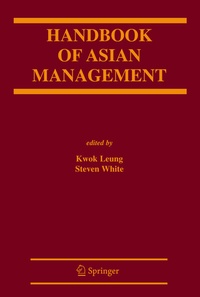
Handbook of Asian Management
1st Edition
Published on 8. May 2007
XIV, 544 pages
978-1-4020-7932-0 (ISBN)
Description

Our understanding of management in Asia has not kept pace with the demands of managers and students. The Handbook of Asian Management provides in-depth critical reviews of central topics in strategy and organizational behavior research in Asian contexts. Leading scholars take stock of what has been learned and give clear directions towards greater rigor and relevance for research in this region.
Reviews / Votes
"This book is important and timely, the first to provide a comprehensive coverage of the latest thinking and research on management in the Asian context. It offers new insights and stimulating perspectives on an extraordinarily complex region in terms of economic and political systems as well as social and cultural heritages. The articles in this Handbook cover a wide range of topics at both the firm and individual levels. They push the boundary of management knowledge as we know today and fill critical gaps in the global management literature. It is a valuable guide for future research, an essential reading for anyone interested in Asian Management from a scholarly point of view."(Anne S. Tsui, Arizona State University, Hong Kong University of Science and Technology, International Association for Chinese Management Research, Management and Organization Review)
"In this volume, Leung and White have assembled a vast set of contributors who exemplify the complexity and importance of studying management from an Asian perspective. The book reads like a Who's-Who of top-notch research scholars and people in areas including Human Resources, Organizational Behavior and Strategy will all benefit by having this volume on their bookshelf. Additionally, any serious student of Asian Management will consider this book to be one of their core treatises." (P. Christopher Earley, Chair, Dept. of Organisational Behaviour, London Business School)
"A landmark volume that offers a wide-ranging view of Asian business, especially in the areas of strategy, organizational behavior and human resource management. Americans, Europeans and others will find here new, useful ideas. A must for everyone interested in leading-edge managerial practices and in the future evolution of the global economy."
(Mauro F. Guillén, The Wharton School and Instituto de Empresa, Madrid)
More details
Other editions
Additional editions
Kwok Leung | Steven White
Handbook of Asian Management
Book
04/2004
Springer
€213.99
Shipment within 15-20 days
Content
Taking Stock and Charting a Path for Asian Management Research.- Etic and Emic Approaches to Asian Management Research.- Strategy.- Towards the Development of Strategy Theory.- Context, Configuration and Capability.- Firm Diversification in Asia.- The Asian Multinational Corporation.- Asian Entrepreneurship Research.- The Double-Edged Sword of Organizational Culture in Asia.- Western and Asian Business Ethics.- Organizational Behavior and Human Resource Management.- Organization Behavior.- Keeping others in Mind.- Work Motivation in Asia.- Leadership Research in Asia.- Intercultural Communication and Effective Decision Making.- In the Eye of the Beholder.- Conflict Management in Asia.- A New Perspective On Diversity and Group Dynamics in Asia.- Human Resource Management in Asia.
Chapter 5 FIRM DIVERSIFICATION IN ASIA (p. 129-130)
Lu Yuan Chinese University of Hong Kong
Garry Bruton Texas Christian University
Hailin Lan Southern China University of Technology
INTRODUCTION
Diversification has long constituted an important position in both firm strategic management practices and academic research (Ansoff, 1965; Argyres, 1996; Chandler, 1962; Hill, Hitt and Hoskisson, 1992; Palich, Cardinal, and Miller, 2000; Rumelt, 1974; Ramanujam and Varadarajan, 1989; Williamson, 1975). Students of economics and strategic management have developed various theories and perspectives to examine corporate activities relevant to firm diversification (Brush, 1996; Ramanujam and Varadarajan, 1989; Reed and Luffman, 1986; Rumelt, 1974). However, despite diversification being wellresearched in Western countries, the topic as an academic inquiry is relatively new in Asia, where environments and business systems have characteristics considerably different from Western society. For example, in contrast to advanced market economies in the West where governments were usually kept away from market, most Asian countries adopted an 'other directed' development strategy in which governments consciously controlled and promoted economic development through policy, regulations, and/or even direct administrative intervention, such as state plans (Berlinger, 1966). In addition to the distinctiveness of Asian societies vis-à-vis those of the West, there is also great variation among Asian countries themselves. Take an example of GDP per capita. In 2000 Japan, Hong Kong and Singapore entered into the top twenty GNI per capita in the world, varying between $34,210 and $24,740. At the same time, two Asian countries with the largest population in the world, the People's Republic of China (the PRC) and India, had GNI per capita of $840 and $460. A gap exists not only between different countries but also across regions which share similar cultural inheritances. For instance, mainland China, Hong Kong and Taiwan were assumed to operate within Greater China Economic Zone where Chinese traditional culture dominated in social norms and values system. In 2000 GNP per capita in Taiwan and Hong Kong exceeded $14,000 and $24,000, more than 60 and 180 percent over that in mainland China. There is also variation in the economic environments within the Greater China Economic Zone. Taiwan and Hong Kong have had a relatively developed market economy and their governments were largely kept away from business operations. By contrast, in mainland China the overall economic institution is in a transition from a centrally planned economy to a market one. A major characteristic of a transition economy is that the government exerts a strong influence over both macro and micro economic activities by allocation of resources allocation and control of or even direct administrative intervention in business organizations (Chen, 1995; Redding, 1990).
These differences between Western and Asian societies, and among Asian societies, have suggested many questions to scholars studying diversification. For example, does diversification in Asia exhibit the same or similar characteristics as that in Western countries if there are distinctive differences between the two societies? Are Western theories appropriate to the study of firm diversification in Asia? Does the research of Asia's diversification require new context-specific design for the purpose of testing the limits of Western theories and conclusions? Furthermore, given the great discrepancy across Asian countries, will such inter-societal variance within Asia cause organizational differences in terms of firm behavior?
In this chapter we review previous studies of corporate diversification in seven major Asian countries and areas, including mainland China, Taiwan, Hong Kong, Japan, South Korea, Singapore and India. It begins with a brief review of Western theories of firm diversification. The second section will introduce findings from a literature survey of existing empirical studies in the seven Asian countries and areas. Building on literature survey findings, we will in the third section attempt to identify distinctive characteristics of firm diversification in Asia. The final section suggests directions for future research in this subject.
Lu Yuan Chinese University of Hong Kong
Garry Bruton Texas Christian University
Hailin Lan Southern China University of Technology
INTRODUCTION
Diversification has long constituted an important position in both firm strategic management practices and academic research (Ansoff, 1965; Argyres, 1996; Chandler, 1962; Hill, Hitt and Hoskisson, 1992; Palich, Cardinal, and Miller, 2000; Rumelt, 1974; Ramanujam and Varadarajan, 1989; Williamson, 1975). Students of economics and strategic management have developed various theories and perspectives to examine corporate activities relevant to firm diversification (Brush, 1996; Ramanujam and Varadarajan, 1989; Reed and Luffman, 1986; Rumelt, 1974). However, despite diversification being wellresearched in Western countries, the topic as an academic inquiry is relatively new in Asia, where environments and business systems have characteristics considerably different from Western society. For example, in contrast to advanced market economies in the West where governments were usually kept away from market, most Asian countries adopted an 'other directed' development strategy in which governments consciously controlled and promoted economic development through policy, regulations, and/or even direct administrative intervention, such as state plans (Berlinger, 1966). In addition to the distinctiveness of Asian societies vis-à-vis those of the West, there is also great variation among Asian countries themselves. Take an example of GDP per capita. In 2000 Japan, Hong Kong and Singapore entered into the top twenty GNI per capita in the world, varying between $34,210 and $24,740. At the same time, two Asian countries with the largest population in the world, the People's Republic of China (the PRC) and India, had GNI per capita of $840 and $460. A gap exists not only between different countries but also across regions which share similar cultural inheritances. For instance, mainland China, Hong Kong and Taiwan were assumed to operate within Greater China Economic Zone where Chinese traditional culture dominated in social norms and values system. In 2000 GNP per capita in Taiwan and Hong Kong exceeded $14,000 and $24,000, more than 60 and 180 percent over that in mainland China. There is also variation in the economic environments within the Greater China Economic Zone. Taiwan and Hong Kong have had a relatively developed market economy and their governments were largely kept away from business operations. By contrast, in mainland China the overall economic institution is in a transition from a centrally planned economy to a market one. A major characteristic of a transition economy is that the government exerts a strong influence over both macro and micro economic activities by allocation of resources allocation and control of or even direct administrative intervention in business organizations (Chen, 1995; Redding, 1990).
These differences between Western and Asian societies, and among Asian societies, have suggested many questions to scholars studying diversification. For example, does diversification in Asia exhibit the same or similar characteristics as that in Western countries if there are distinctive differences between the two societies? Are Western theories appropriate to the study of firm diversification in Asia? Does the research of Asia's diversification require new context-specific design for the purpose of testing the limits of Western theories and conclusions? Furthermore, given the great discrepancy across Asian countries, will such inter-societal variance within Asia cause organizational differences in terms of firm behavior?
In this chapter we review previous studies of corporate diversification in seven major Asian countries and areas, including mainland China, Taiwan, Hong Kong, Japan, South Korea, Singapore and India. It begins with a brief review of Western theories of firm diversification. The second section will introduce findings from a literature survey of existing empirical studies in the seven Asian countries and areas. Building on literature survey findings, we will in the third section attempt to identify distinctive characteristics of firm diversification in Asia. The final section suggests directions for future research in this subject.
