

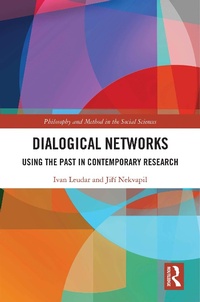
Dialogical Networks
Using the Past in Contemporary Research
1st Edition
Published on 27. March 2022
324 pages
978-1-000-56604-8 (ISBN)
Description

This book brings together two decades of work by the authors on dialogical networks, showing how the concept of the dialogical network developed through series of connected case studies and clarifying the concept through historical analysis. Identifying the key characteristics of dialogical networks and showing that knowledge of them, though formulated in the abstract, is affected by historical contingencies, it demonstrates that work on dialogical networks required the work of a practical historian, connecting contemporary work to foregoing studies. As such, this volume represents an original study of how doing history is a part of research and sheds light on the ways in which people use the past in their social activities.
Reviews / Votes
"Leudar and Nekvapil provide both a comprehensive discussion of dialogical networks and a historical examination of how the notion developed. An authoritative text on how social interactions and events get publicly reported, and hence transformed, across space and time."Ray Wilkinson, Professor of Human Communication, University of Sheffield, UK
"This impressive and broad-ranging book illuminates the importance of historical contextualizations of research in social sciences. Central to this project is the concept of dialogical networks showing how identity, stereotype, and prejudice are reported in interactions of everyday talk, and how continuities, changes and disruptions take place over time."
Ivana Markova, University of Stirling, UK
"This is a must read for anyone interested in dialogical networks. Ivan Leudar and Jiri Nekvapil apply their innovative theoretically and methodologically expansive approach to unpack how we - as everyday historians - bring the past into our present and make this consequential. This is not done as an end in its own right but to address controversial social issues such as how social identities are managed, attempts to change these identities and the real consequences of these practices (e.g. Restricting Roma's freedom of abode and movement)."
Rose McCabe, City, University of London, UK
"This very innovative book presents both a collection of master pieces on the concept of dialogical networks, and a reflexive history of an aspect of the social sciences in the making. As such, it is a major resource for senior and junior scholars who will find substantial information as well as epistemological thoughts regarding the practice of research."
Baudouin Dupret, CNRS, France/UCLouvain, Belgium
More details
Series
Edition
1. Auflage
Language
English
Place of publication
London
United Kingdom
Publishing group
Taylor & Francis Ltd
Target group
College/higher education
Product notice
Reflowable
ISBN-13
978-1-000-56604-8 (9781000566048)
Copyright in bibliographic data and cover images is held by Nielsen Book Services Limited or by the publishers or by their respective licensors: all rights reserved.
Schweitzer Classification
Other editions
Additional editions

Book
09/2023
1st Edition
Routledge
€66.20
Shipment within 10-20 days
Book
03/2022
1st Edition
Routledge
€208.20
Shipment within 10-20 days
Persons
Ivan Leudar is Emeritus Professor of Historical Psychology in the School of Biological Sciences at the University of Manchester, UK. He is the author of Voices of Reason, Voices of Insanity and co-editor of Against Theory of Mind and Conversation Analysis and Psychotherapy.
Jiri Nekvapil is Associate Professor of Sociolinguistics in the Faculty of Arts at Charles University, Prague, Czech Republic. His research has been influenced by poststructuralist linguistics and ethnomethodology.
Jiri Nekvapil is Associate Professor of Sociolinguistics in the Faculty of Arts at Charles University, Prague, Czech Republic. His research has been influenced by poststructuralist linguistics and ethnomethodology.
Content
1. Introduction 2. Reporting Political Arguments 3. Reflection 1: The First Steps - From 'Context Selection' to Dialogical Networks 4. On the Emergence of Political Identity in Czech Mass Media: The Case of Democratic Party of Sudetenland 5. On Dialogical Networks: Arguments about the Migration Law in Czech Mass Media in 1993 6. On Membership Categorisation: 'Us', 'Them'and 'Doing Violence' in Political Discourse 7. Reflection 2: On Historical Contextualisations in Dialogical Networks Project 8. The War on Terror and Muslim Britons' Safety: A Week in the Life of a Dialogical Network 9. Reflection 3: Continuities, Novelties and Dissociations 10. Practical Historians and Adversaries: 9/11 Revisited 11. A Day in the Life of a Dialogical Network - The Case of Czech Currency Devaluation 12. Reflection 4: Multiplication and Emergent Meanings 13. Conclusion
