

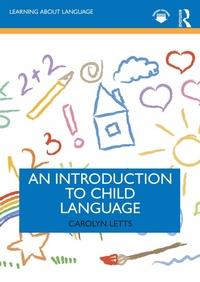
An Introduction to Child Language
1st Edition
Published on 15. November 2024
238 pages
978-1-040-17202-5 (ISBN)
Description

This accessible and inclusive new textbook introduces Child Language Acquisition (CLA), with unique coverage of bilingual and early second language development as well as first languages. The majority of children worldwide will grow up to be bi- or multilingual, and early second language acquisition is a very common experience for migrant children and those in more well-established ethnic minority communities across the world. The book explores the major stages of child language development below the age of five years, covering social context, early words, combining words, inflections and function words, complexity, and use of language, but also some of the major developments that take place post five years.
Including recent developments in the area, this introduction:
* Emphasises the interactive development of the component skills involved in language and the wider skills on which language depends
* Incorporates bilingual language development throughout, covering both two first languages and early naturalistic second language acquisition
* Takes a crosslinguistic and cross-cultural approach, considering the role of input and child directed speech in the light of recent debate about links between socio-economic status and CLA and supposed 'deficient' language-learning environments for some groups of children
Supported with examples taken from child language data and experimental studies, as well as exercises and activities, this student-friendly text is an essential course textbook for any module on child language acquisition.
Including recent developments in the area, this introduction:
* Emphasises the interactive development of the component skills involved in language and the wider skills on which language depends
* Incorporates bilingual language development throughout, covering both two first languages and early naturalistic second language acquisition
* Takes a crosslinguistic and cross-cultural approach, considering the role of input and child directed speech in the light of recent debate about links between socio-economic status and CLA and supposed 'deficient' language-learning environments for some groups of children
Supported with examples taken from child language data and experimental studies, as well as exercises and activities, this student-friendly text is an essential course textbook for any module on child language acquisition.
More details
Series
Edition
1. Auflage
Language
English
Place of publication
London
United Kingdom
Publishing group
Taylor & Francis Ltd
Target group
College/higher education
Illustrations
17 Tables, black and white; 3 Line drawings, black and white; 2 Halftones, black and white; 5 Illustrations, black and white
ISBN-13
978-1-040-17202-5 (9781040172025)
Copyright in bibliographic data and cover images is held by Nielsen Book Services Limited or by the publishers or by their respective licensors: all rights reserved.
Schweitzer Classification
Other editions
Additional editions
Carolyn Letts
An Introduction to Child Language
Book
11/2024
1st Edition
Routledge
€57.00
Shipment within 10-20 days

Carolyn Letts
An Introduction to Child Language
Book
11/2024
1st Edition
Routledge
€196.20
Shipment within 10-20 days

Carolyn Letts
An Introduction to Child Language
Book
11/2024
Taylor & Francis
Unfortunately, price unknown
Available (delivery time upon request)
Person
Carolyn Letts is a Visiting Fellow at Newcastle University, UK. She trained as a Speech & Language Therapist (SLT) and worked for many years in higher education as a lecturer in speech-language pathology with a focus on language acquisition and impairment in children. She is currently working as co-investigator on the Language Intervention in the Early Years (LIVELY) project.
Content
List of tables and figures
Acknowledgements
Introduction
Chapter 1. A brief history of child language research
Chapter 2. What does the child have to learn?
Chapter 3. Starting out: The social world of the child (1)
Chapter 4. Making sense of the chaos: Early words
Chapter 5. Combining words
Chapter 6. Adding complexity
Chapter 7. Putting it all into practice: The social world of the child (2)
Chapter 8. Theory, disorder, and socio-economic status
Glossary
Answers to exercises
Index
Glossary
Appendix: Answers to Exercises
Index
Acknowledgements
Introduction
Chapter 1. A brief history of child language research
Chapter 2. What does the child have to learn?
Chapter 3. Starting out: The social world of the child (1)
Chapter 4. Making sense of the chaos: Early words
Chapter 5. Combining words
Chapter 6. Adding complexity
Chapter 7. Putting it all into practice: The social world of the child (2)
Chapter 8. Theory, disorder, and socio-economic status
Glossary
Answers to exercises
Index
Glossary
Appendix: Answers to Exercises
Index
