

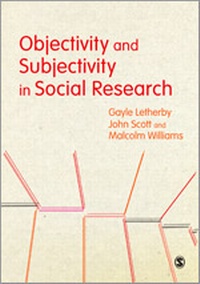
Objectivity and Subjectivity in Social Research
1st Edition
Published on 3. October 2012
200 pages
978-1-4462-7141-4 (ISBN)
Description

Objectivity and subjectivity are key concepts in social research. This book, written by leading authors in the field, takes a completely new approach to objectivity and subjectivity, no longer treating them as opposed - as many existing texts do - but as logically and methodologically related in social research.
The book debates:
- the philosophical bases of objectivity and relativity
- relationism and dynamic synthesis
- situated objectivity
- theorised subjectivity
- social objects and realism
- objectivity and subjectivity in practice
The authors explain complex arguments with great clarity for social science students, while also providing the detail and comprehensiveness required to meet the needs of practising researchers and scholars.
The book debates:
- the philosophical bases of objectivity and relativity
- relationism and dynamic synthesis
- situated objectivity
- theorised subjectivity
- social objects and realism
- objectivity and subjectivity in practice
The authors explain complex arguments with great clarity for social science students, while also providing the detail and comprehensiveness required to meet the needs of practising researchers and scholars.
Reviews / Votes
This book is a positive contribution towards mutual understanding in the sometimes fractious debates about epistemology in social research. The authors each bring to bear a depth of knowledge, and engage in a novel 'trialogue' around their perspectives. If you want to get to grips with the issues in thinking about objectivity and subjectivity, you couldn't do better than to read this book.Rosalind Edwards
University of Southampton
The editors provide solid and accessible accounts of major debates today, their histories, and why they matter. Best of all, after presenting the particular interests that drew each into sociology in different eras, innovative discussions at the end of each singly-authored chapter enable them respectfully to interrogate each other's interpretations of the issues. This brilliant strategy will draw students into the debates in a most engaging way.
Sandra Harding
University of California, Los Angeles
This book is a positive contribution towards mutual understanding in the sometimes fractious debates about epistemology in social research. The authors each bring to bear a depth of knowledge, and engage in a novel 'trialogue' around their perspectives. If you want to get to grips with the issues in thinking about objectivity and subjectivity, you couldn't do better than to read this book.
Rosalind Edwards
University of Southampton
More details
Language
English
Place of publication
London
United Kingdom
Target group
College/higher education
Professional and scholarly
ISBN-13
978-1-4462-7141-4 (9781446271414)
Copyright in bibliographic data and cover images is held by Nielsen Book Services Limited or by the publishers or by their respective licensors: all rights reserved.
Schweitzer Classification
Other editions
Additional editions
Gayle Letherby | John Scott | Malcolm Williams
Objectivity and Subjectivity in Social Research
Book
10/2012
1st Edition
SAGE Publications Ltd
€230.27
Article exhausted; check different version
Gayle Letherby | John Scott | Malcolm Williams
Objectivity and Subjectivity in Social Research
Book
10/2012
1st Edition
SAGE Publications Ltd
€112.10
Shipment within 15-20 days
Persons
Gayle Letherby is an honorary professor of sociology at the University of Plymouth and a visiting professor at the University of Greenwich. Alongside substantive interests in reproductive and non/parental identities; gender, health, and well-being; loss and bereavement; travel and transport mobility and working; and gender and identity within institutions (including universities and prisons), she has an international reputation in research methodology. Expertise in this area includes feminist and qualitative approaches and in auto/biography and creative reflexivity (with reference to data collection and presentation). Gayle is currently a coeditor of the SAGE journal Methodological Innovations and is in the process of editing the Handbook of Feminist Research for Routledge. In addition to her own research and writing, Gayle has significant experience in research mentoring and consultancy both within academia, for grant funding bodies and for HealthWatch UK. For examples of nonacademic writing and pieces written for general readership, see http://arwenackcerebrals.blogspot.co.uk/ and https://www.abctales.com/user/gletherby
John Scott is an Honorary Professor at the Universities of Essex, Exeter, and Copenhagen. He was formerly a professor of sociology at the Universities of Essex and Leicester, and pro-vice-chancellor for research at the University of Plymouth. He has been president of the British Sociological Association, Chair of the Sociology Section of the British Academy, and in 2013 was awarded the CBE for Services to Social Science. His work covers theoretical sociology, the history of sociology, elites and social stratification, and social network analysis. His most recent books include British Social Theory: Recovering Lost Traditions before 1950 (SAGE, 2018), Envisioning Sociology. Victor Branford, Patrick Geddes, and the Quest for Social Reconstruction (with Ray Bromley, SUNY Press, 2013), Objectivity and Subjectivity in Social Research (with Gayle Letherby and Malcolm Williams, SAGE, 2011).
Malcolm Williams is Professor and Director of the School of Social Sciences at Cardiff University. Prior to joining Cardiff in 2010, he was Professor of Social Research Methodology and Head of the School of Psychosocial Sciences at the University of Plymouth where he taught for 16 years.
Malcolm has designed and taught modules in the philosophy of social research for 18 years at both undergraduate and postgraduate level. In these he has introduced a number of innovative pedagogic techniques, such as Problem Based Learning and 'Concept Speed Dating', in which students take a key idea and move from table to table attempting to build conceptual links between ideas.Additionally he has taught many modules and short courses in social theory, research design, questionnaire design, scaling, sampling, scientific method and history of science.
Williams has an extensive publishing record in philosophy of social research, including: Introduction to Philosophy of Social Research (with Tim May, Routledge, 1996), Knowing the Social World (with Tim May, OUP, 1998), Science and Social Science (Routledge, 2000), Making Sense of Social Research (SAGE, 2003), Philosophical Foundations of Social Research (SAGE, 2006), Teaching Quantitative Methods (with Geoff Payne, SAGE, 2011) Objectivity and Subjectivity in Social Research (with Gayle Letherby and John Scott, SAGE, 2012) and The SAGE Handbook of Innovations in Social Research (with W Paul Voght, SAGE, 2014).
John Scott is an Honorary Professor at the Universities of Essex, Exeter, and Copenhagen. He was formerly a professor of sociology at the Universities of Essex and Leicester, and pro-vice-chancellor for research at the University of Plymouth. He has been president of the British Sociological Association, Chair of the Sociology Section of the British Academy, and in 2013 was awarded the CBE for Services to Social Science. His work covers theoretical sociology, the history of sociology, elites and social stratification, and social network analysis. His most recent books include British Social Theory: Recovering Lost Traditions before 1950 (SAGE, 2018), Envisioning Sociology. Victor Branford, Patrick Geddes, and the Quest for Social Reconstruction (with Ray Bromley, SUNY Press, 2013), Objectivity and Subjectivity in Social Research (with Gayle Letherby and Malcolm Williams, SAGE, 2011).
Malcolm Williams is Professor and Director of the School of Social Sciences at Cardiff University. Prior to joining Cardiff in 2010, he was Professor of Social Research Methodology and Head of the School of Psychosocial Sciences at the University of Plymouth where he taught for 16 years.
Malcolm has designed and taught modules in the philosophy of social research for 18 years at both undergraduate and postgraduate level. In these he has introduced a number of innovative pedagogic techniques, such as Problem Based Learning and 'Concept Speed Dating', in which students take a key idea and move from table to table attempting to build conceptual links between ideas.Additionally he has taught many modules and short courses in social theory, research design, questionnaire design, scaling, sampling, scientific method and history of science.
Williams has an extensive publishing record in philosophy of social research, including: Introduction to Philosophy of Social Research (with Tim May, Routledge, 1996), Knowing the Social World (with Tim May, OUP, 1998), Science and Social Science (Routledge, 2000), Making Sense of Social Research (SAGE, 2003), Philosophical Foundations of Social Research (SAGE, 2006), Teaching Quantitative Methods (with Geoff Payne, SAGE, 2011) Objectivity and Subjectivity in Social Research (with Gayle Letherby and John Scott, SAGE, 2012) and The SAGE Handbook of Innovations in Social Research (with W Paul Voght, SAGE, 2014).
Content
Introduction
The Philosophical Bases of Objectivity and Relativity
Relationism and Dynamic Synthesis
Situated Objectivity in Sociology
Theorized Subjectivity
Social Objects and Realism
Objectivity and Subjectivity in Practice
Objectivity Established? A Trialogue
References
Index
The Philosophical Bases of Objectivity and Relativity
Relationism and Dynamic Synthesis
Situated Objectivity in Sociology
Theorized Subjectivity
Social Objects and Realism
Objectivity and Subjectivity in Practice
Objectivity Established? A Trialogue
References
Index
