

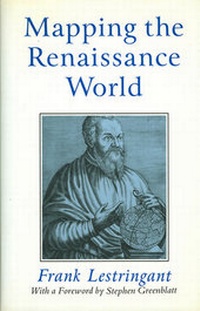
Mapping the Renaissance World
Description

More details
Other editions
Additional editions
Persons
Content
Introduction: Renaissance and Cosmography.
1. The Cosmographical Model.
2. Ancient Lessons: A Bookish Orient.
3. Mythologics: The Invention of Brazil.
4. Mythologics II: Amazons and Monarchs.
5. Cartographics: An Experience of the World and an Experimenton the World.
Epilogue: The End of Cosmography.
Appendices.
Notes.
Index.
Overture: Renaissance and Cosmography
In approaching the geographical literature of the Renaissance, several critical models come to hand. One might, like Gilbert Chinard early this century,1 have recourse to the notion of ‘exoticism’ in order to gauge the evolution, at the progressively enlarged fringes of the oikoumene, of marvellous realities bequeathed by earlier ages and gradually idealized or allegorized into new myths. Thus, an enrichment of the stock of prodigies handed down by Pliny and his followers, such as Solinus and Pomponius Mela, had the effect of slowly eroding traditional taxonomic frameworks. From the resulting encyclopaedic chaos (which is well reflected in the work of André Thevet) there belatedly arose that figure of the Other, the Noble Savage, whose euphoric portrait would take two centuries to crystallize. From Columbus to Chateaubriand, by way of Montaigne and Rousseau, one witnesses the painful and constantly delayed birth of that man of nature, each time more youthful and free of servitude.
This positivist vision of history tends to sin by falling into teleological illusion, and can be corrected by means of a second model: that of the ‘new horizons’ put forward earlier by Geoffroy Atkinson.2 His paradigm has the merit of privileging – at least in theory – geographical space over chronology, the surface of expansion, by contrast with a linear historical development. This enables one to reach, in principle, the nub of the problem. Thus, Atkinson shows the relatively minor importance of the reception of the discovery of America in the Renaissance, compared to an eastern horizon of expectations whose age-old prestige was actually enhanced at the time by the peaking ascendancy of Ottoman power. The foreign reality that literally ‘obsessed’ Europe in the time of Suleiman was not that of naked Indian cannibals springing from the depths of the Brazilian jungle; it was that, close to home and yet at the same time more distant, of the Muslim Turk pitching camp and raising his crescent flag on the very doorstep of Christianity.3
Such an analysis also falls into error, however, by ignoring the question of scales. The Mediterranean space in which that confrontation between Christianity and Islam was played out – between a Europe torn by religious schism and national rivalries, and the seemingly monolithic empire of the Great Turk – had by this time ceased to be confused with global space. It was thenceforward an arbitrary distortion to place on the same level phenomena belonging to maps – world maps or mappae mundi, and chorographies of the Near East and Balkans – whose scales did not coincide. Thus, the author of the ‘New Horizons’ reproduces an illusion which Renaissance men themselves only reluctantly gave up: that of privileging the Mediterranean centre over an unknown or poorly known periphery, and of forcing fragments of the world that were disproportionate to each other to coexist within the same frame of representation.
Now savants in the sixteenth century – most notably, the historians of Venice, the city located at the very pivot between the two antagonistic cultures – began to realize this disparity of spaces (a disparity that had less to do with their ‘quality’ than with their ‘quantity’), and to take up for the modern world certain categories dear to the cosmographical science that was undergoing vigorous revival at the time. Thus two great collections of historical and juridical documents appeared within a few years of each other in the Most Serene Republic, but subdivided the world differently: not in terms of the fundamental directions of space (east and west, north and south), but according to the distances and orders of magnitude they envisaged. Between Giovanni Battista Ramusio and Francesco Sansovino, the editors respectively of Navigationi e viaggi (1550–9) and the collection Dell’historia universale de’ Turchi (1560), the boundary is to be traced not in terms of meridians, nor of any geographical lines whatsoever; since the ‘Orient’ is the object common to both enterprises. It is scale that forms the division between these two complementary collections.
Ramusio is interested in the Far East, and makes his domain the distant outside world – that of ‘navigations and voyages’, as his title explicitly indicates; whereas Sansovino devotes his documentary collection to an intermediary region, Turkey and Persia, which is posited as the precise negation of the Christian West. The distinction between the two might, therefore, seem to be one of genre, as Stéphane Yérasimos has suggested4 – distant peregrinations being opposed to a history primarily concerned with the immediate neighbourhood, to which peoples more recently discovered had no right of access. One might, too, provisionally agree with Yérasimos, that in the outline of the world offered by European humanism in the second half of the century, ‘the more geography there was, the less history.’ But this apparent distinction obscures another that, in my view, is more essential: the small scale of global representation was radically distinct from the medium or large scale appropriate to a region, be it more or less extended, of the earth. The former grasped the quantity of the world, whereas the latter plumbed its quality. A planisphere that reduced the terraqueous globe to its broad outlines did not admit of the same objects as a partial (chorographic or topographic) map swarming with a profusion of different places. A history of events, right down to the cycle of seasons, could easily enter into the latter type of map by way of a large qualitative scale that allowed one to fix accidental details, to inscribe locally the passage of the present. Thus, the gold of harvests or enamelled prairies of flowers formed part of the programme that Girolamo Cardano prescribed for the perfect chorography.5
On the other hand, the small scale of the mappa mundi lent itself ideally, in a future-oriented vein, to audacious strategic anticipations. The reduced scale of cosmography, or universal geography, seemed ideally suited both to the dreams of the navigator and to the speculations of princes or diplomats. To them it was given to ‘sculpture the azure ocean’6 – to carve in it, compass and dividers in hand, the boundaries of purely theoretical spheres of influence. In this sense, the Treaty of Tordesillas might be considered the first cosmographical act of the Renaissance. Concluded on 7 July 1494 between Portugal and Spain, and ratified by Isabel of Castille on 2 August and by John II of Portugal on 5 September, it rigidly divided the two empires by means of a meridian or ‘direct line traced from pole to pole’, set 370 leagues west of the Azores.7
For cosmography did not allow itself to be encumbered by obstacles. From the lofty position it took up it effaced all relief, and abolished every feature of the land. Indeed, its privileged field of action was doubtless that constituted by the vague and unified expanses of the oceans. But to the real configuration of the globe it was, one might say, indifferent. Given that ‘it divided the world according to the circles of the heavens’,8 and that its lines of force resulted from a projection on to the sphere of the circular movement of the stars (within, of course, the geocentric system of Ptolemy), cosmography could reign as an absolute sovereign over the terraqueous globe. It manipulated at will the natural frontiers of rivers and mountains; determined the futures of peoples by fixing their migrations and boundaries; remodelled, if necessary, the structure of continents; and controlled the calculated drift of archipelagos.9
By virtue of this future-oriented dynamism ruling over an unfinished present, cosmography was diametrically opposed to the regional detail of chorography. The latter recorded from place to place the events of the past, and made the regional map into a genuine ‘art of memory’ in the sense that classical antiquity attached to the term.10 The topographer’s landscape-map was a profuse and indefinitely fragmented receptacle of local legends and traditions that were rooted in vagaries of relief, hidden in folds of terrain, and readable in toponymy and folklore; whereas the reticular and geometrical map of the cosmographer anticipated the conquests and ‘discoveries’ of the modern age. No doubt the marvellous was not absent from it; but it subsisted there only by special dispensation.
If, for example, the Le Havre pilot Guillaume Le Testu placed at the margins of the known world, in his Cosmographie universelle of 1556, monstrous populations inherited from Pliny, St Augustine and Isidore of Seville, it was only in order to establish provisional boundaries for a knowledge in a perpetual state of progress.11 ‘Progress’ means here that enlargement of a space that was pushing out on all sides and stitching together, as voyages allowed, the remaining gaps in it; rather than the linear and continuous development of a rectilinear history of knowledge.12 There was not such a great difference between the Monoculi (one-eyed men), Sciopods, Dog-heads or other Blemmyae that haunted the depths of Asia (but also reared their heads elsewhere: in the most impenetrable regions of the New World, or the fabled Southern Land), and the padrões or...
