

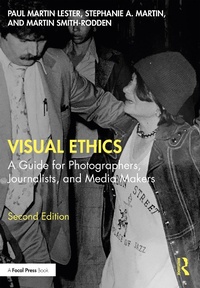
Visual Ethics
A Guide for Photographers, Journalists, and Media Makers
2nd Edition
Published on 31. March 2022
246 pages
978-1-000-56900-1 (ISBN)
Description

An indispensable guide to visual ethics, this book addresses the need for critical thinking and ethical behavior among students and professionals responsible for a variety of mass media visual messages.
Written for an ever-growing discipline, authors Paul Martin Lester, Stephanie A. Martin, and Martin Rodden-Smith give serious ethical consideration to the complex field of visual communication. The book covers the definitions and uses of six philosophies, analytical methods, cultural awareness, visual reporting, documentary, citizen journalists, advertising, public relations, typography, graphic design, data visualizations, cartoons, motion pictures, television, computers and the web, augmented and virtual reality, social media, the editing process, and the need for empathy. At the end of each chapter are case studies for further analysis and interviews with thoughtful practitioners in each field of study, including Steven Heller and Nigel Holmes. This second edition has also been fully revised and updated throughout to reflect on the impact of new and emerging technologies.
This book is an important resource for students of photojournalism, photography, filmmaking, media and communication, and visual communication, as well as professionals working in these fields.
Written for an ever-growing discipline, authors Paul Martin Lester, Stephanie A. Martin, and Martin Rodden-Smith give serious ethical consideration to the complex field of visual communication. The book covers the definitions and uses of six philosophies, analytical methods, cultural awareness, visual reporting, documentary, citizen journalists, advertising, public relations, typography, graphic design, data visualizations, cartoons, motion pictures, television, computers and the web, augmented and virtual reality, social media, the editing process, and the need for empathy. At the end of each chapter are case studies for further analysis and interviews with thoughtful practitioners in each field of study, including Steven Heller and Nigel Holmes. This second edition has also been fully revised and updated throughout to reflect on the impact of new and emerging technologies.
This book is an important resource for students of photojournalism, photography, filmmaking, media and communication, and visual communication, as well as professionals working in these fields.
Reviews / Votes
"The second edition of Visual Ethics updates our understanding of this exciting and ever-changing area of scholarship, media practice, and public concern. With new topics, case studies, and interviews by Paul Martin Lester, Stephanie A. Martin, and Martin Rodden-Smith, the work is engaging, relevant, and timely. This book should be read and consulted by politicians, journalists, and researchers alike. It is especially accessible to students exploring the confusing and often troubling effects of images on their lives."David D. Perlmutter, Professor and Dean of Media & Communication, Texas Tech University, USA
"Informative, engaging, and inviting, this new edition of Visual Ethics is an indispensable resource for media professionals as well as for students and scholars in this exciting and rapidly changing field."
Timothy Beal, Florence Harkness Professor of Religion and Director of h.lab, Case Western Reserve University, USA
More details
Edition
2nd edition
Language
English
Place of publication
London
United Kingdom
Publishing group
Taylor & Francis Ltd
Target group
College/higher education
Professional and scholarly
Illustrations
1 Line drawings, black and white; 45 Halftones, black and white; 46 Illustrations, black and white
ISBN-13
978-1-000-56900-1 (9781000569001)
Copyright in bibliographic data and cover images is held by Nielsen Book Services Limited or by the publishers or by their respective licensors: all rights reserved.
Schweitzer Classification
Other editions
Additional editions
Paul Martin Lester | Stephanie A. Martin | Martin Smith-Rodden
Visual Ethics
A Guide for Photographers, Journalists, and Media Makers
Book
04/2022
2nd Edition
Routledge
€59.70
Shipment within 10-20 days
Paul Martin Lester | Stephanie A. Martin | Martin Smith-Rodden
Visual Ethics
A Guide for Photographers, Journalists, and Media Makers
Book
04/2022
2nd Edition
Routledge
€230.27
Shipment within 10-20 days
Persons
Paul Martin Lester is Professor of Instruction in the School of Arts, Technology, and Emerging Communication at the University of Texas at Dallas and Professor Emeritus in the Department of Communications at California State University, Fullerton. More information can be found at: http://paulmartinlester.info.
Stephanie A. (Sam) Martin is Associate Professor of Political Communication at Meadows School of the Arts, Southern Methodist University. She has written or edited three books, most prominently Decoding the Digital Church: Evangelical Storytelling and the Election of Donald J. Trump (2021). Her research has been published in top journals including the Quarterly Journal of Speech, Rhetoric and Public Affairs, and Visual Communication Quarterly.
Martin Smith-Rodden is Assistant Professor in the School of Journalism and Strategic Communication at Ball State University (Muncie, Indiana). He was a professional visual journalist for 35 years including at The Virginian-Pilot. Much of his research focuses on twenty-firsts-century skills for visual storytelling, including media effects and development of evidence-based practices, topics in visual ethics, diversity, and inclusion in the field, as well as solutions-based and advocacy photojournalism.
Stephanie A. (Sam) Martin is Associate Professor of Political Communication at Meadows School of the Arts, Southern Methodist University. She has written or edited three books, most prominently Decoding the Digital Church: Evangelical Storytelling and the Election of Donald J. Trump (2021). Her research has been published in top journals including the Quarterly Journal of Speech, Rhetoric and Public Affairs, and Visual Communication Quarterly.
Martin Smith-Rodden is Assistant Professor in the School of Journalism and Strategic Communication at Ball State University (Muncie, Indiana). He was a professional visual journalist for 35 years including at The Virginian-Pilot. Much of his research focuses on twenty-firsts-century skills for visual storytelling, including media effects and development of evidence-based practices, topics in visual ethics, diversity, and inclusion in the field, as well as solutions-based and advocacy photojournalism.
Content
Preface: Welcome to Your Personal Visual Ethics Journey 1. Philosophical Underpinnings for Visual Ethics 2. Visual Ethics Analytical Procedures 3. Cultural Awareness and Visual Ethics 4. Visual Reporting Ethics 5. Documentary Ethics 6. The Ethics of Citizen Journalists 7. Advertising Ethics 8. Public Relations Ethics 9. Typography Ethics 10. Graphic Design Ethics 11. Data Visualization Ethics 12. Cartoon Ethics 13. Screened Media Ethics 14. Augmented, Mixed, and Virtual Reality Ethics 15. Social Media Ethics 16. Editing Ethics Conclusion: Let Empathy Be Your Guide
