

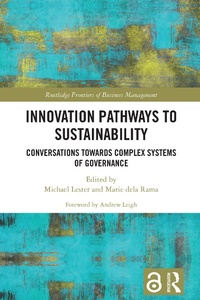
Innovation Pathways to Sustainability
Conversations Towards Complex Systems of Governance
1st Edition
Published on 9. August 2024
376 pages
978-1-040-14413-8 (ISBN)
Description

The book offers insights into reconciling innovation with sustainability and identifying key stakeholders responsible for the reconciliation. Through conversations with experts in various fields, the intersection of innovation, sustainability, governance and complex systems in a rapidly changing climate-driven world is discussed.
Countries around the world face the urgent existential challenge to tackle climate change and CO2 emissions. In its discussions of case studies of key economic sectors in Australia, this book focuses on the emerging experience with harnessing innovation to sustainability. The interdisciplinary approach to the complexity of climate change and policy making provides readers an opportunity for thoughtful discussions and lessons to be learnt from multiple angles.
This is a vital resource for scholars in climate studies, innovation and sustainability that also confronts important challenges facing policymakers, government and society.
Countries around the world face the urgent existential challenge to tackle climate change and CO2 emissions. In its discussions of case studies of key economic sectors in Australia, this book focuses on the emerging experience with harnessing innovation to sustainability. The interdisciplinary approach to the complexity of climate change and policy making provides readers an opportunity for thoughtful discussions and lessons to be learnt from multiple angles.
This is a vital resource for scholars in climate studies, innovation and sustainability that also confronts important challenges facing policymakers, government and society.
More details
Series
Edition
1. Auflage
Language
English
Place of publication
London
United Kingdom
Target group
College/higher education
Professional and scholarly
File size
1,11 MB
ISBN-13
978-1-040-14413-8 (9781040144138)
Copyright in bibliographic data and cover images is held by Nielsen Book Services Limited or by the publishers or by their respective licensors: all rights reserved.
Schweitzer Classification
Other editions
Additional editions
Michael Lester | Marie Dela Rama
Innovation Pathways to Sustainability
Conversations Towards Complex Systems of Governance
Book
approx. 12/2025
1st Edition
Routledge
€69.70
Not yet published

Michael Lester | Marie Dela Rama
Innovation Pathways to Sustainability
Conversations Towards Complex Systems of Governance
Book
10/2024
Taylor & Francis
Unfortunately, price unknown
Available (delivery time upon request)
Michael Lester | Marie Dela Rama
Innovation Pathways to Sustainability
Conversations Towards Complex Systems of Governance
Book
08/2024
1st Edition
Routledge
€203.30
Shipment within 10-20 days
Persons
Michael Lester is an independent economist, writer and radio presenter. A former public-sector executive in Australia, he has worked and lived internationally. His experience spans science, technology, innovation, environment, resources, industry, trade and investment domains. He has undergraduate and postgraduate degrees in engineering, public administration and economics.
Marie dela Rama, PhD (UTS), is an independent researcher. She participated as an accredited civil society observer in these multilateral meetings: G20 ACWG, OECD GACIF, UNCAC IRG, UN COSP9, UNGASS, UNODC ISM COSP UNGASS and UN SPT OPCAT. Her publications include The Changing Face of Corruption in the Asia Pacific (Elsevier) and Corporate Governance and Corruption (Journal of Business Ethics).
Marie dela Rama, PhD (UTS), is an independent researcher. She participated as an accredited civil society observer in these multilateral meetings: G20 ACWG, OECD GACIF, UNCAC IRG, UN COSP9, UNGASS, UNODC ISM COSP UNGASS and UN SPT OPCAT. Her publications include The Changing Face of Corruption in the Asia Pacific (Elsevier) and Corporate Governance and Corruption (Journal of Business Ethics).
Content
TABLE OF CONTENTS
List of Acronyms
The Interviewees
Chapter 1: Introduction - Exploring the Opportunities and Challenges Of Innovation, Technology, Climate Change and Sustainability
Section I Understanding Innovation and Sustainability
Chapter 2: Mark Dodgson - The things that matter: understanding and communicating the process and impact of innovation
Chapter 3: Kevin Fox - The delayed growth impact of disruptive digital technologies: measuring and accounting for the 'productivity paradox'
Chapter 4: Nicholas Gruen - Entrepreneurs and start-ups in the digital age: profiles, values and paradigms
Chapter 5: Robert Atkinson- National innovation and competitiveness in the United States: at a strategic 'tipping point' -
Chapter 6: Roy Green - Innovation policies in Australia: the divisive politics and administration of systemic transformation
Chapter 7: Ross Garnaut - Efficient, effective and integrated economy-wide climate change policy: economics and politicisation
Chapter 8: Warwick McKibbin - Climate change energy transition: modelling, scenarios and the political economy of 'the tragedy of the commons'
Chapter 9: Sami Kara - The innovative 'circular economy' as a sustainable business model: design and transformation challenges
Section II Climate Change and Energy Resources
Chapter 10: Giles Parkinson - Renewable energy development : the costs of policy uncertainty and lack of political stability
Chapter 11: Chris Dunstan - The National Energy Guarantee (NEG): frustrated reductions in electricity emissions and dirty party politics
Chapter 12: Peter Khoury - Electric Vehicles (EV): Infrastructure and policy barriers lead to laggardly diffusion and adoption
Chapter 13: Sean Foley - Bitcoin, cryptocurrency and global finance industry disruption: dirty little energy secret
Chapter 14: Jim Green - Small Modular Nuclear Reactors (SMRs) untried and untested: why all the political interest now?
Chapter 15: Tony Wood - Hydrogen-Based Economy: shipping sunshine energy to the world
Section III Agriculture, Land and Water Resources
Chapter 16: Richard Heath - Agricultural productivity improvement: the role of digital technologies
Chapter 17: Lesley Hughes - The second domestication of dairy and beef: Food 2.0 proteins without the animals
Chapter 18: Richard Beasley - Murray Darling Basin (MDB) environmental catastrophe: federalism politics and best available science
Chapter 19: Bruce Pascoe - Indigenous agriculture and sustainability knowledge: the great Australian silence
Chapter 20: Charles Massy - Regenerative agriculture: confronting industrial agriculture with farmer-led sustainability innovation
Section IV Governance Roles and Responsibilities
Chapter 21: Michael Piore - 'Silicon Valley Consensus': self-fulfilling technological determinism
Chapter 22: Bob Carr - The business of climate change: reimagining 'material interests' and the corporation
Chapter 23: Pru Bennett - Environment, Social and Governance (ESG): harnessing capital to sustainability or just 'woke' and 'greenwashing'?
Chapter 24: Ross Garnaut - Decarbonising & transforming the Australian economy: a game changing renewable energy opportunity
Chapter 25: Allan Fels - Public interest journalism: vanishing pillar for a sustainable democracy?
Chapter 26: Aaron Mertz and Abhilash Mishra - Public confidence in science: building trust on understanding scientific method and uncertainties
Chapter 27: Ray Ison - Systems-based governance: for a complex sustainable future
Chapter 28: Barry Jones - Political reform and public engagement: necessary sustainable path for confronting climate change
Chapter 29: Conclusion - Towards Complex Systems of Governance
Selected Readings (Available at www.routledge/9781032248295)
Index
List of Acronyms
The Interviewees
Chapter 1: Introduction - Exploring the Opportunities and Challenges Of Innovation, Technology, Climate Change and Sustainability
Section I Understanding Innovation and Sustainability
Chapter 2: Mark Dodgson - The things that matter: understanding and communicating the process and impact of innovation
Chapter 3: Kevin Fox - The delayed growth impact of disruptive digital technologies: measuring and accounting for the 'productivity paradox'
Chapter 4: Nicholas Gruen - Entrepreneurs and start-ups in the digital age: profiles, values and paradigms
Chapter 5: Robert Atkinson- National innovation and competitiveness in the United States: at a strategic 'tipping point' -
Chapter 6: Roy Green - Innovation policies in Australia: the divisive politics and administration of systemic transformation
Chapter 7: Ross Garnaut - Efficient, effective and integrated economy-wide climate change policy: economics and politicisation
Chapter 8: Warwick McKibbin - Climate change energy transition: modelling, scenarios and the political economy of 'the tragedy of the commons'
Chapter 9: Sami Kara - The innovative 'circular economy' as a sustainable business model: design and transformation challenges
Section II Climate Change and Energy Resources
Chapter 10: Giles Parkinson - Renewable energy development : the costs of policy uncertainty and lack of political stability
Chapter 11: Chris Dunstan - The National Energy Guarantee (NEG): frustrated reductions in electricity emissions and dirty party politics
Chapter 12: Peter Khoury - Electric Vehicles (EV): Infrastructure and policy barriers lead to laggardly diffusion and adoption
Chapter 13: Sean Foley - Bitcoin, cryptocurrency and global finance industry disruption: dirty little energy secret
Chapter 14: Jim Green - Small Modular Nuclear Reactors (SMRs) untried and untested: why all the political interest now?
Chapter 15: Tony Wood - Hydrogen-Based Economy: shipping sunshine energy to the world
Section III Agriculture, Land and Water Resources
Chapter 16: Richard Heath - Agricultural productivity improvement: the role of digital technologies
Chapter 17: Lesley Hughes - The second domestication of dairy and beef: Food 2.0 proteins without the animals
Chapter 18: Richard Beasley - Murray Darling Basin (MDB) environmental catastrophe: federalism politics and best available science
Chapter 19: Bruce Pascoe - Indigenous agriculture and sustainability knowledge: the great Australian silence
Chapter 20: Charles Massy - Regenerative agriculture: confronting industrial agriculture with farmer-led sustainability innovation
Section IV Governance Roles and Responsibilities
Chapter 21: Michael Piore - 'Silicon Valley Consensus': self-fulfilling technological determinism
Chapter 22: Bob Carr - The business of climate change: reimagining 'material interests' and the corporation
Chapter 23: Pru Bennett - Environment, Social and Governance (ESG): harnessing capital to sustainability or just 'woke' and 'greenwashing'?
Chapter 24: Ross Garnaut - Decarbonising & transforming the Australian economy: a game changing renewable energy opportunity
Chapter 25: Allan Fels - Public interest journalism: vanishing pillar for a sustainable democracy?
Chapter 26: Aaron Mertz and Abhilash Mishra - Public confidence in science: building trust on understanding scientific method and uncertainties
Chapter 27: Ray Ison - Systems-based governance: for a complex sustainable future
Chapter 28: Barry Jones - Political reform and public engagement: necessary sustainable path for confronting climate change
Chapter 29: Conclusion - Towards Complex Systems of Governance
Selected Readings (Available at www.routledge/9781032248295)
Index
