

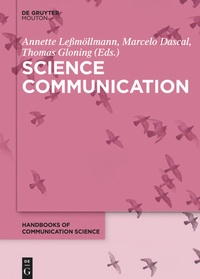
Science Communication
Description

The volume gives a multi-perspective overview of scholarly and science communication, exploring its diverse functions, modalities, interactional structures, and dynamics in a rapidly changing world. In addition, it provides a guide to current research approaches and traditions on communication in many disciplines, including the humanities, technology, social and natural sciences, and on forms of communication with a wide range of audiences.
Reviews / Votes
"Insgesamt ist dieses neue Handbuch "Science Communication" ein Ausrufezeichen: Europäische Wissenschaftskommunikationsforschung existiert: Fundiert, mit breitemAnsatz, mit vielen hochklassigen Forschungsergebnissen!" Reiner Korbmann in: https://wissenschaftkommuniziert.wordpress.com/2020/04/21/ein-neues-standardwerk-der-wissenschaftskommunikation-forschung-pur-in-science-communication/ (21.04.2020)
"Altogether this is the most comprehensive and multidisciplinary single volume on science communication currently available and as such it is definitely worth being on the shelf of anyone interested in understanding and teaching the topic in its widest possible scope. [.] Each chapter thoroughly references further work, which makes the reference lists a very useful resource in themselves, enabling pursuit of the specific topics to the next level(s)." Erik Stengler in JCOM ( Journal of Science Communication) 19(03), https://doi.org/10.22323/2.19030702. (29.06.2020)
More details
Other editions
Additional editions
Persons
Annette Leßmöllmann, Karlsruhe Inst. of Technology; Marcelo Dascal , University of Tel Aviv; Thomas Gloning , University Gießen.
Content
- Intro
- Preface
- Table of contents
- Annette Leßmöllmann and Thomas Gloning Introduction to the volume
- I Perspectives of research on scholarly and science communication
- 1. Philosophy of science for science communication in twenty-two questions
- 2. Science understanding between scientific literacy and trust: contributions from psychological and educational research
- 3. The contribution of media studies to the understanding of science communication
- 4. Analyzing science communication through the lens of communication science: Reviewing the empirical evidence
- 5. Modeling science communication: from linear to more complex models
- 6. The contribution of laboratory studies, science studies and Science and Technology Studies (STS) to the understanding of scientific communication
- 7. The contribution of linguistics and semiotics to the understanding of science communication
- 8. The contribution of terminology research to the understanding of science communication
- 9. The study of student academic writing
- II Text types, media, and practices of science communication
- 10. Epistemic genres
- 11. On the nature and role of visual representations in knowledge production and science communication
- 12. The lecture and the presentation - rhetorics and technology
- 13. Spoken language in science and the humanities
- 14. Scholarly reviewing
- 15. Scientific controversies
- 16. Symbolic notation in scientific communication: a panorama
- 17. The rise of symbolic notation in scientific communication: the case of mathematics
- 18. Grant proposal writing as a dialogic process
- III Science, scientists, and the public
- 19. Communicative strategies of popularization of science (including science exhibitions, museums, magazines)
- 20. Science journalism
- 21. Teaching science journalism as a blueprint for future journalism education
- 22. Science communication and public relations: beyond borders
- 23. Science communication, advising, and advocacy in public debates
- 24. Forms of science presentations in public settings
- IV Historical perspectives on science communication
- 25. Historical perspectives on internal scientific communication
- 26. Academic teaching: the lecture and the disputation in the history of erudition and science
- 27. Historical aspects of external science communication
- V Science communication: present and future
- 28. Reconfigurations of science communication research in the digital age
- 29. The library in a changing world of scientific communication
- 30. Scholarly communication in social media
- 31. Current trends and future visions of (research on) science communication
- Contributors to this volume
- Index
