

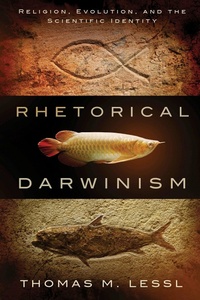
Rhetorical Darwinism
Description

Everything evolves, science tells us, including the public language used by scientists to sustain and perpetuate their work. Harkening back to the Protestant Reformation--a time when the promise of scientific inquiry was intimately connected with a deep faith in divine Providence--Thomas Lessl traces the evolving role and public identity of science in the West.
As the Reformation gave way to the Enlightenment, notions of Providence evolved into progress. History's divine plan could now be found in nature, and scientists became history's new prophets. With Darwin and the emergence of evolutionary science, progress and evolution collapsed together into what Lessl calls "evolutionism," and the grand scientific identity was used to advance science's power into the world.
In this masterful treatment, Lessl analyzes the descent of these patterns of scientific advocacy from the world of Francis Bacon into the world of Thomas Huxley and his successors. In the end, Rhetorical Darwinism proposes that Darwin's power to fuel the establishment of science within the Western social milieu often turns from its scientific course.
Rhetorical Darwinism: Religion, Evolution, and the Scientific Identity received the Religious Communication Associatons "Book of the Year" award in 2012.
More details
Other editions
Additional editions
Person
Content
1. The Social Meaning of Evolutionary Rhetoric
2. Francis Bacon and the Scientific Identity
3. Science in God's Bosom
4. From Two Books to One
5. The New Christianity
6. Positivism in the World of Thomas Huxley
7. Scientism Scientized
8. The Continuing Education of Evolutionism and Science's Battle for the Public Mind
