

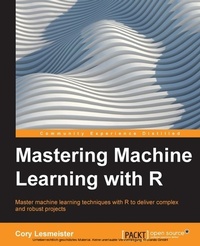
Mastering Machine Learning with R
Master machine learning techniques with R to deliver insights for complex projects
1st Edition
Published on 8. July 2025
400 pages
978-1-78398-453-4 (ISBN)
Description

Master machine learning techniques with R to deliver insights for complex projectsKey FeaturesBook DescriptionMachine learning is a field of Artificial Intelligence to build systems that learn from data. Given the growing prominence of R-a cross-platform, zero-cost statistical programming environment-there has never been a better time to start applying machine learning to your data. The book starts with introduction to Cross-Industry Standard Process for Data Mining. It takes you through Multivariate Regression in detail. Moving on, you will also address Classification and Regression trees. You will learn a couple of "Unsupervised techniques". Finally, the book will walk you through text analysis and time series. The book will deliver practical and real-world solutions to problems and variety of tasks such as complex recommendation systems. By the end of this book, you will gain expertise in performing R machine learning and will be able to build complex ML projects using R and its packages.What you will learn - Gain deep insights to learn the applications of machine learning tools to the industry
- Manipulate data in R efficiently to prepare it for analysis
- Master the skill of recognizing techniques for effective visualization of data
- Understand why and how to create test and training data sets for analysis
- Familiarize yourself with fundamental learning methods such as linear and logistic regression
- Comprehend advanced learning methods such as support vector machines
- Realize why and how to apply unsupervised learning methods
Who this book is for
- Manipulate data in R efficiently to prepare it for analysis
- Master the skill of recognizing techniques for effective visualization of data
- Understand why and how to create test and training data sets for analysis
- Familiarize yourself with fundamental learning methods such as linear and logistic regression
- Comprehend advanced learning methods such as support vector machines
- Realize why and how to apply unsupervised learning methods
Who this book is for
More details
Other editions
New editions
Cory Lesmeister
Mastering Machine Learning with R
Advanced prediction, algorithms, and learning methods with R 3.x
E-Book
01/2025
2nd Edition
Packt Publishing
€48.49
Available for download
Additional editions
Cory Lesmeister
Mastering Machine Learning with R
Master machine learning techniques with R to deliver insights for complex projects
Book
10/2015
Packt Publishing
€63.90
Shipment within 3-4 weeks
Person
Lesmeister Cory :
Cory Lesmeister has over fourteen years of quantitative experience and is currently a senior data scientist for the advanced analytics team at Cummins, Inc. in Columbus, Indiana. He has spent 16 years at Eli Lilly and Company in sales, market research, Lean Six Sigma, marketing analytics, and new product forecasting. He also has several years of experience in the insurance and banking industries, both as a consultant and as a manager of marketing analytics. A former US Army active duty and reserve officer, Cory was stationed in Baghdad, Iraq, in 2009. Here, he served as the strategic advisor to the 29,000-person Iraqi Oil Police, succeeding where others failed by acquiring and delivering promised equipment to help the country secure and protect its oil infrastructure. He has a BBA in aviation administration from the University of North Dakota and a commercial helicopter license.
Cory Lesmeister has over fourteen years of quantitative experience and is currently a senior data scientist for the advanced analytics team at Cummins, Inc. in Columbus, Indiana. He has spent 16 years at Eli Lilly and Company in sales, market research, Lean Six Sigma, marketing analytics, and new product forecasting. He also has several years of experience in the insurance and banking industries, both as a consultant and as a manager of marketing analytics. A former US Army active duty and reserve officer, Cory was stationed in Baghdad, Iraq, in 2009. Here, he served as the strategic advisor to the 29,000-person Iraqi Oil Police, succeeding where others failed by acquiring and delivering promised equipment to help the country secure and protect its oil infrastructure. He has a BBA in aviation administration from the University of North Dakota and a commercial helicopter license.
Content
- Cover
- Copyright
- Credits
- About the Author
- About the Reviewers
- www.PacktPub.com
- Table of Contents
- Preface
- Chapter 1: A Process for Success
- The process
- Business understanding
- Identify the business objective
- Assess the situation
- Determine the analytical goals
- Produce a project plan
- Data understanding
- Data preparation
- Modeling
- Evaluation
- Deployment
- Algorithm flowchart
- Summary
- Chapter 2: Linear Regression - The Blocking and Tackling of Machine Learning
- Univariate linear regression
- Business understanding
- Multivariate linear regression
- Business understanding
- Data understanding and preparation
- Modeling and evaluation
- Other linear model considerations
- Qualitative feature
- Interaction term
- Summary
- Chapter 3: Logistic Regression and Discriminant Analysis
- Classification methods and linear regression
- Logistic regression
- Business understanding
- Data understanding and preparation
- Modeling and evaluation
- The logistic regression model
- Logistic regression with cross-validation
- Discriminant analysis overview
- Discriminant analysis application
- Model selection
- Summary
- Chapter 4: Advanced Feature Selection in Linear Models
- Regularization in a nutshell
- Ridge regression
- LASSO
- Elastic net
- Business case
- Business understanding
- Data understanding and preparation
- Modeling and evaluation
- Best subsets
- Ridge regression
- LASSO
- Elastic net
- Cross-validation with glmnet
- Model selection
- Summary
- Chapter 5: More Classification Techniques - K-Nearest Neighbors and Support Vector Machines
- K-Nearest Neighbors
- Support Vector Machines
- Business case
- Business understanding
- Data understanding and preparation
- Modeling and evaluation
- KNN modeling
- SVM modeling
- Model selection
- Feature selection for SVMs
- Summary
- Chapter 6: Classification and Regression Trees
- Introduction
- An overview of the techniques
- Regression trees
- Classification trees
- Random forest
- Gradient boosting
- Business case
- Modeling and evaluation
- Regression Tree
- Classification tree
- Random forest regression
- Random forest classification
- Gradient boosting regression
- Gradient boosting classification
- Model selection
- Summary
- Chapter 7: Neural Networks
- Neural network
- Deep learning, a not-so-deep overview
- Business understanding
- Data understanding and preparation
- Modeling and evaluation
- An example of deep learning
- H2O background
- Data preparation and uploading it to H2O
- Create train and test datasets
- Modeling
- Summary
- Chapter 8: Cluster Analysis
- Hierarchical clustering
- Distance calculations
- K-means clustering
- Gower and partitioning around medoids
- Gower
- PAM
- Business understanding
- Data understanding and preparation
- Modeling and evaluation
- Hierarchical clustering
- K-means clustering
- Clustering with mixed data
- Summary
- Chapter 9: Principal Components Analysis
- An overview of the principal components
- Rotation
- Business understanding
- Data understanding and preparation
- Modeling and evaluation
- Component extraction
- Orthogonal rotation and interpretation
- Creating factor scores from the components
- Regression analysis
- Summary
- Chapter 10: Market Basket Analysis and Recommendation Engines
- An overview of a market basket analysis
- Business understanding
- Data understanding and preparation
- Modeling and evaluation
- An overview of a recommendation engine
- User-based collaborative filtering
- Item-based collaborative filtering
- Singular value decomposition and principal components analysis
- Business understanding and recommendations
- Data understanding, preparation, and recommendations
- Modeling, evaluation, and recommendations
- Summary
- Chapter 11: Time Series and Causality
- Univariate time series analysis
- Bivariate regression
- Granger causality
- Business understanding
- Data understanding and preparation
- Modeling and evaluation
- Univariate time series forecasting
- Time series regression
- Examining the causality
- Summary
- Chapter 12: Text Mining
- Text mining framework and methods
- Topic models
- Other quantitative analyses
- Business understanding
- Data understanding and preparation
- Modeling and evaluation
- Word frequency and topic models
- Additional quantitative analysis
- Summary
- Appendix: R Fundamentals
- Introduction
- Getting R up and running
- Using R
- Data frames and matrices
- Summary stats
- Installing and loading the R packages
- Summary
- Index
