

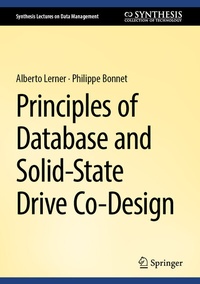
Principles of Database and Solid-State Drive Co-Design
1st Edition
Published on 6. December 2024
XV, 135 pages
978-3-031-57877-9 (ISBN)
Description

This book offers a comprehensive resource on Solid-State Drives (SSD) as the field undergoes a radical evolution characterized by the incredible variety of SSD forms and their rapid diversification. It proposes a new classification system to help readers navigate the SSD landscape. For years, the evolution of SSDs was obscured by the unchanging abstractions of block devices and POSIX I/O, but it is apparent that these abstractions have become a problematic hinderance to performance and also fail to reduce software complexity. The book explores how such a state of affairs impacts the database community in at least two ways. First, it considers how using SSDs through legacy interfaces that hide internal mechanisms invariably results in erratic performance. While the blame often goes to the notoriously expensive garbage collection of SSDs, the authors argue that in truth, several other complex processes result in nonlinear effects on latency and bandwidth. The book describes these processes and how they are implemented in modern devices, knowledge that will help system designers better choose SSDs and shape database workloads to match their performance characteristics. Second, the book explores how the inadequacy of the traditional I/O abstractions opens up an entire research field focused on the co-design of database management systems and SSD. Such research aims at devising mechanisms and policies coupling the storage manager of database and SSD internals, e.g., placing an SSD FTL under the control of database, changing SSD sub-systems in response to the workload, or executing logic within an SSD on a database's behalf. The book introduces these principles of DBMS/SSD co-design and argues that a more seamless integration of databases and storage solutions as well as the study of SSD variations adapted to database computations are central to the development of the next generation of database systems.
More details
Series
Language
English
Place of publication
Cham
Switzerland
Publishing group
Springer International Publishing
Target group
Professional and scholarly
Product notice
Reflowable
Illustrations
XV, 135 p. 65 illus., 49 illus. in color.
File size
7,38 MB
ISBN-13
978-3-031-57877-9 (9783031578779)
DOI
10.1007/978-3-031-57877-9
Schweitzer Classification
Other editions
Additional editions
Alberto Lerner | Philippe BONNET
Principles of Database and Solid-State Drive Co-Design
Book
12/2024
Springer
€48.14
Shipment within 15-20 days
Persons
Alberto Lerner has a mixed profile of industrial and academic work with over thirty years of experience. He worked as research or software technical staff at numerous tech companies, such as IBM, Google, and MongoDB and as a consultant at many database start-ups. His interest revolves around high-scale, high-performance distributed systems, particularly using heterogeneous hardware to support them. He has participated in designing and implementing several such systems, including, more recently, the X-SSD device and ongoing efforts to create more easily programmable co-designed devices. Alberto has been a Senior Researcher at the Computer Science Department of the University of Fribourg in Switzerland since 2018. He has been on several Program Committees for the Database and Systems communities, including SIGMOD, VLDB, CIDR, EDBT, ICDE, and Usenix ATC.
Philippe Bonnet is an experimental computer scientist with a background in database systems. For thirty years, Philippe has explored the design, implementation, and evaluation of database systems in the context of successive generations of computer classes, including wireless sensor networks, computer clusters, and most recently disaggregated heterogeneous computers. Philippe is an expert on storage system software. He contributed to the uFlip Benchmark, the Linux multiqueue block layer, the Linux framework for Open-Channel SSDs, the OX architecture for computational storage, the xNVMe library, and Delilah, a prototype for eBPF offload on computational storage. Philippe has been a professor in the department of Computer Science at the IT University of Copenhagen since 2016. He is a trustee of the VLDB Endowment and currently chairs the ACM EIG on Reproducibility and Replicability.
Philippe Bonnet is an experimental computer scientist with a background in database systems. For thirty years, Philippe has explored the design, implementation, and evaluation of database systems in the context of successive generations of computer classes, including wireless sensor networks, computer clusters, and most recently disaggregated heterogeneous computers. Philippe is an expert on storage system software. He contributed to the uFlip Benchmark, the Linux multiqueue block layer, the Linux framework for Open-Channel SSDs, the OX architecture for computational storage, the xNVMe library, and Delilah, a prototype for eBPF offload on computational storage. Philippe has been a professor in the department of Computer Science at the IT University of Copenhagen since 2016. He is a trustee of the VLDB Endowment and currently chairs the ACM EIG on Reproducibility and Replicability.
Content
Introduction.- Internal Interfaces.- External Interfaces.- Computational Storage.- Reprogrammed Devices.- Co-Designed Devices.- Conclusion.
