

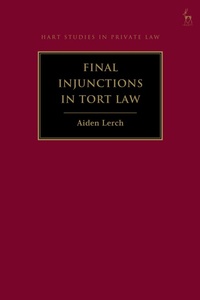
Final Injunctions in Tort Law
1st Edition
Published on 13. November 2025
272 pages
978-1-5099-8973-7 (ISBN)
Description

This book is the first considered study of final injunctions in tort law. It devises a novel taxonomy of such injunctions and explores the implications of the law on injunctions for the way in which scholars think about tort law more generally.
The book begins by analysing how the injunction in aid of legal rights came to be developed as a remedy in the Court of Chancery. It then provides definitive guidance as to the range of final injunctions that may be available to restrain or remedy torts. A clear, structured framework to guide legal reasoning in injunction cases is constructed. The book concludes by making several claims about tort law in the light of the availability of injunctive relief.
In addition to the taxonomy that is developed, the overarching message of the book is that injunctive relief is a central component of the law of tort. The way in which tort law is expounded in textbooks and monographs, and taught in universities, needs revising. Specifically, we must not overemphasise the award of damages and neglect to highlight the importance of the injunction. The true position is that injunctive relief is as crucial as damages are to enforcing the rights that are generated by tort law.
The book begins by analysing how the injunction in aid of legal rights came to be developed as a remedy in the Court of Chancery. It then provides definitive guidance as to the range of final injunctions that may be available to restrain or remedy torts. A clear, structured framework to guide legal reasoning in injunction cases is constructed. The book concludes by making several claims about tort law in the light of the availability of injunctive relief.
In addition to the taxonomy that is developed, the overarching message of the book is that injunctive relief is a central component of the law of tort. The way in which tort law is expounded in textbooks and monographs, and taught in universities, needs revising. Specifically, we must not overemphasise the award of damages and neglect to highlight the importance of the injunction. The true position is that injunctive relief is as crucial as damages are to enforcing the rights that are generated by tort law.
More details
Series
Edition
1. Auflage
Language
English
Place of publication
London
United Kingdom
Publishing group
Bloomsbury Publishing PLC
Target group
Professional and scholarly
ISBN-13
978-1-5099-8973-7 (9781509989737)
Copyright in bibliographic data and cover images is held by Nielsen Book Services Limited or by the publishers or by their respective licensors: all rights reserved.
Schweitzer Classification
Other editions
Additional editions
Aiden Lerch
Final Injunctions in Tort Law
Book
11/2025
Hart Publishing
€122.30
Shipment within 15-20 days
Person
Aiden Lerch is a solicitor at Arnold Bloch Leibler in Sydney, Australia.
Content
1. Introduction
2. Equity's Development of the Injunction in Aid of Legal Rights Before the Judicature Acts
3. The Formal Distinctions Between Prohibitory, Mandatory and Quia Timet Injunctions
4. Prohibitory Injunctions
5. Desisting and Restorative Mandatory Injunctions
6. Quia Timet Injunctions
7. Implications for Tort Law
8. Conclusion
2. Equity's Development of the Injunction in Aid of Legal Rights Before the Judicature Acts
3. The Formal Distinctions Between Prohibitory, Mandatory and Quia Timet Injunctions
4. Prohibitory Injunctions
5. Desisting and Restorative Mandatory Injunctions
6. Quia Timet Injunctions
7. Implications for Tort Law
8. Conclusion
