

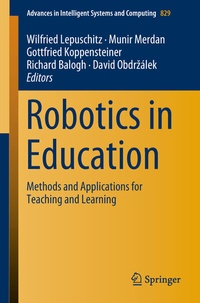
Robotics in Education
Description

This proceedings volume comprises the latest achievements in research and development in educational robotics presented at the 9th International Conference on Robotics in Education (RiE) held in Qawra, St. Paul's Bay, Malta, during April 18-20, 2018. Researchers and educators will find valuable methodologies and tools for robotics in education that encourage learning in the fields of science, technology, engineering, arts and mathematics (STEAM) through the design, creation and programming of tangible artifacts for creating personally meaningful objects and addressing real-world societal needs. This also involves the introduction of technologies ranging from robotics platforms to programming environments and languages. Extensive evaluation results are presented that highlight the impact of robotics on the students' interests and competence development. The presented approaches cover the whole educative range from elementary school to the university level in both formal as well as informal settings.
More details
Other editions
Additional editions
Content
- Intro
- Preface
- Organization
- Committee
- Co-chairpersons
- International Program Committee
- Local Conference Organization
- Sponsors
- Contents
- Comprehensive View on Educational Robotics
- roboterfabrik: A Pilot to Link and Unify German Robotics Education to Match Industrial and Societal Demands
- 1 Introduction and State of the Art
- 2 Concept
- 2.1 Robotics in the Education System
- 2.2 Robotics Focus Workshops
- 2.3 Robothons
- 2.4 Reference Education Platform
- 3 Evaluation
- 3.1 Lessons Learned
- 3.2 Possible Evaluation Methods and Metrics
- 4 Further Roll-Out
- 4.1 Integration into the German Dual Education System
- 4.2 Certification
- 4.3 From Pilot Project to General Concept
- 5 Conclusion
- References
- The Robotics Concept Inventory
- Abstract
- 1 Introduction
- 2 Concept Inventories Revisited
- 3 Robotics Concept Inventory
- 4 Robotics Concept Inventory Development Process
- 4.1 Alpha-Test Phase
- 4.2 Collecting Community Input
- 4.3 Involvement of Students
- 5 Summary and Future Work
- 5.1 Summary
- 5.2 Future Work
- References
- Workshops, Curricula and Related Aspects
- RobotCraft: The First International Collective Internship for Advanced Robotics Training
- 1 Introduction
- 1.1 The RobotCraft Programme
- 2 Crafts - Training Modules
- 2.1 Introduction to Robotics
- 2.2 Computer-Aided Design
- 2.3 Mechatronics
- 2.4 Arduino Low-Level Programming
- 2.5 ROS High-Level Programming
- 2.6 Artificial Intelligence
- 2.7 Competition
- 3 Results and Feedback
- 4 Conclusions
- References
- University Students Were Creating Activities for Leisure Time Robotic Lessons with Constructionist Approach
- 1 Introduction
- 2 University Course the Robotic Kits in Education 2
- 2.1 Course Content
- 2.2 The Participants of Our Course
- 3 Methodology
- 4 Activities for Robotic Lessons Created by Students
- 4.1 BeeBot, AlbiRobot and CodePillar
- 4.2 Ozobot Evo
- 4.3 LEGO WeDo 1.0 and LEGO WeDo 2.0
- 4.4 LEGO Mindstorms NXT
- 5 Students Findings
- 6 Discussion
- 7 Conclusion
- References
- Short Course at Brazilian Robotics Olympiad: Forming Competitors
- 1 Introduction
- 2 Educational Robotics
- 3 Brazilian Robotics Olympiad
- 3.1 Practical Modality
- 3.2 Theoretical Modality
- 4 Educational Robotics Short Course
- 5 W-Educ System
- 6 Experiences and Results
- 7 Conclusion
- References
- Case Study on Physical Computing with NodeMCU on Summer School
- Abstract
- 1 Introduction
- 2 Hardware and Software
- 3 Methodology
- 4 Activities
- 4.1 Connect the Device and Light the LED
- 4.2 Blink the LED
- 4.3 Blink the S.O.S. Sign
- 4.4 Addressable LED Strip
- 5 Findings
- 6 Conclusion
- References
- MOOC on the Art of Grasping and Manipulation in Robotics: Design Choices and Lessons Learned
- 1 Introduction
- 2 Previous Work
- 2.1 Educational Resources on Robotic Grasping and Manipulation
- 2.2 On-Line Courses on Advanced Robotics
- 3 MOOC on The Art of Grasping and Manipulation in Robotics
- 3.1 Design
- 3.2 Students' Feedback and Lessons Learned
- 4 Conclusions and Future Work
- References
- Challenging Intensive Project-Based Education: Short-Term Class on Mobile Robotics with Mechatronic Elements
- 1 Introduction
- 2 Class Specifics
- 3 Conclusion
- References
- Using Finite State Machines in Introductory Robotics
- 1 Introduction
- 2 Finite State Machines
- 3 Examples
- 3.1 Line Following Robot
- 3.2 Ketchup Cans Collecting Robot
- 4 Conclusions
- References
- Teacher Training in Educational Robotics
- Abstract
- 1 Introduction
- 2 Framework
- 3 The "PReSO" Project
- 3.1 Educational Robotics
- 3.2 Didactic Activities
- 3.3 Evaluation
- 4 Conclusion and Future Work
- References
- Impact Evaluation
- Bringing Educational Robotics into the Classroom
- Abstract
- 1 Introduction
- 2 Investigation of the Field
- 3 The Project "Robotics"
- 4 The Survey
- 4.1 Research Design
- 4.2 Research Results
- 4.3 Discussion of Results
- 5 Conclusions and Implications
- References
- Improving Students' Concepts About Newtonian Mechanics Using Mobile Robots
- 1 Introduction
- 2 Research Methodology
- 2.1 MHS Project
- 2.2 MARRtino Educational Robot
- 2.3 Surveys
- 3 Data Analysis Results
- 3.1 Physics Survey Results
- 3.2 Technology Perceptions and Collaborative Work Attitudes Surveys Results
- 3.3 Discussion
- 4 Conclusions
- References
- Multigenerational Collaboration to Create a Community of Practice Through Robot Application Development
- Abstract
- 1 Background
- 2 Purpose
- 3 Procedure
- 3.1 Cooperative Active Learning Class
- 3.2 Developed Application
- 4 Method
- 4.1 Communication Analysis
- 4.2 Measures and Participants
- 5 Results
- 5.1 Communication Change
- 5.2 Effects of Participation on Social Skills and Attitude Toward the Future
- 6 Discussion
- Acknowledgments
- References
- Two-Stage Approach for Long-Term Motivation of Children to Study Robotics
- 1 Introduction
- 2 Stage I: wITches - Motivating and Educating Children
- 2.1 Activities Organized for Children
- 2.2 LEGO Robots Workshop
- 3 Stage II: Robotic Competition - Attracting Students
- 4 Evaluation of the Two-Stage Approach
- 4.1 Stage I: Questionnaire-Based Feedback
- 4.2 Stage II: The Impact of ``RoboSoutez''
- 5 Conclusion and Future Work
- References
- How can we Teach Educational Robotics to Foster 21st Learning Skills through PBL, Arduino and S4A?
- 1 Introduction
- 1.1 Educational Robotics for Promoting 21st Century Learning Skills
- 1.2 Some Pedagogic Strategies to Develop 21st Century Learning Skills in Classroom
- 1.3 What Is the Problem Based-Learning, PBL?
- 1.4 PBL to Teach Educational Robotics
- 1.5 Friendly Technology: S4A and Arduino
- 2 Methods
- 2.1 Apparatus and Materials
- 2.2 Instrument for Data Collection
- 2.3 Procedure
- 2.4 Data Treatment
- 3 Results and Discussion
- 3.1 Coding by Variable: Phases
- 3.2 Coding Frequency: Skills
- 3.3 Coding by Variable: Groups
- 4 Conclusions
- References
- How Does Participation in FIRST LEGO League Robotics Competition Impact Children's Problem-Solving Process?
- Abstract
- 1 Introduction
- 2 FIRST LEGO League Challenge
- 3 Research Design
- 4 Data Analysis
- 5 Finding and Discussion
- 5.1 Robot Game
- 5.2 Project Design
- 5.3 Core Values
- 6 Conclusion and Future Implications
- References
- Educational Robotics to Support Social Relations at School
- 1 Introduction
- 2 Materials and Method
- 2.1 Participants
- 2.2 Lego Mindstorms NXT and Scratch
- 2.3 Sociometric Test
- 2.4 Procedure
- 3 Results
- 4 Conclusions and Future Directions
- References
- Technologies and Platforms
- AMiRo: A Mini Robot as Versatile Teaching Platform
- 1 Introduction
- 2 The AMiRo Habitat
- 2.1 Hardware
- 2.2 Operating Systems
- 2.3 Tools
- 3 AMiRo in the Education Curriculum
- 3.1 Teaching the Basics
- 3.2 Robot Design and Programming
- 3.3 Study Projects and Theses
- 4 Experiences and Student Feedback
- 4.1 Lecturer's View
- 4.2 Student's View
- 5 Conclusion and Future Prospect
- References
- Teaching with Open-Source Robotic Manipulator
- 1 Introduction
- 2 Robotic Manipulator
- 2.1 Hardware Platform
- 2.2 Programming Interfaces
- 3 Teaching Use-Cases
- 3.1 University Course on Robotics and Computer Vision
- 3.2 Summer School for Primary-School Level Children
- 3.3 Shorter Educational Events
- 4 Conclusion
- References
- Prototyping and Programming a Multipurpose Educational Mobile Robot - NaSSIE
- 1 Introduction
- 2 Design Considerations
- 2.1 Competitions
- 2.2 Design Constraints
- 3 NaSSIE Design
- 3.1 Mechanical
- 3.2 Electronic Hardware
- 3.3 Software
- 4 Prototype
- 5 Approach and Results
- 6 Conclusions and Future Work
- References
- Education with Robots Inspired in Biological Systems
- Abstract
- 1 Introduction
- 2 Mathematical Model
- 2.1 Forward Kinematics
- 2.2 Inverse Kinematics
- 3 Control of a Walking Robot
- 4 Hexapod Robot
- 5 Walking vs Running
- 6 Research Work
- 7 Conclusions and Future Work
- References
- Programming Environments and Languages
- Tailoring a ROS Educational Programming Language Architecture
- 1 Introduction
- 1.1 Statement of Contribution
- 2 Lessons Taken from Previous Initiatives
- 3 ROS Educational Programming Language Architecture
- 3.1 RobotCraft Bot V2.0: ROS-enabled Robot
- 3.2 rosbridge JSON API to ROS
- 3.3 roslibjs Javascript Library
- 3.4 Snap! Blocks-Based Programming
- 4 A Simple Scenario: Teleoperation
- 5 Conclusions and Future Extensions
- References
- Real-Time Matlab-Simulink-Lego EV3 Framework for Teaching Robotics Subjects
- 1 Introduction
- 2 LEGO Mindstorms Platforms
- 3 LEGO Mindstorms for Education
- 3.1 Teaching Code
- 3.2 Teaching Robotics
- 3.3 Teaching Particular Robot Models
- 3.4 Goal of the Paper
- 4 Matlab-Simulink-Lego EV3 for Teaching Robotics
- 4.1 Linking Matlab-Simulink-EV3
- 5 Testing the Platform with a New Motion Planning Algorithm
- 6 Conclusions
- References
- IDEE: A Visual Programming Environment to Teach Physics Through Robotics in Secondary Schools
- 1 Introduction
- 2 General Overview of IDEE
- 3 Learning Activities in IDEE
- 4 Conclusions and Future Work
- References
- Cross Topics in Educational Robotics
- Robotic Trains as an Educational and Therapeutic Tool for Autism Spectrum Disorder Intervention
- 1 Introduction
- 2 Smart Robotic Train: A New Intervention and Learning Tool
- 2.1 Motivation
- 2.2 The Proposed Model
- 3 Methods
- 3.1 Participants
- 3.2 Stimuli
- 3.3 Experimental Setup
- 3.4 Analysis
- 4 Results and Discussions
- 4.1 Experiment 1
- 4.2 Experiment 2
- 4.3 Experiment 3
- 4.4 Experiment 4
- 5 Conclusions
- References
- iBridge - Participative Cross-Generational Approach with Educational Robotics
- Abstract
- 1 Introduction
- 2 Project Activities and Schedule
- 3 The Workshops and Cross-Generational Setting
- 4 Research Design
- 5 Sensitive Cuddly Toys
- 6 Impact
- 7 Conclusion
- Acknowledgements
- References
- Modelling the Driver Assistance Systems Using an Arduino Compatible Robot
- 1 Introduction
- 2 Driver Assistance Systems
- 3 Acceleration Skid Control (ASR)
- 4 Autonomous Cruise Controll (ACC)
- 5 Lane Departure Warning (LDW)
- 6 Conclusions
- References
- Author Index
