

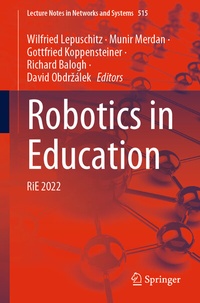
Robotics in Education
RiE 2022
Published on 20. July 2022
XI, 198 pages
978-3-031-12848-6 (ISBN)
Description

This book comprises the latest achievements in research and development in educational robotics presented at the 13th International Conference on Robotics in Education (RiE), which was carried out as a purely virtual conference from April 27 to 28, 2022. Researchers and educators will find valuable methodologies, experiences, and tools for robotics in education that encourage learning in the fields of science, technology, engineering, arts, and mathematics (STEAM) through the design, creation, and programming of robots addressing real-world societal needs. Social robotics is becoming an important topic in education as well. This also involves various modern technologies ranging from robotics platforms to programming environments and languages. Many papers also prove the positive impact of robotics on the students' interests and competence development. The presented approaches cover the whole educative range from kindergarten to the university level and lifelong learning.
More details
Series
Edition
1st ed. 2022
Language
English
Place of publication
Cham
Switzerland
Publishing group
Springer International Publishing
Target group
Professional and scholarly
Product notice
Reflowable
Illustrations
XI, 198 p. 79 illus., 69 illus. in color.
File size
29,65 MB
ISBN-13
978-3-031-12848-6 (9783031128486)
DOI
10.1007/978-3-031-12848-6
Schweitzer Classification
Other editions
Additional editions
Book
07/2022
Springer
€235.39
Shipment within 15-20 days
Content
- Intro
- Preface
- Organization
- Committee
- Co-chairpersons
- International Programme Committee
- Local Conference Organization
- Contents
- Workshops, Curricula and Related Aspects
- Educational Robots and Flow Experience
- 1 Introduction
- 2 Flow
- 3 Educational Robots and Flow
- 4 Studying Flow
- 5 Aim
- 6 Methodology
- 7 Results
- 8 Discussion
- 9 Conclusion and Suggestions for Further Studies
- Appendix 1
- Appendix 2
- References
- Implementation of a Multi-disciplinary Robotics Curriculum for master's Student: The Use Case of AMSCC1 International Semester
- 1 Introduction
- 2 General Considerations and Requirements
- 2.1 Prerequisites
- 2.2 Semester's Goals
- 2.3 Semester Design's Guidelines
- 3 Hardware and Software Selection
- 3.1 The Robotics Platform
- 3.2 Simulation of the Robot Digital Twin
- 3.3 Operating System, ROS Version and Programming Language Picks
- 3.4 Docker Containers as Last Building Blocks
- 4 Efficiently Learning or Teaching ROS
- 5 The Semester's Syllabus at a Glance
- 5.1 Topics and Lectures Requirements
- 5.2 Three Modules
- 6 Conclusion
- References
- Light Painting with Mobile Robots as Motivating Projects for Robotics and Control Education
- 1 Introduction
- 2 Curriculum and Projects
- 2.1 Related Curriculum
- 2.2 Projects and Teams
- 2.3 Supervising Team
- 3 Objectives and Results of the Projects
- 3.1 Objectives
- 3.2 Obtained Results
- 4 Pedagogy and Outcomes for the Students
- 5 Conclusions
- References
- Perspectives on Virtual Reality in Higher Education for Robotics and Related Engineering Disciplines
- 1 Introduction
- 2 State of the Art
- 3 Approach
- 4 Results
- 4.1 Demographic Data
- 4.2 The Students Perspectives on Virtual Reality
- 4.3 Attitudes Towards Virtual Reality in Education
- 5 Discussion
- 6 Summary
- 7 Funding Statement
- References
- Understanding Machine Learning Through AI-powered Educational Robotics - Pilot Study with Undergraduate Students
- 1 Introduction
- 2 Why AI-powered Educational Robotics for AI, Computer Science, and Computational Thinking Learning?
- 3 CogBots: AI-powered Educational Robotics Tool
- 4 Working with Undergraduates on the Development of an AI-powered Educational Robotics Lesson
- 5 Discussion and Next Step
- References
- Educational Robotics: Methodological Considerations and Practice of Mechatronics
- 1 Introduction
- 2 Context, Hands-On Approach, Its Properties and Improvement
- 3 Methodological Considerations with Examples
- 4 Conclusion
- References
- Towards Futures Literacy Through Computational Thinking and Storytelling Activities
- 1 Introduction
- 2 Theoretical Background
- 2.1 Futures Literacy and Computational Thinking
- 2.2 Tell, Draw & Code
- 3 Methodology and Participants
- 4 Results
- 5 Discussion and Outlook
- References
- Taxonomy for Educational Robotics at Schools
- 1 Introduction
- 2 Related Literature
- 3 Taxonomy
- 4 Discussion and Conclusion
- References
- Social Robotics
- How Social Robots Can Facilitate Teaching Quality - Findings from an Explorative Interview Study
- 1 Introduction
- 2 Background
- 2.1 Social Robots in the Classroom
- 2.2 Theoretical Framework - Teaching Quality in Classroom Settings
- 3 Method
- 3.1 Design
- 3.2 Participants
- 3.3 Data Collection
- 3.4 Data Analysis
- 4 Results
- 4.1 Use of Social Robots for Learning Purposes in Classroom
- 4.2 Perceived Capabilities of Robots to Perform Classroom Teaching Tasks
- 5 Discussion
- 6 Conclusion and Future Work
- References
- Pupil-Robot Interaction in a Math Card Game: An Iterative Process of Studying the Use of Social Robotics in Primary School Math Education
- 1 Introduction
- 2 Theoretical Background
- 3 Study Overview and Data Collection
- 3.1 The Math Card Game
- 4 Procedures and Results
- 4.1 Phase 1 Procedure
- 4.2 Lessons Learned from Phase 1
- 4.3 Phase 2 Procedure
- 4.4 Lessons Learned from Phase 2
- 5 Discussion
- 6 Conclusions and Future Directions
- References
- Telepresence Robots in Higher Education - The Current State of Research
- 1 Introduction
- 2 Literature Review on Using Telepresence Robots in Higher Education
- 3 Strengths and Weaknesses of Using Telepresence Robots in Higher Education
- 4 Conclusions and Discussion
- References
- Technologies for Educational Robotics
- Open Design Meets Robotics - Customizable Educational Robot Construction System
- 1 Introduction
- 2 Overview of Existing Solutions
- 2.1 Open Design Principles
- 2.2 Modularity in Robotics
- 3 Requirements and Proposals
- 4 Results
- 4.1 Technology Used
- 5 Testing
- 6 Conclusions
- References
- Playing Tic-Tac-Toe with a Lightweight Robot
- 1 Introduction
- 2 Experimental Setup
- 3 Robot Programming
- 4 Image Processing
- 5 Artificial Intelligence
- 6 Robot Force/Torque Control
- 7 Conclusion
- References
- Design of a Bio-Inspired Optical Compass for Education Purposes
- 1 Introduction
- 2 Optical Compass Design
- 2.1 Polarized Light from the Sky
- 2.2 Description of the Device
- 3 Heading Estimation Method
- 4 Evaluation
- 5 Conclusion
- References
- Evaluating Educational Robotics
- Teachers' Exposure Workshop for Integrating Robotics Activities in STEM
- 1 Introduction
- 2 Methodology
- 2.1 Participants
- 2.2 The Workshop
- 2.3 Research Tools
- 3 Results
- 3.1 Participants' Attitudes Toward the Use of Robotics in Science Teaching
- 3.2 Understanding the Importance of Integrating Robotics Activities into Science Classes
- 3.3 The Possibility of Integrating Robotics Activities in Science Classes
- 4 Conclusions
- References
- Software Testing, AI and Robotics (STAIR) Learning Lab
- 1 Introduction
- 2 Hardware and Software
- 3 The Learning Lab on a Running Example
- 3.1 Traffic Sign Recognition
- 4 Conclusion
- References
- Evaluating the Effects of Educational Robotics Activities Concerning the Interest in STEM and Collaboration Skills
- 1 Introduction
- 2 The Educational Robotics Activities
- 3 Evaluation Methodology
- 4 Evaluation Results
- 5 Conclusion and Outlook
- References
- Children's Perspectives on Robotics and the Relevance to Educational Robotics Competitions
- Author Index
