

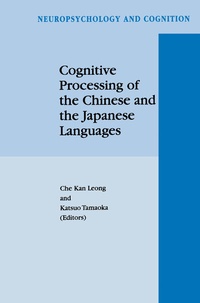
Cognitive Processing of the Chinese and the Japanese Languages
Published on 9. March 2013
VI, 322 pages
978-94-015-9161-4 (ISBN)
Description

The area of cognitive processing of Chinese and Japanese is currently attracting a great deal of attention by leading cognitive psychologists. They aim to find out the similarities and differences in processing the morphosyllabic Chinese and Japanese syllabary as compared with alphabetic language systems.
Topics under the processing of Chinese include: the use of phonological codes in visual identification of Chinese words, the constraint on such phonological activation, recognition of Chinese homophones, Chinese sentence comprehension and children's errors in writing Chinese characters.
Topics under the processing of Japanese include: the automatic recognition of kanji within an interactive-activation framework, On-reading and Kun-reading of kanji characters, processing differences between hiragana and kanji, the effect of polysemy on katakana script, and the writing behavior of Japanese and non-Japanese speakers.
The interactive-activation model provides the phonologic-orthographic links in processing both language systems.
The present volume should add greatly to our understanding of this topic. Many of the contributors are internationally known for their experimental psychological work.
Topics under the processing of Chinese include: the use of phonological codes in visual identification of Chinese words, the constraint on such phonological activation, recognition of Chinese homophones, Chinese sentence comprehension and children's errors in writing Chinese characters.
Topics under the processing of Japanese include: the automatic recognition of kanji within an interactive-activation framework, On-reading and Kun-reading of kanji characters, processing differences between hiragana and kanji, the effect of polysemy on katakana script, and the writing behavior of Japanese and non-Japanese speakers.
The interactive-activation model provides the phonologic-orthographic links in processing both language systems.
The present volume should add greatly to our understanding of this topic. Many of the contributors are internationally known for their experimental psychological work.
More details
Other editions
Additional editions
C.K. Leong | Katsuo Tamaoka
Cognitive Processing of the Chinese and the Japanese Languages
Book
12/2010
Springer
€160.49
Shipment within 15-20 days
C.K. Leong | Katsuo Tamaoka
Cognitive Processing of the Chinese and the Japanese Languages
Book
12/1998
Kluwer Academic Publishers
€160.49
Shipment within 15-20 days
Content
Cognitive processing of Chinese characters, words, sentences and Japanese kanji and kana: An introduction.- Phonological codes as early sources of constraint in Chinese word identification: A review of current discoveries and theoretical accounts.- Differential effects of phonological priming on Chinese character recognition.- Context effects and the processing of spoken homophones.- The effective visual field in reading Chinese.- A slot-filling model of sentence comprehension.- Children's stroke sequence errors in writing Chinese characters.- The effects of morphological semantics on the processing of Japanese two-kanji compound words.- Form and sound similarity effects in kanji recognition.- What matters in kanji word naming: Consistency, regularity, or On/Kun-reading difference?.- Identifying the On- and Kun-readings of Chinese characters: Identification of On versus Kun as a strategy-based judgment.- The effects of polysemy for Japanese katakana words.- The time course of semantic and phonological access in naming kanji and kana words.- The role of phonology in reading Japanese: Or why I don't hear myself when reading Japanese.- Writing errors in Japanese kanji: A study with Japanese students and foreign learners of Japanese.
