

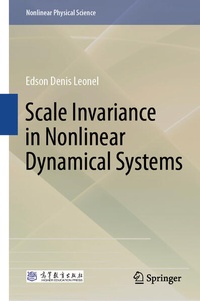
Scale Invariance in Nonlinear Dynamical Systems
Description

This book aims to explore the scale invariance present in certain nonlinear dynamical systems. We will discuss both ordinary differential equations (ODEs) and discrete-time maps. The loss of predictability in the temporal evolution of nearby initial conditions, and the resulting exponential divergence of their trajectories in phase space, leads to the concept of chaos. Some observables studied in nonlinear systems exhibit characteristics that can be described through scaling laws, giving rise to scale invariance. Several nonlinear systems present temporal evolutions that can be described using scaling formalism. As control parameters vary, physical quantities and phase space observables can be characterized by power laws. These, in turn, may lead to the definition of critical exponents, resulting in universal behaviors. The application of this formalism has been widely accepted in the scientific community in the investigation of various problems. Therefore, in writing this book, I aimed to compile research results on some nonlinear systems, partially employing the scaling formalism, in a way that could be presented at the undergraduate and graduate levels. At the same time, the text was designed to be original enough to contribute to the existing literature without excessive overlap with topics already well established in textbooks. Most chapters in the book include a set of review exercises. Students are encouraged to work through them. Some exercises are analytical, others are numerical, and some involve a degree of computational complexity.
More details
Other editions
Additional editions
Person
Edson Denis Leonel is a Professor of Physics at São Paulo State University (UNESP), Rio Claro, Brazil. He has been working on scaling investigations since his Ph.D. in 2003, where he conducted the first study of scaling behavior in the chaotic sea of the Fermi-Ulam model. His research group has developed a variety of approaches and formalisms to investigate and characterize scaling properties across a wide range of systems, including one-dimensional mappings, ordinary differential equations, cellular automata, meme propagation, and time-dependent billiards. His group has investigated different types of transitions in using scaling investigations, including but not limited to: (i) the transition from integrability to non-integrability; (ii) the transition from limited to unlimited diffusion; and (iii) the production and suppression of Fermi acceleration - the latter involving the analytical solution of the diffusion equation. Professor Leonel and his collaborators have published more than 180 scientific papers in respected international journals, including three in Physical Review Letters. He is the author of Scaling Laws in Dynamical Systems (Springer & Higher Education Press, 2021), and Dynamical Phase Transitions in Chaotic Systems (Springer & Higher Education Press, 2023) as well as two books in Portuguese: one on Statistical Mechanics (Blucher, 2015) and another on Nonlinear Dynamics (Blucher, 2019).
