

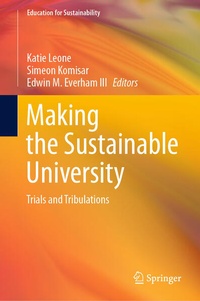
Making the Sustainable University
Trials and Tribulations
1st Edition
Published on 21. May 2021
XXII, 310 pages
978-981-334-477-8 (ISBN)
Description

This book documents strategies for universities engaging sustainability challenges through the education of global citizens on topics such as climate change, habitat alteration, species loss, resource depletion and contamination, food access and sovereignty, economic equity, and energy use. Different disciplines and operational units often have disparate ideas in mind when they work toward advancing sustainability. For example, some disciplines focus on environmental challenges (identifying impacts to ecosystems, mitigation and remediation strategies), some on greening of industrial and commercial practices while others address social equity-often there is little effort to connect these pieces especially while considering economic impacts. This book examines how Florida Gulf Coast University has attempted to infuse sustainability across curricula and operations as an integrated concept and our successes and shortcomings are instructional for sustainability practitioners on college campuses and other industries in a wide audience.
More details
Other editions
Additional editions
Katie Leone | Simeon Komisar | Edwin M. Everham III
Making the Sustainable University
Trials and Tribulations
Book
05/2021
Springer
€171.19
Shipment within 3-4 weeks
Persons
Katie Leone, M.A., is a systems thinker with proven success in connecting communities, organizations, and individuals to set and achieve audacious goals aimed at improving quality of life. She leads sustainability and impact programs at Collaboratory, where she works to accelerate local actions toward achieving Sustainable Development Goal targets. Her work centers on integrating sustainability as a strategic framework for solving social, economic, and environmental problems. She earned her master's from Chatham University's Falk School of Sustainability and completed a Climate Fellowship at the University of New Hampshire Sustainability Institute. Before joining the team at Collaboratory, Katie studied and taught abroad in Italy and South Korea. She also served as Florida Gulf Coast University's sustainability officer, where she worked across institutional units to bridge educational and operational sustainability goals. Katie is committed to helping organizations and people transform communities by using sustainability metrics alongside stakeholder engagement processes. She is particularly experienced in food systems, climate action, education, and social equity.
Simeon Komisar, Ph.D., is Associate Professor and Program Director of Environmental Engineering at Florida Gulf Coast University where he holds the Backe Chair in Renewable Energy. His research focuses on sustainable water and wastewater processes, resource recovery, sustainable design, and energy efficiency which is reflected in his teaching. He developed the course Sustainability in Engineering, required of all graduating Florida Gulf Coast University Environmental and Civil engineering students, and has taken an active role in the teaching and assessment of sustainability practices at Florida Gulf Coast University as a whole. He has headed efforts to renew the Florida Gulf Coast University's signature course, University Colloquium-A Sustainable Future, and is actively participating in an effort to integrate sustainability across the curriculum. His courses utilize the Florida Gulf Coast University campus as a living laboratory and engage students in service-learning projects in the SW Florida community. He is an active member of the Florida Water Environment Association, the Association of Environmental Engineering and Science Professors, and the American Society of Civil Engineers.
Edwin M. Everham III, Ph.D., is a Professor in the Department of Ecology and Environmental Studies, in The Water School, at Florida Gulf Coast University. He teaches courses at a variety of levels across the discipline, including the capstone course- Conservation Strategies for a Sustainable Future . His scholarship focuses on the response of ecosystems to disturbances. In southwest Florida, his research has included the impacts of exotic invasion and exotic removal in wetlands, fire ecology in exotic infested systems, ecological dynamics of stormwater ponds, freshwater lake restoration and recovery, changes in herpetofauna communities through time, impacts of mosquito control on non-target species, and the response of ecosystems in SWF to hurricane disturbance. Since arriving in Florida in 1996, he has served with numerous local community organizations including: Chairman of the Estero Bay Agency on Bay Management, Fort Myers Beach Marine Resources Task Force, Calusa Nature Center, Big Cypress National Preserve Off-Road Vehicle Advisory Committee, and Institute for Food and Agriculture Immokalee Field Station Agroecology Advisory Board, and is currently a Board Member for the Brandwein Institute.
Simeon Komisar, Ph.D., is Associate Professor and Program Director of Environmental Engineering at Florida Gulf Coast University where he holds the Backe Chair in Renewable Energy. His research focuses on sustainable water and wastewater processes, resource recovery, sustainable design, and energy efficiency which is reflected in his teaching. He developed the course Sustainability in Engineering, required of all graduating Florida Gulf Coast University Environmental and Civil engineering students, and has taken an active role in the teaching and assessment of sustainability practices at Florida Gulf Coast University as a whole. He has headed efforts to renew the Florida Gulf Coast University's signature course, University Colloquium-A Sustainable Future, and is actively participating in an effort to integrate sustainability across the curriculum. His courses utilize the Florida Gulf Coast University campus as a living laboratory and engage students in service-learning projects in the SW Florida community. He is an active member of the Florida Water Environment Association, the Association of Environmental Engineering and Science Professors, and the American Society of Civil Engineers.
Edwin M. Everham III, Ph.D., is a Professor in the Department of Ecology and Environmental Studies, in The Water School, at Florida Gulf Coast University. He teaches courses at a variety of levels across the discipline, including the capstone course- Conservation Strategies for a Sustainable Future . His scholarship focuses on the response of ecosystems to disturbances. In southwest Florida, his research has included the impacts of exotic invasion and exotic removal in wetlands, fire ecology in exotic infested systems, ecological dynamics of stormwater ponds, freshwater lake restoration and recovery, changes in herpetofauna communities through time, impacts of mosquito control on non-target species, and the response of ecosystems in SWF to hurricane disturbance. Since arriving in Florida in 1996, he has served with numerous local community organizations including: Chairman of the Estero Bay Agency on Bay Management, Fort Myers Beach Marine Resources Task Force, Calusa Nature Center, Big Cypress National Preserve Off-Road Vehicle Advisory Committee, and Institute for Food and Agriculture Immokalee Field Station Agroecology Advisory Board, and is currently a Board Member for the Brandwein Institute.
Content
Chapter 1 The Sustainability Perspective at Florida Gulf Coast University.- Chapter 2 Our Creation Story.- Chapter 3 Planning the Sustainable University: From Aspiration to Implementation.- Chapter 4 Creating a Culture of Sustainability: Organizational Strategies and Employee Training.- Chapter 5 University Colloquium: Educating for a Sustainable Future.- Chapter 6 Infusing Sustainability Across the Curriculum.- Chapter 7 Grounded in Place: Strategies for Teaching Sustainability in Cross-Cultural Learning Communities.- Chapter 8 Campus as a Living laboratory: the Built Environment.- Chapter 9 Campus as a Living Laboratory: Conservation Areas that Create a Community who Then Ensure its Sustainability.- Chapter 10 Implementing Sustainability: How Partnerships in Higher Education Operationalize Sustainability Lessons Taught in the Classroom.- Chapter 11 Service-Learning as a High Impact Practice.- Chapter 12 Student Leadership and Sustainability: The Florida Gulf Coast University Food Forest and the Real Food Challenge Pledge.- Chapter 13 Students in the Driver's Seat.- Chapter 14 Mission-driven Education and Research in Action: Center for Environmental and Sustainability Education.- Chapter 15 The FGCU Effect: Institutional Impact on Regional Sustainability.- Chapter 16 Assessing Sustainability: Measuring Individual and Institutional Progress.- Chapter 17 Building a green and sustainable university: An international review.- Chapter 18 Leaders and Heroes: Sustaining the Sustainable University.- Afterword: Sustainability in the time of Covid-19.
