

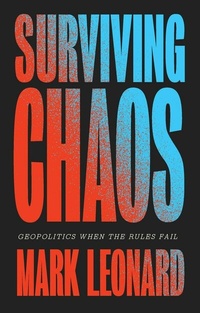
Surviving Chaos
Description

We live in an explosive world. Trump is blowing up political order. Xi Jinping is scrambling the economy. And Putin is redrawing the map of Europe. At a time when every crisis bleeds into the next - from pandemics and wars to climate shocks and AI revolutions - the old rules of global order are collapsing.
Mark Leonard reveals how geopolitics is being rewritten in an age of 'Un-Order', where no one agrees on the rules, and even the concept of order itself is up for debate. Drawing on years of conversations with leaders and thinkers from Beijing to Washington, Leonard argues that we are witnessing a new divide in international politics between the grand 'architects' who try to build a stable global system and the nimble 'artisans' who adapt, improvise and survive amidst disruption. China, he shows, has embraced the artisan's mindset, while Europe and the West cling to the fading certainties of the architects.
Part analysis, part manifesto, Surviving Chaos offers a bold new framework for understanding power in the twenty-first century - and a call for leaders to stop defending yesterday's world and start learning how to thrive in tomorrow's.
Mark Leonard is Co-Founder and Director of the European Council on Foreign Relations, the first pan-European think-tank. He hosts the weekly podcast Mark Leonard's World in 30 Minutes and writes a syndicated column on global affairs for Project Syndicate.
More details
Other editions
Additional editions
Person
Mark Leonard is Co-Founder and Director of the European Council on Foreign Relations, the first pan-European think-tank. He hosts the weekly podcast Mark Leonard's World in 30 Minutes and writes a syndicated column on global affairs for Project Syndicate.
Content
1. The Age of Unorder
2. Embracing Change
3. The Power of Connections
4. Many Worlds
5. From the Inside Out
6. Adaptation, Not Control
Conclusion: Europe's Artisan Playbook
Acknowledgements
Notes
References
CHAPTER 1
THE AGE OF UN- ORDER
If people had to put a face on the new world without rules, it is likely that it would have the orange complexion and improbable quiff of Donald J. Trump. Foreign policy experts and US allies have looked on in horror as he has taken a wrecking ball to his country's vision of order. For eighty years, US strategists thought alliances made them stronger and safer - and they were willing to spend blood and treasure to defend them. Donald Trump sees allies as vampires that take advantage of America's generosity and give little in return. He wants to leave global institutions like the World Health Organization and pull back from NATO and the United Nations.
The same is true with free trade. Rather than seeing it as a phenomenon that delivers cheap goods to US consumers and record profits for US companies, Trump regards it as a curse that has hollowed out American manufacturing and left working-class people with fewer jobs and less money. He wants tariffs to re-establish America's economic sovereignty.
The free movement of people has been central to America's economic model and its identity. From Apple and Intel to Google and Tesla, the brains and entrepreneurial drive that built America's world-beating companies have been those of migrants. But Trump thinks the country is full, and that building walls is now the best way to defend America.
A similar story is true of human rights. The defence of rights is integral to the US Constitution - but Trump thinks that these rights have become symbols of 'wokery'. He now embraces far-right parties in countries like Germany and the UK and wants to promote 'traditional values' as well as an idea of 'free speech' that makes it legal to spread racism and misogyny.
It seems that the US is leading a revolution against its own order - on alliances and multilateralism, trade, migration and human rights. Rather than defending the status quo, Trump has transformed the country into the world's leading disruptor.
But a more accurate description of the situation might be to see Trump as a symptom of the world's lack of order rather than its prime cause. When he was elected on 5 November 2024, chaos was certainly on the ballot. It was not necessarily that the American people wanted a chaos-monger, but that they thought that chaos was now inevitable. During the previous administration, when Joe Biden was in office, they had to cope with Covid-19, the inflation crisis, a surge in migration, wars in Ukraine and Gaza, cyberattacks that shut down hospitals and grounded aeroplanes, not to mention the wild fires and hurricanes that brought the climate emergency into the fanciest neighbourhoods. In each of these cases, Biden's response was to uphold the existing order and rules - and remind the world of an idea of liberal progress.
He said he was on the side of the middle classes - but they took a big hit from rising food and gas prices.
He talked about a two-state solution in the Middle East - but every day fewer numbers of people believed it would happen on both the Palestinian and the Israeli sides.
He said he would support Ukraine for as long as it took to recover its entire territory - but Russia seems to have the advantage in the war of attrition.
He said he would act to stop climate change rising more than 1.5 degrees - but every year the world fell further short of its targets.
He said controlling AI is the biggest challenge facing humanity - but did little to keep us safe from its abuse.
He said China is on the wrong side of history - and yet it continues to grow stronger and more technologically advanced.
President Biden thought he understood how the world should work and hoped that with courage and determination he could impose his rules on a global basis. He was surrounded by brilliant and committed people who did their best to achieve this by developing imaginative policies and modelling the best ideas of competent administration.
However, after years of living with crisis, the American people decided the purveyors of order were not credible. And Trump - who had no solutions of his own to any of these problems - was able to tap into growing public cynicism about the state's ability to cope with these new crises of interdependence. He challenged the viability and the legitimacy of the postwar system - and cynically tried to show that it often helped the better-off rather than those in greatest need. In so doing, he was echoing the views of the many outside the developed West who never believed we had order in the first place. For them, the period perceived of by the West as one of 'order' had been its very opposite. As a former foreign minister of Pakistan once told me: 'For the developing world, the Cold War wasn't very cold.' Although war never broke out in Europe or the US, conflicts raged from Korea and Vietnam to Afghanistan and Angola. In fact, an average of 1,200 people were killed every single day of the 'Cold War'.1 Some people have described the Western order in racial terms, calling it a 'white peace' because it coexisted with so much violence in other parts of the globe.2 There were 237 wars between 1945 and 2007. But fewer than ten of these took place physically in Europe and North America.3
Rather than waiting for further disruptions or for other people to take down America's world, Donald Trump has made clear that he wants to blow it up himself. And the biggest victims of this move are America's closest allies, who built their ideas of security and prosperity around a close relationship with the United States. No one feels more alone in this than the Europeans, who face a military threat from Russia and an economic one from China - without knowing whether they can rely on their alliance with America.
* * *
In fact, the biggest threat to order comes not so much from the actions of disruptive leaders as from the bigger historical forces we looked at above in the opening images of crises. The changes that will define the rest of the century - the four big Cs - are best explained by four simple graphs.
The first graph is about capital. It shows the world's GDP, which flatlined for centuries but has grown at an exponential rate over the past eighty years - from under 10 billion in 1950 to almost 110 billion today. It has grown by gradually enmeshing all the countries in the world into a hyperconnected economy with global financial networks, supply chains and infrastructures that are increasingly fragile and subject to shocks, contagion and radical inequality within and between countries. Capitalism is lurching from crisis to crisis - bringing chaos and inequality in its wake. And that is before we look at the dangers that globalizing capitalism spreads in its wake, such as future pandemics, which epidemiologists warn could be hundreds of times deadlier than Covid-19 caused by the SARS-CoV-2 virus.
Figure 1.1 Global GDP over the long run
Note: This data is expressed in international dollars at 2021 prices.
Source: Data derived from Eurostat, OECD and World Bank (2025); J. Bolt and J.L. van Zanden, Maddison Project Database (2023); Maddison Database (2010) with major processing by Our World in Data: https://ourworldindata.org/grapher/global-gdp-over-the-long-run?time=1700..latest.
The second graph is about climate. It shows annual global CO2 emissions, which began increasing quickly with the Industrial Revolution and which sky-rocketed after 1950, growing more in the past eighty years than the 800 million years before that (from 5 billion tonnes per year in 1950 to 35 billion today). Scientists think we are on the threshold of irreversible changes to our climate, which will see cyclones, droughts, floods and hurricanes unleash chaos on the world. They estimate that hundreds of major cities will end up under water and a billion people will be living in uninhabitable parts of the planet within fifty years.4 They claim we are already in the middle of the fifth great extinction (the last one, which took place 65 million years ago, saw the end of the dinosaurs) and that 1 million species will disappear by 2050.5
Figure 1.2 Annual global CO2 emissions
Source: H. Ritchie, P. Rosado and M. Roser, CO2 and Greenhouse Gas Emissions, Our World in Data, 2023: https://ourworldindata.org/co2-and-greenhouse-gas-emissions.
The third graph is about chips. It shows the exponential growth of our computing power which, in turn, is driving a technological revolution that includes genetic engineering, artificial intelligence, quantum computing and the construction of new materials. Gordon Moore claimed in 1965 that the number of transistors on a chip would double every two years. And this chart shows that his rule is still accurate six decades later - although some people claim that advances in AI and quantum computing could see our capabilities grow even more quickly in the future. These technological leaps will turn our economies, societies and politics upside down, and potentially even change what it means to be human. The fragmentation of our societies into filter-bubbles, the rise of fake news and the erosion of agreed 'facts' in public life are natural consequences of this. Technologists talk about...
