

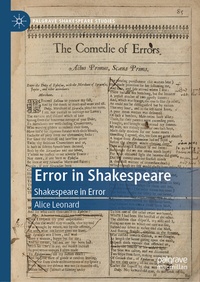
Error in Shakespeare
Description

The traditional view of Shakespeare's mastery of the English language is alive and well today. This is an effect of the eighteenth-century canonisation of his works, and subsequently Shakespeare has come to be perceived as the owner of the vernacular. These entrenched attitudes prevent us from seeing the actual substance of the text, and the various types of error that it contains and even constitute it. This book argues that we need to attend to error to interpret Shakespeare's disputed material text, political-dramatic interventions and famous literariness. The consequences of ignoring error are especially significant in the study of Shakespeare, as he mobilises the rebellious, marginal, and digressive potential of error in the creation of literary drama.
Reviews / Votes
"Alice Leonard's wide-ranging overview of error in Shakespeare and early modern literature is eminently readable, providing new insights . . As with all good studies, Error in Shakespeare: Shakespeare in Error opens the door to further research with its aim of challenging notions of correctness, of exposing gendered, cultural underpinnings of bias, as well as xenophobia's all too familiar role in depictions of error." (Stephanie Chamberlain, Renaissance Quarterly, Vol. 76 (2), 2023)"Leonard's conception of error is not figured as something incorrect and in need of deletion or revision; rather, to commit error can be read as taking a different path and ending up somewhere new. It is this fundamental opening up of possibilities, rather than shutting them down, which makes Leonard's work provocative, liberating, and even radical. . its uninhibited call to the field to consider different approaches results in a piece of scholarship that punches well above its weight as a first monograph." (Miranda Fay Thomas, Shakespeare Quarterly, October 18, 2021)
"This book . succeeds in showing that Shakespeare's early plas thrive on error to an unusual, or even an exceptional, degree." (Katie Mennis, TLS The Times Literary Supplement, the-tls-co.uk, April 2, 2021)
"Error in Shakespeare offers a provocative reading of key themes and images in the plays, offering teachers some places to wander as they encourage their students to see Shakespeare not as the master of the absolute, but as virtuoso of the variable." (Seth Lerer, Shakespeare, Vol. 16 (4), 2020)
More details
Other editions
Additional editions
Person
Dr Alice Leonard is a Marie-Curie Co-Fund Postdoctoral Fellow at the Institute of Advanced Study, University of Warwick (UK). She has published on the opportunities for digital humanities and textual criticism in revising Shakespeare; on the female audience and Hamlet ; and on European linguistic and cultural inclusion in early modern drama. She is Co-editor on the Notebooks volume of The Complete Works of Thomas Browne (OUP). Her new project investigates error in the seventeenth century history of science.
Content
Chapter 1. Introduction.- Chapter 2. Error and Figurative Language.- Chapter 3. Error and the Mother Tongue.- Chapter 4. Error and the Nation.- Chapter 5. Error and the Text.- Index.
