

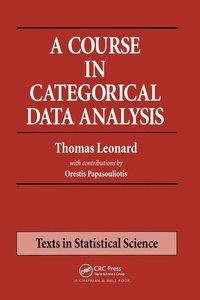
A Course in Categorical Data Analysis
1st Edition
Published on 26. August 2020
204 pages
978-1-000-15465-8 (ISBN)
Description

Categorical data-comprising counts of individuals, objects, or entities in different categories-emerge frequently from many areas of study, including medicine, sociology, geology, and education. They provide important statistical information that can lead to real-life conclusions and the discovery of fresh knowledge. Therefore, the ability to manipulate, understand, and interpret categorical data becomes of interest-if not essential-to professionals and students in a broad range of disciplines.
Although t-tests, linear regression, and analysis of variance are useful, valid methods for analysis of measurement data, categorical data requires a different methodology and techniques typically not encountered in introductory statistics courses. Developed from long experience in teaching categorical analysis to a multidisciplinary mix of undergraduate and graduate students, A Course in Categorical Data Analysis presents the easiest, most straightforward ways of extracting real-life conclusions from contingency tables. The author uses a Fisherian approach to categorical data analysis and incorporates numerous examples and real data sets. Although he offers S-PLUS routines through the Internet, readers do not need full knowledge of a statistical software package.
In this unique text, the author chooses methods and an approach that nurtures intuitive thinking. He trains his readers to focus not on finding a model that fits the data, but on using different models that may lead to meaningful conclusions. The book offers some simple, innovative techniques not highighted in other texts that help make the book accessible to a broad, interdisciplinary audience. A Course in Categorical Data Analysis enables readers to quickly use its offering of tools for drawing scientific, medical, or real-life conclusions from categorical data sets.
Although t-tests, linear regression, and analysis of variance are useful, valid methods for analysis of measurement data, categorical data requires a different methodology and techniques typically not encountered in introductory statistics courses. Developed from long experience in teaching categorical analysis to a multidisciplinary mix of undergraduate and graduate students, A Course in Categorical Data Analysis presents the easiest, most straightforward ways of extracting real-life conclusions from contingency tables. The author uses a Fisherian approach to categorical data analysis and incorporates numerous examples and real data sets. Although he offers S-PLUS routines through the Internet, readers do not need full knowledge of a statistical software package.
In this unique text, the author chooses methods and an approach that nurtures intuitive thinking. He trains his readers to focus not on finding a model that fits the data, but on using different models that may lead to meaningful conclusions. The book offers some simple, innovative techniques not highighted in other texts that help make the book accessible to a broad, interdisciplinary audience. A Course in Categorical Data Analysis enables readers to quickly use its offering of tools for drawing scientific, medical, or real-life conclusions from categorical data sets.
Reviews / Votes
"...presents an interesting and alternative view of categorical data analysis (CDA)...This book would be appropriate for upper undergraduates or master's level courses in statistics for non-majors who need an overview of CDA without going into great detail and theory...represents a fresh perspective on CDA. It is well worth a look, both by practitioners who use these methods in their research and by instructors who plan to teach courses on this subject ... The author has extensive teaching experience at the University of Wisconsin-Madison and at the University of Edinburgh, and the choice of topics in this book reflects that experience ... Each chapter is followed by useful exercises that should aid in developing an understanding of the presented material ... Its many biological and medical examples, some developed in detail, make it especially useful for students with interests in the health sciences."--C. B. Borkowf, National Cancer Institute, Bethesda, MD, in Biometrics, December 2000
"This book offers something different...what a wealth of detail and insight he develops! Copious numerical examples are discussed alongside the theory, and each of these are interpreted in the context of the study that generated the data...a welcome addition to the literature."
--J. M. Juritz, Short Book Reviews of the ISI, April 2000
"...a unique work in the implementation of techniques and methodologies needed...are not usually found in introductory statistics courses...Highly recommended for upper-division undergraduates and graduate students, faculty, and professionals."
--D. J. Gougeon, University of Scranton in CHOICE
"This book would be appropriate for upper undergraduate or master's level courses in statistics for non-majors who need an overview of CDA without going into great detail and theory. Its many biological and medical examples, some developed in detail, make it especially useful for students with interests in the health sciences."
C.B. Borkowf, National Cancer Institute, Bethesda, maryland, USA
"...the excellent discussion of Simpson's paradox, could be included in more general survey courses."
C.B. Borkowf, National Cancer Institue, Bethesda, Maryland, USA
"...this book represents a fresh perspective on CDA. It is well worth a look, both by practitioners who use these methods in their research and by instructors who plan to teach courses on this subject."
C.B. Borkowf, National Cancer Institute, Bethesda, Maryland, USA
"... this is a very useful little book that serves as an excellent introduction to S-PLUS commands..."
-Journal of the Royal Statistical Society
This ia a very useful handbook...accessible introduction and quick reference to S-PLUS."
-Short Book Reviews of the ISI
"...written in a clear and lucid style...an excellent candidate for a beginning level graduate textbook on statistical methods...a useful reference for practitioners."
-Zentralblatt fuer Mathematik
More details
Series
Edition
1. Auflage
Language
English
Place of publication
London
United Kingdom
Publishing group
Taylor & Francis Ltd
Target group
Professional and scholarly
Product notice
Reflowable
ISBN-13
978-1-000-15465-8 (9781000154658)
Copyright in bibliographic data and cover images is held by Nielsen Book Services Limited or by the publishers or by their respective licensors: all rights reserved.
Schweitzer Classification
Other editions
Additional editions
Thomas Leonard
A Course in Categorical Data Analysis
Book
09/2020
1st Edition
CRC Press
€267.41
Shipment within 10-20 days
Thomas Leonard
A Course in Categorical Data Analysis
Book
11/1999
1st Edition
Chapman & Hall/CRC
€74.46
Shipment within 15-20 days
Person
Leonard, Thomas
Content
Preface -- Special Software -- 1 Sampling Distributions -- 1.1 Experimental design for a population proportion -- 1.2 Further properties of the binomial distribution -- 1.3 Statistical procedures for the binomial distribution -- 1.4 The Poisson distribution -- 1.5 Statistical procedures for the Poisson distribution -- 1.6 The multinomial distribution -- 1.7 Sir Ronald Fisher's conditioning result -- 1.8 More general sampling models -- 1.9 Generalising the binomial distribution -- 1.10 The discrete exponential family of distributions -- 1.11 Generalising the multinomial distribution -- Exercises -- 2 Two-by-Two Contingency Tables -- 2.1 Conditional probability and independence -- 2.2 Independence of rows and columns -- 2.3 Investigating independence, given observational data -- 2.4 Edwards' theorem -- 2.5 Log-contrasts and the multinomial distribution -- 2.6 The log-measure-of-association test -- 2.7 The product binomial model -- 2.8 The independent Poisson model -- 2.9 Fisher's exact test -- 2.10 Power properties of our test procedures -- Exercises -- 3 Sim pson's Paradox and 23 Tables -- 3.1 Probability theory -- 3.2 The Cornish pixie /Irish leprechaun example -- 3.3 Interpretation of Simpson's paradox -- 3.4 The three-directional approach -- 3.5 Measure of association analysis for 23 tables -- 3.6 Medical example -- 3.7 Testing equality for two 2 x 2 tables -- 3.8 The three-directional approach to the analysis of 23 tables -- (summary) -- Exercises -- 4 The M adison Drug and Alcohol Abuse Study -- 4.1 Experimental design -- 4.2 Statistical results (phase 3) of study -- 4.3 Further validation of results -- Exercises -- 5 G oodm an's Full-Rank Interaction Analysis -- 5.1 Introductory example (no totals fixed) -- 5.2 Methodological developments (no totals fixed) -- 5.3 Numerical example (a four-corners model) -- 5.4 Methodological developments (overall total fixed) -- 5.5 Business school example (overall total fixed) -- 5.6 Methodological developments (row totals fixed) -- 5.7 Advertising example (row totals fixed) -- 5.8 Testing for equality of unconditional cell probabilities -- 5.9 Analysis of Berkeley admissions data -- 5.10 Further data sets -- Exercises -- 6 Further Exam ples and Extensions -- 6.1 Hypertension, obesity, and alcohol consumption -- 6.2 The Bristol cervical screening data -- 6.3 The multiple sclerosis data -- 6.4 The Dundee dental health data -- Exercises -- 7 C onditional Independence M odels for Two-Way Tables -- 7.1 Fixed zeroes and missing observations -- 7.2 Incomplete tables -- 7.3 Perfectly fitting further cells -- 7.4 Complete tables -- 7.5 Further data sets -- Exercises -- 8 Logistic Regression -- 8.1 Review of general methodology -- 8.2 Analysing your data using Splus -- 8.3 Analysis of the mice exposure data -- 8.4 Analysis of space shuttle failure data -- 8.5 Further data sets -- Exercises -- 9 Further Regression Models -- 9.1 Regression models for Poisson data -- 9.2 The California earthquake data -- 9.3 A generalisation of logistic regression -- 9.4 Logistic regression for matched case-control studies -- 9.5 Further data -- Exercises -- 10 Final Topics -- 10.1 Continuous random variables -- 10.2 Logistic discrimination analysis -- 10.3 Testing the slope and quadratic term -- 10.4 Extensions -- 10.5 Three-way contingency tables -- Exercises -- References -- Index.
