

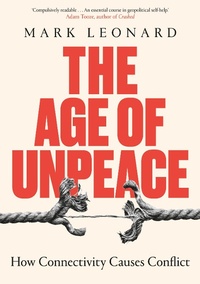
The Age of Unpeace
How Connectivity Causes Conflict
Published on 2. September 2021
256 pages
978-1-4735-9043-4 (ISBN)
Description

A FINANCIAL TIMES ECONOMICS BOOK OF THE YEAR
'Compulsively readable... An essential course in geopolitical self-help' - Adam Tooze
'Full of fresh - and often surprising - ideas' - Niall Ferguson
'Extraordinary... One of those rare books that defines the terms of our conversation about our times' - Michael Ignatieff
We thought connecting the world would bring lasting peace. Instead, it is driving us apart.
In the three decades since the end of the Cold War, global leaders have been working to create a connected world. They've integrated the world's economy, transport and communications, breaking down borders in the hope of making war impossible. In doing so, they unwittingly created a formidable arsenal of weapons for new kinds of warfare.
Troublingly, we are now seeing rising conflict at every level, from individuals on social media all the way up to full-blown war in eastern Europe. The past decade has seen a new antagonism between the US, Russia and China; an inability to co-operate on global issues such as climate change and pandemic response; and a breakdown in the distinction between war and peace, as the theatre of conflict expands to include sanctions, cyberwar and the pressures of large migrant flows.
A leading authority on international relations, Mark Leonard lays out the ways that globalization has broken its fundamental promise to make our world safer and more prosperous, and explores how we might wrest a more hopeful future from an age of unpeace.
'Compulsively readable... An essential course in geopolitical self-help' - Adam Tooze
'Full of fresh - and often surprising - ideas' - Niall Ferguson
'Extraordinary... One of those rare books that defines the terms of our conversation about our times' - Michael Ignatieff
We thought connecting the world would bring lasting peace. Instead, it is driving us apart.
In the three decades since the end of the Cold War, global leaders have been working to create a connected world. They've integrated the world's economy, transport and communications, breaking down borders in the hope of making war impossible. In doing so, they unwittingly created a formidable arsenal of weapons for new kinds of warfare.
Troublingly, we are now seeing rising conflict at every level, from individuals on social media all the way up to full-blown war in eastern Europe. The past decade has seen a new antagonism between the US, Russia and China; an inability to co-operate on global issues such as climate change and pandemic response; and a breakdown in the distinction between war and peace, as the theatre of conflict expands to include sanctions, cyberwar and the pressures of large migrant flows.
A leading authority on international relations, Mark Leonard lays out the ways that globalization has broken its fundamental promise to make our world safer and more prosperous, and explores how we might wrest a more hopeful future from an age of unpeace.
Reviews / Votes
The "age of unpeace" [is] an apt phrase for an era in which wars between states are uncommon but conflict is endemic... Leonard adroitly captures evolving trends in geopolitics over the past decade... Leonard's argument is all the more compelling because of the way his own beliefs have evolved. * New Statesman * Thought-provoking... If Leonard is right, then every trade deal or every new technology that brings people closer will also make the world a more dangerous place. * Irish Times * Leonard is a creative and well-connected thinker, and his timely, insightful book is useful for its explanations of the differing ideological viewpoints found in Beijing, Brussels and Washington, with an interesting section on Chinese thinkers in particular. Just as important, he explains why the conflicts in our global era remain so different from those in the cold war, in particular given the role being played by new technologies from quantum computing to machine learning as a new focus for geopolitical contestation. -- James Crabtree * Financial Times * Mark Leonard... has been a force in foreign policy thinking for a quarter century... rich in data and anecdote... If you're feeling intellectually disoriented after the fall of Kabul, start here. -- Matthew d'Ancona, <i>Tortoise</i> Compulsively readable, Mark Leonard's globe-trotting book not only offers us a fascinating and disturbing panorama, it redefines realism for an age of massive and toxic connectivity. Rather than fleeing into anachronistic visions of grand architecture and Cold War rhetoric, it demands that we face our actual problem. An essential course in geopolitical self-help. -- Adam Tooze, author of <i>Crashed: How a Decade of Financial Crises Changed the World</i> There was a time when we all naively thought that a networked world would be awesome. But, as Mark Leonard argues in The Age of Unpeace, 'The connections that knit the world together are also driving it apart. It is not that the Internet and globalization have led to a war of all against all; more that the distinction between war and peace has broken down. 'Connectivity conflicts' are the signature style of the new 'unpeace', an old Anglo-Saxon word that, as Leonard persuasively argues, nicely describes our new era of financial sanctions, trade wars, infowars and cyberwars. Leonard, once a true believer in the European project, is that rare thing: a public intellectual willing to question his own assumptions and come up with fresh - and often surprising - ideas. If you want to understand the geopolitical significance of Grindr, the gay hook-up app, or the historical consequences of Sun Yatsen's Hawaiian childhood, look no further. -- Niall Ferguson, author of <i>The Square and the Tower</i> and <i>DOOM: The Politics of Catastrophe</i> We now understand that we live and must live between the duelling utopias of unrestricted globalization and national sovereignty. The task is to make the best of our connections, and here Mark Leonard offers a creative and clarifying way forward. -- Timothy Snyder, author of <i>On Tyranny</i> One of Mark Leonard's great strengths is his sensitivity to the zeitgeist. This book is no exception. Rather than rejecting or ignoring the growing rebellion against connectivity, he accepts it and seeks to find ways of responding to it. The result is a highly readable book packed full of insights and ideas about what needs to be done. -- Martin Jacques, author of <i>When China Rules The World</i> Mark Leonard has done something extraordinary: written a powerful and persuasive analysis of our 'age of unpeace', in which the three 'empires of connectivity' that define our time-China, the US and Europe-are competing for hegemony by exploiting the very connectedness that ties our world together. This is one of those rare books that defines the terms of our conversation about our times. -- Michael Ignatieff, President and Rector, Central European UniversityMore details
Language
English
Place of publication
London
United Kingdom
Publishing group
Transworld Publishers Ltd
Target group
College/higher education
Professional and scholarly
File size
0,64 MB
ISBN-13
978-1-4735-9043-4 (9781473590434)
Copyright in bibliographic data and cover images is held by Nielsen Book Services Limited or by the publishers or by their respective licensors: all rights reserved.
Schweitzer Classification
Other editions
Additional editions
Book
06/2022
Penguin (Transworld)
€16.50
Available immediately
Person
Mark Leonard is the Director and Co-Founder of the European Council on Foreign Relations, a council of 300 European leaders including serving and former presidents, prime ministers, economics and foreign ministers, and the author of Why Europe Will Run the 21st Century (2005) and What Does China Think? (2008). He lives in London and Berlin.
