

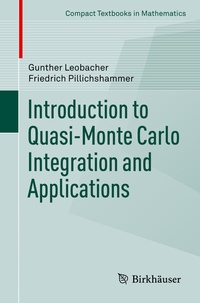
Introduction to Quasi-Monte Carlo Integration and Applications
Description

This textbook introduces readers to the basic concepts of quasi-Monte Carlo methods for numerical integration and to the theory behind them. The comprehensive treatment of the subject with detailed explanations comprises, for example, lattice rules, digital nets and sequences and discrepancy theory. It also presents methods currently used in research and discusses practical applications with an emphasis on finance-related problems. Each chapter closes with suggestions for further reading and with exercises which help students to arrive at a deeper understanding of the material presented.
The book is based on a one-semester, two-hour undergraduate course and is well-suited for readers with a basic grasp of algebra, calculus, linear algebra and basic probability theory. It provides an accessible introduction for undergraduate students in mathematics or computer science.
Reviews / Votes
"The book under review is based on a one-semester undergraduate course and suited for readers with a basic knowledge in linear algebra, finite fields, calculus and elementary probability theory. The authors give a concise and well-written introduction to multivariate integration by Quasi-Monte Carlo (QMC) techniques and applications to mathematical finance. . Every chapter contains interesting exercise problems and useful hints for further reading of related literature." (Robert F. Tichy, Mathematical Reviews, June, 2015)
More details
Other editions
New editions
Additional editions
Persons
Gunther Leobacher is assistant professor at the Institute of Financial Mathematics at the Johannes Kepler University Linz.
Friedrich Pillichshammer is associate professor at the Institute of Financial Mathematics at the Johannes Kepler University Linz.
