

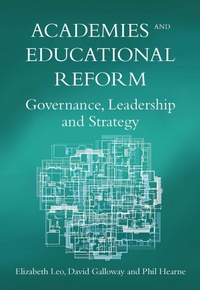
Academies and Educational Reform
Governance, Leadership and Strategy
Published on 20. October 2010
240 pages
978-1-84769-487-4 (ISBN)
Description

Behind the headlines and controversy surrounding new academy schools, many of their principals, teachers and pupils have been quietly changing the culture of learning and achievement in some of the most disadvantaged communities in England. While successful innovation and change is not unique to academies, this book illustrates how the academy policy represents a significant opportunity to improve the life chances of their pupils. Too much attention has focused on unanswerable questions about whether academies are better or worse than their predecessor or comparable schools in their neighbourhood. Too little focus has been on what policy makers and practitioners can learn from the different, and often conflicting, perspectives of the key players, notably sponsors, architects, principals, parents and pupils in order to create a school that can truly serve their community with distinction.
Reviews / Votes
The development of Academies is a high profile initiative which has given rise to a large number of publications. However, as the analysis in this book illustrates, many of these consist either of polemic or of attempts at evaluation with limited sophistication or success. By asking the question 'what can be learned from the Academies programme?' this book provides a different perspective. The range of interviews with key informants provides concrete original data around which the discussion and analysis are skilfully woven. -- Mike Fleming, University of Durham, UK Not only do the authors draw upon interviews with a wide range of practitioners working in Academies, but they also give the reader access to the thinking of leading strategists in the development of their philosophy, most notably Lord Adonis. This in its own right recommends the book as a text of critical importance. More than this, however, the authors undertake a painstaking but always riveting analysis of the successes and failures of this central strategy in New Labour educational policy. -- Derrick Armstrong, University of Sydney, AustraliaMore details
Language
English
Place of publication
Bristol
United Kingdom
Publishing group
Channel View Publications Ltd
Target group
Professional and scholarly
Product notice
Reflowable
ISBN-13
978-1-84769-487-4 (9781847694874)
Copyright in bibliographic data and cover images is held by Nielsen Book Services Limited or by the publishers or by their respective licensors: all rights reserved.
Schweitzer Classification
Other editions
Additional editions
Elizabeth Leo | David Galloway | Phil Hearne
Academies and Educational Reform
Governance, Leadership and Strategy
Book
10/2010
Multilingual Matters
€42.10
Shipment within 10-20 days
Persons
Elizabeth Leo has held senior leadership and management posts in universities and schools in the UK. She has led research and development with academies, maintained schools and local education authorities to promote strategic leadership that transforms teacher and student motivation, learning and achievement. Her research and publications focus on improving academies and schools in high poverty, highly disadvantaged communities from a cognitive-motivational perspective.
David Galloway has published research on school and teacher influences on bullying in schools, extending his previous work on school influences on students' behaviour, and on provision for special educational needs. He also has a research interest in motivation. He has (co)authored or edited 15 books and about 100 articles.
Phil Hearne is one of the most successful academy principals in England having led two academies in London. He is currently executive director of the country's largest and most complex all-age Academy in the North East. He has contributed to national and international conferences on leadership and, more recently, is focusing his research on rethinking the nature of organisational change and development of academies.
David Galloway has published research on school and teacher influences on bullying in schools, extending his previous work on school influences on students' behaviour, and on provision for special educational needs. He also has a research interest in motivation. He has (co)authored or edited 15 books and about 100 articles.
Phil Hearne is one of the most successful academy principals in England having led two academies in London. He is currently executive director of the country's largest and most complex all-age Academy in the North East. He has contributed to national and international conferences on leadership and, more recently, is focusing his research on rethinking the nature of organisational change and development of academies.
Content
Part 1. Background
Chapter 1. Why Academies?
Chapter 2. Socially Divisive Gimmick or Political and Moral Imperative?
Chapter 3. Opposition: Dogma or Legitimate Concern?
Part 2. Innovation, Governance, Leadership, Teaching and Learning
Chapter 4. 'It's really down to the sponsor.'
Chapter 5. Schools for the Future: Trophy Buildings or Learning Environments?
Chapter 6. Distinctive Features of Academies: 1. Independence, Accountability, Pressure
Chapter 7. Distinctive Features of Academies: 2. Innovation
Part 3. Futures
Chapter 8. A Coherent Policy?
Chapter 9. Designed to Deliver?
Chapter 10. The Future of Academies: Consolidating the Beachhead?
Chapter 1. Why Academies?
Chapter 2. Socially Divisive Gimmick or Political and Moral Imperative?
Chapter 3. Opposition: Dogma or Legitimate Concern?
Part 2. Innovation, Governance, Leadership, Teaching and Learning
Chapter 4. 'It's really down to the sponsor.'
Chapter 5. Schools for the Future: Trophy Buildings or Learning Environments?
Chapter 6. Distinctive Features of Academies: 1. Independence, Accountability, Pressure
Chapter 7. Distinctive Features of Academies: 2. Innovation
Part 3. Futures
Chapter 8. A Coherent Policy?
Chapter 9. Designed to Deliver?
Chapter 10. The Future of Academies: Consolidating the Beachhead?
