

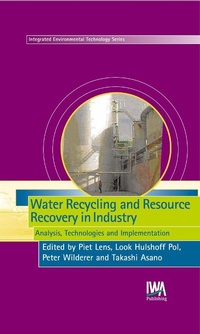
Water Recycling and Resource Recovery in Industry
Analysis, Technologies and Implementation
Published on 31. March 2002
703 pages
978-1-78040-280-2 (ISBN)
Description

Water Recycling and Resource Recovery in Industry: Analysis, Technologies and Implementation provides a definitive and in-depth discussion of the current state-of-the-art tools and technologies enabling the industrial recycling and reuse of water and other resources. The book also presents in detail how these technologies can be implemented in order to maximize resource recycling in industrial practice, and to integrate water and resource recycling in ongoing industrial production processes. Special attention is given to non-process engineering aspects such as systems analysis, software tools, health, regulations, life-cycle analysis, economic impact and public participation. Case studies illustrate the huge potential of environmental technology to optimise resource utilisation in industry. The large number of figures, tables and case studies, together with the book's multidisciplinary approach, makes Water Recycling and Resource Recovery in Industry: Analysis, Technologies and Implementation the perfect reference work for academics, professionals and consultants dealing with industrial water resources recovery. Contents Part I: Industrial reuse for environmental protection Part II: System analysis to assist in closing industrial resource cycles Part III: Characterisation of process water quality Part IV: Technological aspects of closing industrial cycles Part V: Examples of closed water cycles in industrial processes Part VI: Resource protection policies in industry
More details
Series
Language
English
Place of publication
London
United Kingdom
Target group
College/higher education
Professional and scholarly
File size
6,79 MB
ISBN-13
978-1-78040-280-2 (9781780402802)
Copyright in bibliographic data and cover images is held by Nielsen Book Services Limited or by the publishers or by their respective licensors: all rights reserved.
Schweitzer Classification
Other editions
Additional editions
Piet Lens | L. W. Hulshoff Pol | Peter A. Wilderer
Water Recycling and Resource Recovery in Industry
Book
03/2002
IWA Publishing
€218.75
Article exhausted; check different version
Content
- Cover
- Copyright
- Contents
- List of contributors
- Preface
- Part I: Industrial reuse for environmental protection
- 1. Sustainable water management in industry
- 1.1 The sustainability concept
- 1.2 Water resources
- 1.3 Sustainable water use in industry
- 1.4 Sustainable industrial water management
- 1.5 Conclusions
- 1.6 References
- 2. Water reclamation, recycling and reuse in industry
- 2.1 Introduction
- 2.2 Water reuse definitions
- 2.3 Industrial water reuse
- 2.4 Wastewater treatment technology
- 2.5 Industrial use of reclaimed municipal wastewater for cooling tower make-up water
- 2.6 Industrial use of reclaimed municipal wastewater for industrial process water
- 2.7 Summary and conclusions
- 2.8 References
- 3. Environmental protection in industry for sustainable development
- 3.1 Introduction
- 3.2 Integrated concepts for sustainable industrial technology
- 3.3 Anaerobic technology in clean technology
- 3.4 Risk assessment and public acceptance
- 3.5 References
- Part II: Resource protection policies in industry
- 4. Cleaner production: history, concepts, policies and instruments, incentives and practical examples
- 4.1 Introduction
- 4.2 Explanation of methods and measures to achieve sustainable development
- 4.3 Comparison of Instruments in 70s and 80s with those for the 21st century
- 4.4 Process of change towards sustainable development
- 4.5 "Rules of the game" for successful collaboration
- 4.6 Closing remarks
- 4.7 References
- 5. National policies for efficient resource utilization and protection
- 5.1 Introduction
- 5.2 Rationale for reducing resource use intensity in industry
- 5.3 Command and control instruments
- 5.4 Economic instruments
- 5.5 Other instruments
- 5.6 Evaluation of national policies for resource conservation
- 5.7 Supporting measures to adopt input oriented policies
- 5.8 References
- 6. Strategies for the environmental management of chains
- 6.1 Introduction
- 6.2 Supply chain management
- 6.3 Life cycle assessment
- 6.4 Environmental care strategies and types of LCA
- 6.5 Requirements to types of LCA implementation
- 6.6 Supply chain structures and requirements
- 6.7 Case studies
- 6.8 Prospect for chain management in closing industrial cycles
- 6.9 References
- 7. Ecological modernization of industrial ecosystems
- 7.1 Introduction
- 7.2 Industrial ecology as a concept of industrial transformation
- 7.3 Agents and institutions in industrial transformation
- 7.4 Eco-industrial park configurations
- 7.5 Conclusions and outlook
- 7.6 References
- Part III: Tools to assist on in closing industrial water and resource cycles - A. Regulatory measures
- 8. International guidelines for water recycling
- 8.1 Introduction
- 8.2 Health and environmental protection
- 8.3 Examples of water recycling regulations and guidelines
- 8.4 Developing an international framework with national decision making
- 8.5 Discussion
- 8.6 Conclusions
- 8.7 References
- 9. Eco management and audit scheme a step forward towards sustainability
- 9.1 Introduction
- 9.2 Objectives of EMAS
- 9.3 EMAS and EPER (European pollutant emissions register)
- 9.4 EMAS: A stepwise approach
- 9.5 Auditing
- 9.6 Conclusions
- 9.7 References
- 10. Best available techniques (BAT) for the reuse of waste oil
- 10.1 Best Available Techniques (BAT)
- 10.2 Treatment of waste oil in Flanders
- 10.3 Description of the treatment and pre-treatment systems
- 10.4 Technical, economic and environmental evaluation of the systems
- 10.5 References
- Part III: Tools to assist on in closing industrial water and resource cycles - B. System analysis
- 11. Water pinch analysis: minimisation of water and wastewater in the process industry
- 11.1 Introduction
- 11.2 Theoretical framework
- 11.3 Case study of a water pinch application
- 11.4 Water pinch: practical implementation
- 11.5 References
- 12. Key parameter methodology for increased water recovery in the pulp and paper industry
- 12.1 Water loops in papermaking systems
- 12.2 Definition of key characteristics
- 12.3 Verification of the definitions
- 12.4 Application of the K-parameters
- 12.5 Conclusions and Outlook
- 12.6 References
- 13. Systematic approach to water resource management in industry
- 13.1 Introduction
- 13.2 Challenges of water reuse
- 13.3 Systematic approach to water resource management
- 13.4 Case study - Paper industry
- 13.5 Conclusions
- 13.6 References
- 14. A customised software tool for environmental impact assessment of drinking water production and distribution
- 14.1 Introduction
- 14.2 LCA
- 14.3 LCAqua
- 14.4 References
- 15. Quantifying the sustainability of technology by exergy analysis
- 15.1 Introduction: sustainability and technology
- 15.2 Exergy
- 15.3 Exergy and sustainability: principles
- 15.4 Exergy and sustainability: applications
- 15.5 Further perspectives
- 15.6 References
- Part III: Tools to assist on in closing industrial water and resource cycles - C. Characterisation of process water quality
- 16. Analytical techniques for measurement of physico-chemical properties
- 16.1 Introduction
- 16.2 Basis of analytical data
- 16.3 Spectrometry
- 16.4 Chromatography
- 16.5 Electroanalytical methods
- 16.6 Special methods for water analysis
- 16.7 On-line monitoring
- 16.8 References
- 17. Use of modelling to prevent food contamination in production chains
- 17.1 Introduction
- 17.2 Predictive models
- 17.3 Application in the food industry
- 17.4 Conclusions and opportunities
- 17.5 References
- Part IV: Technological aspects of closing industrial cycles - A. Potentials of environmental biotechnology
- 18. Potentials of biotechnology in water and resource cycle management
- 18.1 Introduction
- 18.2 Role of water reuse in closing the water cycle
- 18.3 Technical advance and challenges for water reuse
- 18.4 Innovative biotechnologies for closing water cycle
- 18.5 Design of innovative bioreactors for industrial wastewater treatment
- 18.6 Conclusions
- 18.7 References
- 19. Novel biological processes for advanced wastewater treatment
- 19.1 Introduction
- 19.2 Novel bioconversion processes of nitrogenous compounds
- 19.3 Novel bioconversion processes of phosphorus compounds
- 19.4 Novel bioconversion processes of sulfurous compounds
- 19.5 References
- 20. Biodegradation of recalcitrant and xenobiotic compounds
- 20.1 Introduction
- 20.2 Microbiology of anaerobic biodegradation
- 20.3 Anaerobic bioreactor technology
- 20.4 Novel developments
- 20.5 References
- Part IV: Technological aspects of closing industrial cycles - B. Advanced technologies for meeting reuse criteria
- 21. Physico-chemical wastewater treatment
- 21.1 Introduction
- 21.2 Physico-chemical unit operations
- 21.3 Unit operations aimed at particle removal
- 21.4 Unit operations aimed at removal of dissolved contaminants
- 21.5 References
- 22. Advanced oxidation technologies for industrial water reuse
- 22.1 Introduction
- 22.2 Ozone, Hydrogen peroxide
- 22.3 Photooxidation
- 22.4 Fenton's reaction, Photo Fenton process
- 22.5 Photocatalysis
- 22.6 Electron Beam Irradiation
- 22.7 Sonolysis
- 22.8 Combination of biological and chemical Processes
- 22.9 Conclusions
- 22.10 References
- 23. Industrial experience of water reuse by membrane technology
- 23.1 Introduction
- 23.2 Membranes
- 23.3 Membrane processes
- 23.4 Case studies
- 23.5 References
- Part IV: Technological aspects of closing industrial cycles - C. Resource recovery and management
- 24. Technologies for nitrogen recovery and reuse
- 24.1 Introduction
- 24.2 Wastewater
- 24.3 Urine source separation
- 24.4 Conclusions
- 24.5 References
- 25. Phosphorus recycling potentials
- 25.1 Introduction
- 25.2 History of phosphorus
- 25.3 Phosphorus life cycle
- 25.4 Closing the phosphorus cycle
- 25.5 Phosphate recycling case studies
- 25.6 Economic assessment
- 25.7 Further outlook
- 25.8 Conclusions
- 25.9 References
- 26. Material and nutrient recycling and energy recovery from solid waste: a systems perspective
- 26.1 Introduction
- 26.2 The ORWARE model
- 26.3 System boundaries in this study
- 26.4 Description of the scenarios
- 26.5 System analysis
- 26.6 Conclusions
- 26.7 References
- Part V: Examples of closed water cycles in industrial processes
- 27. Water minimisation and reuse in the textile industry
- 27.1 Textile and clothing industry
- 27.2 Characteristics of textile water and wastewater
- 27.3 Textile wastewater minimisation, treatment and reuse
- 27.4 Case studies
- 27.5 References
- 28. Novel process on thermophilic conditions opens up new opportunities of integrated white water treatment in recycling mills - Kidney technology-concept
- 28.1 Introduction
- 28.2 State of the art
- 28.3 Results and discussion
- 28.4 Conclusions
- 28.5 Acknowledgements
- 28.6 References
- 29. Biological recovery of metals, sulfur and water in the mining and metallurgical industry
- 29.1 Introduction
- 29.2 Sulfate-reducing bacteria
- 29.3 Biological sulfate reduction technology for metal removal
- 29.4 Applications in the mining and metallurgical industries
- 29.5 Acknowledgements
- 29.6 References
- 30. Solar photocatalysis: application to the treatment of pesticides in water
- 30.1 Introduction
- 30.2 Solar photocatalysis fundamentals
- 30.3 Experimental systems: technology issues
- 30.4 Photocatalytic treatment of pesticides
- 30.5 Case study: recycling of pesticide bottles
- 30.6 Conclusions
- 30.7 References
- 31. Water reuse in greenhouse horticulture
- 31.1 Introduction
- 31.2 Water availability
- 31.3 Greenhouse horticulture
- 31.4 Soil-less growing systems
- 31.5 Disinfection of the nutrient solution
- 31.6 Conclusions
- 31.7 References
- 32. The industrial symbiosis in kalundborg, Denmark - industrial networking and cleaner industrial production
- 32.1 The Symbiosis at Kalundborg
- 32.2 Facts
- 32.3 Reflections
- 32.4 Lessons learned
- 32.5 References
- Index
