

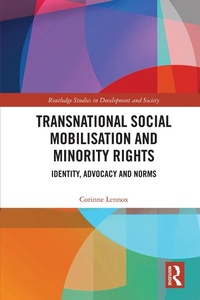
Transnational Social Mobilisation and Minority Rights
Identity, Advocacy and Norms
1st Edition
Published on 5. December 2019
284 pages
978-0-429-67835-6 (ISBN)
Description

This book explores the ways in which minority groups across the world are reshaping the international minority rights protection system. It documents the actions of four major groups that are using transnational social mobilisation to achieve recognition of their identities and their rights. The result is a greater pluralism in global identity politics and a wide range of new group-specific standards that can inform policies on multiculturalism, political participation, and socio-economic inclusion in the national and international spheres.
The book begins by summarising the learning from the global movements of indigenous peoples and Roma. The book then focuses in greater depth on the cases of Afro-descendants in Latin America and of Dalits and caste-affected groups in South Asia and beyond. Each case study shows the historical roots of group-specific transnational mobilisation and how activists have constructed a distinct identity frame out of shared experiences. The book explores key parallels and differences between the discourse, framing strategies, organisational structures and political opportunities used in each case to show which factors have influenced the success or failures of their norm entrepreneurship. The role that international institutions have played in supporting these efforts is given special attention, including intergovernmental bodies such as the UN, the EU and the OAS, and international non-governmental organisations. The UN World Conference Against Racism is explored as a particularly significant political opportunity across the cases.
Among academic audiences, this book will appeal to those researching minority rights, social movements, global governance, discrimination and multiculturalism from legal, political, sociological and critical theory perspectives. It will also interest practitioners and activists working on minority rights and the challenges of norm compliance, socio-economic inclusion and governance.
The book begins by summarising the learning from the global movements of indigenous peoples and Roma. The book then focuses in greater depth on the cases of Afro-descendants in Latin America and of Dalits and caste-affected groups in South Asia and beyond. Each case study shows the historical roots of group-specific transnational mobilisation and how activists have constructed a distinct identity frame out of shared experiences. The book explores key parallels and differences between the discourse, framing strategies, organisational structures and political opportunities used in each case to show which factors have influenced the success or failures of their norm entrepreneurship. The role that international institutions have played in supporting these efforts is given special attention, including intergovernmental bodies such as the UN, the EU and the OAS, and international non-governmental organisations. The UN World Conference Against Racism is explored as a particularly significant political opportunity across the cases.
Among academic audiences, this book will appeal to those researching minority rights, social movements, global governance, discrimination and multiculturalism from legal, political, sociological and critical theory perspectives. It will also interest practitioners and activists working on minority rights and the challenges of norm compliance, socio-economic inclusion and governance.
Reviews / Votes
"Corinne Lennox's ground-breaking study of transnational norm entrepreneurship by marginalized groups offers an instructive contrast to State-centred understandings of norm development and acceptance. In examining models of possibility in place of stasis, the rich analysis of the dynamics of minority achievement undermines standard narratives of community powerlessness and State hegemony." - Patrick Thornberry, Emeritus Professor of International Law, Keele University, UK"Corinne Lennox makes a powerful and original contribution to minority rights theory. Drawing on her unique experience and research, and her sophisticated political science approach, especially norm entrepreneurship theory, she throws new light on the struggles and achievements, and their right to self-determination, of the Roma, the Dalits, and Afro-descendants from 2001 to the present." - Professor Bill Bowring FAcSS, Barrister, Director of the LLM/MA in Human Rights, Director of Mooting, School of Law, Birkbeck College, University of London, UK
"Lennox's extensive research history within the global development network, working with the UNDP and NGOs and more recently criticizing activist scholarship, makes for analysis that acknowledges both the gains and limitations of human-rights discourse. Lennox provides a detailed resource for those interested in minority rights in general, those interested in cases such as the ones concerning Dalits in South Asia and descendants of Africans in Latin America, and those studying norm entrepreneurship. Advanced students and scholars of political science and human rights will benefit from the lucid case studies and the solid theoretical grounding of this work." - H. L. Katz, Southwestern Oklahoma State University, USA
More details
Series
Edition
1. Auflage
Language
English
Place of publication
London
United Kingdom
Publishing group
Taylor & Francis Ltd
Target group
College/higher education
Illustrations
1 Tables, black and white; 1 Line drawings, black and white; 1 Illustrations, black and white
ISBN-13
978-0-429-67835-6 (9780429678356)
Copyright in bibliographic data and cover images is held by Nielsen Book Services Limited or by the publishers or by their respective licensors: all rights reserved.
Schweitzer Classification
Other editions
Additional editions
Book
08/2021
1st Edition
Routledge
€65.60
Shipment within 10-20 days
Book
12/2019
1st Edition
Routledge
€206.70
Shipment within 15-20 days
Person
Corinne Lennox is Senior Lecturer in Human Rights at the Institute of Commonwealth Studies, and Co-Director of the Human Rights Consortium, both at the School of Advanced Study, University of London, UK.
Content
Preface 1. Introduction: Minorities, States and Norm Entrepreneurship in International Society 2. Indigenous Peoples and Roma as Norm Entrepreneurs 3. Dalits and Norm Entrepreneurship on Caste-Based Discrimination 4. Afro-descendants and Norm Entrepreneurship in Latin America 5. Conclusion: Assessing Group-Specific Norm Entrepreneurship
