

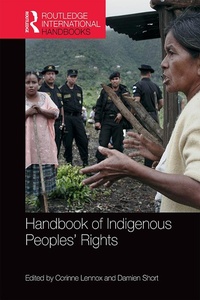
Handbook of Indigenous Peoples' Rights
1st Edition
Published on 5. February 2016
486 pages
978-1-136-31386-8 (ISBN)
Description

This handbook will be a comprehensive interdisciplinary overview of indigenous peoples' rights. Chapters by experts in the field will examine legal, philosophical, sociological and political issues, addressing a wide range of themes at the heart of debates on the rights of indigenous peoples. The book will address not only the major questions, such as 'who are indigenous peoples? What is distinctive about their rights? How are their rights constructed and protected? What is the relationship between national indigenous rights regimes and international norms? but also themes such as culture, identity, genocide, globalization and development, rights institutionalization and the environment.
Reviews / Votes
"In 2007, the United Nations General Assembly adopted the UN Declaration on Rights of Indigenous Peoples (UNDRIP). Though not legally binding, the declaration provides the basis for the existing and emerging human rights claims associated with indigenous peoples. This large handbook includes an introductory overview of the field of indigenous rights and is followed by 27 chapters focusing on a variety of issues related to the topic. These include the philosophical basis of indigenous rights, governance, the rights of women, development, the environment, political mobilization, and reparations. The last four chapters address specific case studies on advancing and protecting indigenous rights. Though many of the scholars and activists contributing to this handbook acknowledge the contested nature of these rights, the writers are generally sympathetic to the political, economic, social, and cultural claims of indigenous peoples. Given the new and emerging nature of this type of group rights, this comprehensive handbook provides an excellent introduction to the subject. This handbook is recommended for international organization scholars, human rights specialists, international relations students, and general readers.Summing Up: Recommended. General readers through professionals."
M. Amstutz, Wheaton College - CHOICE
More details
Series
Edition
1. Auflage
Language
English
Place of publication
London
United Kingdom
Publishing group
Taylor & Francis Ltd
Target group
College/higher education
File size
3,41 MB
ISBN-13
978-1-136-31386-8 (9781136313868)
Copyright in bibliographic data and cover images is held by Nielsen Book Services Limited or by the publishers or by their respective licensors: all rights reserved.
Schweitzer Classification
Other editions
Additional editions
Corinne Lennox | Damien Short
Handbook of Indigenous Peoples' Rights
Book
09/2018
1st Edition
Europa Publications Ltd
€78.17
Shipment within 3-4 weeks
Corinne Lennox | Damien Short
Handbook of Indigenous Peoples' Rights
Book
02/2016
1st Edition
Europa Publications Ltd
€430.82
Shipment within 3-4 weeks
Persons
Corinne Lennox is Senior Lecturer in Human Rights at the Institute of Commonwealth Studies and Associate Director of the Human Rights Consortium, School of Advanced Study, University of London. She holds a PhD in International Relations from the London School of Economics and an MA in the Theory and Practice of Human Rights from the University of Essex. Corinne Lennox has worked as a human rights practitioner with various NGOs, including at Minority Rights Group International, and has been an adviser on minority and indigenous rights to governments and United Nations agencies.
Damien Short is Director of the Human Rights Consortium at the School of Advanced Study, University of London and a Reader in Human Rights. He has spent much of his career researching and writing on indigenous peoples' rights and reconciliation debates issues in Australia, including Reconciliation and Colonial Power: Indigenous Rights in Australia (2008). Damien Short is a frequent contributor to the United Nations Expert Mechanism on the Rights of Indigenous Peoples and is the Editor-in-Chief of The International Journal of Human Rights.
Damien Short is Director of the Human Rights Consortium at the School of Advanced Study, University of London and a Reader in Human Rights. He has spent much of his career researching and writing on indigenous peoples' rights and reconciliation debates issues in Australia, including Reconciliation and Colonial Power: Indigenous Rights in Australia (2008). Damien Short is a frequent contributor to the United Nations Expert Mechanism on the Rights of Indigenous Peoples and is the Editor-in-Chief of The International Journal of Human Rights.
Content
Chapter 1 Introduction, Corinne Lennox, Damien Short; Part I Indigeneity; Chapter 2 Philosophical justifications for Indigenous rights, Paul Patton; Chapter 3 Beyond Black and White, Yin Paradies; Chapter 4 Indigenous membership and human rights, Kirsty Gover; Part II Right and governance; Chapter 5 The United Nations Declaration on the Rights of Indigenous Peoples, Marco Odello; Chapter 6 Development projects and indigenous peoples' land, Mauro Barelli; Chapter 7 Exploring indigenous self-government and forms of autonomy, Alexandra Tomaselli; Chapter 8 Reparations for indigenous peoples in Canada, New Zealand and Australia, Andrew Erueti; Chapter 9 The long reach of frontier justice, Elizabeth Cassell, Colin Samson; Part III Indigeneity; Chapter 10 Indigenous women's rights and international law, Rauna Kuokkanen; Chapter 11 Human rights and Indigenous feminisms, Cheryl Suzack; Part IV Development and the environment; Chapter 12 Living well with the Earth, Deborah McGregor; Chapter 13 Mother Earth, Indigenous peoples and neo-liberal climate change governance, Paul Havemann; Chapter 14 Indigenous peoples and the corporate responsibility to respect human rights, Corinne Lewis; Chapter 15 The fetish mechanism, Alonso Barros; Chapter 16 Evolution of indigenous peoples' rights and indigenous knowledge debate, Rebecca C. Fan; Part V Mobilization for indigenous peoples' rights; Chapter 17 Indigenous mobilization and activism in the UN system, Sheryl R. Lightfoot; Chapter 18 Indigenous mobilization and activism, Maria Sapignoli; Part VI Justice and reparations; Chapter 19 Beyond lawful obligation, Jane Dickson; Chapter 20 Reconciliation, reparations and rights, Andrew Gunstone; Part VII International monitoring and mechanisms for indigenous peoples' rights; Chapter 21 From outsiders to centre stage, Julian Burger; Chapter 22 The United Nations Special Rapporteur on the Rights of Indigenous Peoples, Rodolfo Stavenhagen; Chapter 23 Indigenous and tribal peoples' culture and work under the ILO, Lee Swepston; Chapter 24 From theory to practice, Cynthia Morel; Part VIII Regional case studies; Chapter 25 International human rights standards and indigenous peoples' land and human rights in Asia, Raja Devasish Roy; Chapter 26 The struggle for protection of indigenous peoples' rights in Africa, George Mukundi Wachira, Tuuli Karjala; Chapter 27 Indigenous peoples' rights and the law in Latin America, Rachel Sieder; Chapter 28 Indigenous self-determination in the Nordic countries, Peter Johansson;
