

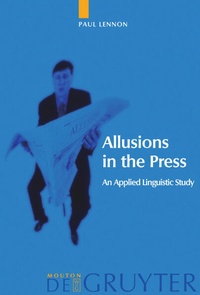
Allusions in the Press
An Applied Linguistic Study
1st Edition
Published on 22. August 2008
XIV, 297 pages
978-3-11-019733-4 (ISBN)
Description

This corpus-based study of allusions in the British press shows the range of targets journalists allude to - from Shakespeare to TV soaps, from Jane Austen to Hillary Clinton, from hymns to nursery rhymes, proverbs and riddles. It analyzes the linguistic forms allusions take and demonstrates how allusions function meaningfully in discourse. It explores the nature of the background cultural and intertextual knowledge allusions demand of readers and sets out the processing stages involved in understanding an allusion. Allusion is integrated into existing theories of indirect language and linked to idioms, word-play and metaphor.
More details
Language
English
Place of publication
Berlin/Boston
Germany
Publishing group
de Gruyter Mouton
Target group
Professional and scholarly
US School Grade: College Graduate Student
Illustrations
36 s/w Tabellen
36 b/w tbl.
File size
0,89 MB
ISBN-13
978-3-11-019733-4 (9783110197334)
Schweitzer Classification
Other editions
Additional editions
Book
03/2004
1st Edition
De Gruyter Mouton
€250.00
Shipment within 7-9 days
Book
01/2004
1st Edition
De Gruyter Mouton
€239.00
Article exhausted; check different version
Person
Paul Lennon teaches at the University of Bielefeld, Germany.
Content
Introduction
Theories of indirect language comprehension
Previous work on allusion
A newspaper corpus of allusions: Initial analysis (of quotations, titles, proverbs, formulaic text, names and naming phrases, set phrases)
The alluding and target units
The comprehension of allusions
The functions of allusion
Conclusion
Appendix: The national dailies: Social class and age of readers, average daily sales 1995
Notes
List of primary texts
References
Theories of indirect language comprehension
Previous work on allusion
A newspaper corpus of allusions: Initial analysis (of quotations, titles, proverbs, formulaic text, names and naming phrases, set phrases)
The alluding and target units
The comprehension of allusions
The functions of allusion
Conclusion
Appendix: The national dailies: Social class and age of readers, average daily sales 1995
Notes
List of primary texts
References
