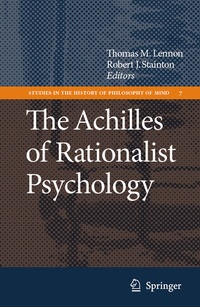
The Achilles of Rationalist Psychology
Description

In his Second Paralogism of the Critique of Pure Reason, Kant described what he called the "Achilles of all dialectical inferences in the pure doctrine of the soul". This argument, which he took to be powerful yet fatally flawed, purports to establish the simplicity of the human mind, or soul, on the basis of the unity of consciousness. In Kant's illustration, the unity had by our perception of a verse cannot be accounted for if the words of the verse are distributed among parts thought to compose the mind. The argument, or at least the unity of consciousness that underpins it, has a history extending from Plato to the present. Moreover, many philosophers have extended the argument, some of them using to argue such views as immortality.
It is the aim of this volume to treat the major figures who have advanced the argument, or who have held views importantly bearing on it. Original essays by scholars with expertise on the relevant authors treat Plato, Aristotle, the Neoplatonists, the medievals, Descartes, Locke, Cudworth, Bayle, Clarke, Spinoza, Leibniz. Hume, Mendelsohn, Kant, Lotze, James, as well as those working in contemporary cognitive science on what is called the binding problem of how the human brain can unify the elements of experience into a single representation.
More details
Other editions
Additional editions