

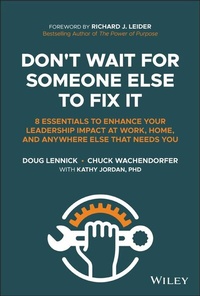
Don't Wait for Someone Else to Fix It
Description

The world needs positive leadership more than ever. Luckily, there is a large untapped source of leaders who can change the world for the better: all of us! Since each of us constantly influences those around us, by definition, everyone is a leader, not just people with formal titles.
This book will help everyone tap into the power of their influence to pursue a meaningful purpose, whether on the job, in the community, or at home. All it takes is leadership intelligence, a combination of 8 moral, social, and technical imperatives essential to our ability to positively influence others. These 8 essentials include:
* Aim to be Your Ideal Self
* Know Your Real Self
* Ignite Integrity and Responsibility
* Embrace Empathy and Compassion
* Decide Wisely
* Let Go of What You Know
* Achieve Meaningful Goals
* Empower Others
Don't Wait for Someone Else to Fix It is liberally illustrated with compelling stories of a varied cast of characters, including the head of a skiing expedition to the North Pole, an Olympic snowboarding coach, a mountaineer leading a high-altitude Himalayan climbing team, the executive director of an innovative low-income senior housing community, and the founder of a pioneering youth basketball program for girls. Examples of "fixing it" also come from the journeys of entrepreneurs and executives in the financial services, health care, educational, travel and media industries. In addition, the book highlights insights of thought leaders such as internationally famous author and coach, Richard Leider; Stephen M. R Covey, a best-selling author and global authority on leadership; world-renowned performance psychologist and author Jim Loehr; and Richard Sheridan, best-selling author, and co-founder of the award-winning software company Menlo Innovations.
Authors Doug Lennick and Chuck Wachendorfer are highly qualified to share the lessons of Don't Wait for Someone Else to Fix It. Both have decades of experience as corporate executives, entrepreneurs, community volunteers, business coaches, and parents. For the reader who wants down-to-earth guidance about how to be a successful leader, the book does more than just talk about the significance of leadership intelligence. It features a wealth of practical exercises and tools for developing each of the 8 leadership intelligence essentials.
More details
Other editions
Additional editions
Persons
CHUCK WACHENDORFER is a renowned leadership development professional and has worked with clients including American Express, Wells Fargo, Comerica Bank, TD Wealth of Canada, Charles Schwab, and others. His insights on leadership have been featured extensively in media such as CNN Money, Forbes, Fortune, and The Denver Post.
Content
Part One: the Big Picture 1
Chapter One Everyone Is a Leader 3
Chapter Two Follow the Leadership Logic Chain 19
Part Two: Eight Leadership Essentials 35
Chapter Three Aim to Be Your Ideal Self 37
Chapter Four Know Your Real Self 52
Chapter Five Ignite Integrity and Responsibility 72
Chapter Six Embrace Empathy and Compassion 95
Chapter Eight Let Go of What You Know 136
Chapter Nine Achieve Purposeful Goals 153
Chapter Ten Empower Others 177
Part Three: Climbing Leadership Mountains 187
Chapter Eleven Confront Crises 189
Chapter Twelve Recovering from Leadership Setbacks 202
Afterword 219
Acknowledgments 223
References 227
Index 233
CHAPTER ONE
Everyone Is a Leader
Tuesday, September 11, 2001, dawned as a surprisingly cool and cloudless late summer morning in the northeastern United States. It would soon become memorable for all the wrong reasons. Between 8:46 and 9:03 a.m. Eastern time, hijackers flew two large commercial airliners into the North and South Towers of the World Trade Center in lower Manhattan, New York City. The towers quickly caught fire. By 10:28 a.m., both towers, each more than 100 stories high, had collapsed. Meanwhile, at 9:37 a.m., a third hijacked plane crashed into the Pentagon in Washington, DC, igniting an explosive fire. Within an hour, five stories of the Pentagon had collapsed. A fourth hijacked airline, United Flight 93, was rerouted toward Washington, DC. It never reached its target, likely the White House or the United States Capitol, thanks to heroic resistance by passengers who had learned through cell phone communication with loved ones of the previous attacks. Flight 93's hijackers decided to down the aircraft before passengers could breach the cockpit, and at 10:03 a.m., the plane crashed in rural western Pennsylvania.
All told, nearly 3,000 people died that day, and more than 6,000 others were injured. These coordinated attacks remain the deadliest terrorist operation in world history.
Osama bin Laden, who founded the radical Islamic organization al-Qaeda in 1988, was the mastermind of the September 11, 2001 attacks. Bin Laden was an unusually charismatic figure, obviously capable of influencing his followers to sacrifice their own lives to destabilize Western civilization. Under bin Laden's leadership, the 9/11 terrorist attacks were brilliantly conceived and diabolically successful.
Fortunately, bin Laden had competitors in the global leadership space, leaders committed to positive change based on universal principles and positive values. These leaders answered an urgent call to arms in the aftermath of the 9/11 attacks. One such leader, Ken Chenault, was well known to coauthors Doug and Chuck, then senior leaders at American Express Financial Advisors (AEFA). Ken Chenault, a 20-year veteran of American Express, had become CEO and chairman only 10 months earlier. Suddenly, Ken faced a leadership crisis of monumental proportions. At the time of the attack, American Express was headquartered at the World Financial Center, just across the street from the twin towers of the World Trade Center. The World Financial Center building sustained massive collateral damage from the attack and had to be evacuated. Tragically, the company also lost 11 employees who had worked in the American Express Corporate Travel office on the 94th floor of the World Trade Center's North Tower.
Ken immediately understood the impact of the terrorist attack on the American Express workforce. Ken's gift for empathy meant that he knew personally and deeply how the American Express community would respond to the attack, no more so than when he met with the families of the employees who lost their lives on that dark September day.
On September 20, 2001, only nine days after the attacks, Ken held a town hall meeting at Madison Square Garden for all New York City metropolitan area employees. Coauthor Doug, at the time one of Ken's senior advisors, recalls his conversation with Ken on the day following the attacks:
Ken and I were on the phone discussing the emotional impact the terrorist attack had and would have on the workforce. The American Express headquarters workforce would be displaced for at least several months across a three-state area: New York, New Jersey, and Connecticut. Ken knew it would be challenging to keep the American Express community together. So, he began by scheduling a meeting for all employees in the Northeast United States to be held at Madison Square Garden.
On the 20th anniversary of the September 11 attacks, Ken shared with us his thoughts at the time about preparing for the Madison Square Garden meeting:
The first thing that came to my mind was this quote from Napoleon, "The role of the leader is to define reality and give hope." I knew that's what I had to do, especially under those terrible circumstances. Second, I realized the need to demonstrate genuine compassion. Everyone's emotions were pretty raw, as were mine. Third, I felt it was important to be very authentic and personal, and to share my vulnerability without losing track of my strength. Finally, I wanted to speak from the heart.
According to the American Express employees who filled the seats of Madison Square Garden that day, Ken accomplished what he set out to communicate. He was authentic and compassionate. He supported the employees dealing with the trauma of their escape from the World Financial Center and the lower Manhattan area on September 11. He expressed his shared grief over the deaths of their colleagues. And he acknowledged the disorientation they would all face in the coming months. But Ken also voiced confidence in employees' ability to unite as a community to weather the difficult times ahead. As Ken recalls saying, "Our company is strong, but our hearts are stronger, and over time, our minds will get clearer. We will overcome."
In the weeks and months following the terrorist attack on the World Trade Center, Ken unfailingly aligned his leadership actions with the compelling messages he had conveyed at Madison Square Garden. Fortunately for the American Express team, Ken's leadership positively influenced the company's employees well beyond those who had been eyewitnesses to the New York City tragedy. For example, coauthor Chuck was at the time group vice president for the Southeast Michigan and Northern Ohio region of American Express Financial Advisors. Chuck recalls Ken's leadership in the days following 9/11 in this way:
During the 16 years I had worked for American Express, I had great pride in the brand. I was proud of our company's reputation for helping people when in trouble, especially while traveling. When September 11th struck, it was personal to us, not just in New York, where the trauma of the attacks was most acute, but also in Detroit, my region's headquarters, and everywhere American Express employees were stationed across the globe. Ken's response to the September 11 attacks was inspiring but not surprising. Ken embodied the kind of leadership I expected from our company. Ken carried the baton forward in the difficult months that followed September 11, 2001. Ken's reach extended well beyond the fabled Madison Square Garden meeting. He was a great leader who inspired my colleagues and me to be the best leaders we could be during a time of enormous crisis. Ken made us believe that, even in this unprecedented time, it was our opportunity to shine and not shrink from the situation. We paid attention to how Ken dealt with things and did our best to emulate his leadership in supporting our people.
Though Ken needed to make tough decisions to deal with the financial downturn post-9/11, ultimately including layoffs, he succeeded in his mission to accurately define reality and give hope to the expansive American Express community. He communicated often, holding frequent town hall meetings with employees across the globe so they always knew what to expect going forward. Ken encouraged employees to develop innovative products and services that would excite customers and help offset losses in struggling post-9/11 business lines. Because Ken demonstrated such compassion and respect for employees, even people laid off told him how much they appreciated how compassionately he had connected with them throughout the crisis.
What explains the remarkable leadership Ken Chenault demonstrated in the wake of 9/11? Ken had a high degree of leadership intelligence-the capacity to positively influence and engage the best efforts of others.
More than 20 years after 9/11, the entire global community suffers increasing threats to human happiness and security, including a European war, nuclear saber rattling, terrorism, a persistent pandemic, an endangered climate, anti-democratic movements, racial injustice, and economic disruption. Sadly, there is a worldwide shortage of leaders with the leadership intelligence to help us overcome these crises.
Consider, for example, the impact of inadequate leadership on the response to the coronavirus pandemic that exploded in early 2020. At that time, the World Health Organization (WHO) commissioned an independent panel of experts to analyze the causes of the pandemic and make recommendations for preventing and mitigating future pandemics. One media outlet reported on the panel's findings with this headline: World leaders had the ability to avert the COVID-19 pandemic but failed to do it, a scathing WHO-commissioned report said.1 Years from now, history books will tell the story of global heads of state who ignored their duty to protect the health of their fellow citizens.
Fortunately, there are heartening examples of political leadership, such as New Zealand's Prime Minister, Jacinda Ardern, widely credited for taking swift action to help New Zealand avoid the mass infections and deaths that devastated the United States and Europe at the beginning of the coronavirus pandemic. As Vox reported:
Ardern responded swiftly, with an early lockdown that essentially eliminated the spread of the virus. She also spoke directly to New Zealanders with a warmth and empathy that's been lacking in other world leaders, helping to soothe New...
