

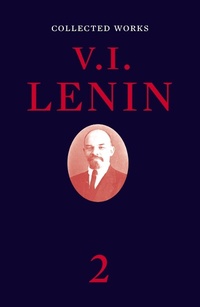
Collected Works, Volume 2
Published on 7. August 2018
572 pages
978-1-78663-632-4 (ISBN)
Description

Among the most influential political and social forces of the twentieth century, modern communism rests firmly on philosophical, political, and economic underpinnings developed by Vladimir Ilyich Ulyanov, later known as Lenin. For anyone who seeks to understand capitalism, the Russian Revolution, and the role of communism in the tumultuous political and social movements that have shaped the modern world, the works of Lenin offer unparalleled insight and understanding.
This second volume contains Lenin's works from 1895 to 1897. Included are Lenin's early economic and political writings, as well as his prescriptions for the program and strategy of Russian Marxism.
This second volume contains Lenin's works from 1895 to 1897. Included are Lenin's early economic and political writings, as well as his prescriptions for the program and strategy of Russian Marxism.
More details
Edition
Ebook UK & RoW
Language
English
Place of publication
London
United Kingdom
Product notice
Reflowable
ISBN-13
978-1-78663-632-4 (9781786636324)
Copyright in bibliographic data and cover images is held by Nielsen Book Services Limited or by the publishers or by their respective licensors: all rights reserved.
Schweitzer Classification
Other editions
Additional editions
Person
Vladimir Ilyich Ulyanov (1870-1924), better known by the alias Lenin, was a Russian communist revolutionary, politician, and political theorist. He played a leading role in the Bolshevik revolution of October 1917.
Content
- Cover Page
- Title Page
- Copyright Page
- Contents
- Illustrations
- Preface
- 1895
- Frederick Engels
- Explanation of the Law on Fines Imposed on Factory Workers
- I. What Are Fines?
- II. How Were Fines Imposed Formerly and What Gave Rise to the New Legislation on Fines?
- III. On What Grounds May the Factory Owner Impose Fines?
- IV. How Big May Fines Be?
- V. What Is the Procedure for Imposing Fines?
- VI. What, According to the Law, Should the Fines Be Spent On?
- VII. Do the Fine Laws Apply to All Workers?
- VIII. Conclusion
- Gymnasium Farms and Corrective Gymnasia (Russkoye Bogatstvo)
- To the Working Men and Women of the Thornton Factory
- What are Our Ministers Thinking About?
- Draft and Explanation of a Programme for the Social-Democratic Party
- Draft Programme
- Explanation of the Programme
- 1896
- To The Tsarist Government
- 1897
- A Characterisation of Economic Romanticism (Sismondi and Our Native Sismondists)
- Chapter I: The Economic Theories of Romanticism
- I. Does the Home Market Shrink Because of the Ruination of the Small Producers?
- II. Sismondi's Views on National Revenue and Capital
- III. Sismondi's Conclusions from the Fallacious Theory of Two Parts of the Annual Product in Capitalist Society
- IV. Wherein Lies the Errors of Adam Smith's and Sismondi's Theories of National Revenue?
- V. Accumulation in Capitalist Society
- VI. The Foreign Market as the "Way out of the Difficulty of Realizing Surplus-Value
- VII. Crisis
- VIII. Capitalist Rent and Capitalist Overpopulation
- IX. Machines in Capitalist Society
- X. Protection
- XI. Sismondi's Place in the History of Political Economy
- Postscript
- Chapter II: The Character of the Romanticists' Criticism of Capitalism
- I. The Sentimental Criticism of Capitalism
- II. The Petty-Bourgeois Character of Romanticism
- III. The Problem of the Growth of the Industrial Population at the Expense of the Agricultural Population
- IV. Practical Proposals of Romanticism
- V. The Reactionary Character of Romanticism
- VI. Corn Tariffs in England as Appraised by Romanticism and by Scientific Theory
- The New Factory Law
- I. Why Was the New Factory Law Passed?
- II. What Should Be Considered Working Time?
- III. To What Extent Does the New Law Reduce Working Hours?
- IV. What Does the Law Consider "Night-Time" for the Workers?
- V. How Does the Ministry of Finance Try to Prove That to Restrict Overtime Would be "Unfair" to the Worker?
- VI. What Power Does the New Law Grant the Ministers?
- VII. How Our "Christian" Government Curtails the Workers' Holidays
- VIII. How Is the Observance of the New Law Guaranteed?
- IX. Will the New Law Improve the Workers' Condition?
- X. What Is the Significance of the New Law?
- Appendix
- I
- II
- III
- IV
- V
- VI
- VII
- About a Certain Newspaper Article
- The Tasks of the Russian Social-Democrats
- To the Workers and Socialists of St. Petersburg from the League of Struggle
- The Handicraft Census of 1894-95 in Perm Gubernia and General Problems of "Handicraft" Industry
- Article One
- I. General Data
- II. The "Handicraftsmen" and Wage-Labour
- III. "Communal-Labour Continuity"
- Article Two
- IV. The Agriculture of "Handicraftsmen"
- V. Large and Small Establishments.-The Incomes of the Handicraftsmen
- Article Three
- VI. What Is a Buyer-Up?
- VII. "Gratifying Features" of Handicraft Industry
- VIII. The Narodnik Programme of Industrial Policy
- Gems of Narodnik Project-Mongering (S. N. Yuzhakov, Educational Problems. Journalistic Essays.-Secondary-School Reform. -Systems and Aims of Higher Education.-Gymnasium Textbooks.-The Problem of Universal Education.-Women and Education. St. Petersburg, 1897, pp. VIII + 283. Price 1 ruble 50 kopeks.)
- I
- II
- III
- IV
- V
- VI
- VII
- The Heritage We Renounce
- I. One Representative of the "Heritage"
- II. Narodism's Addition to the "Heritage"
- III. Has the "Heritage" Gained from Association with Narodism?
- IV. The "Enlighteners," the Narodniks, and the "Disciples"
- V. Mr. Mikhailovsky on the "Disciples'" Renunciation of the Heritage
- Notes
- The Life and Work of V. I. Lenin. Outstanding Dates
