

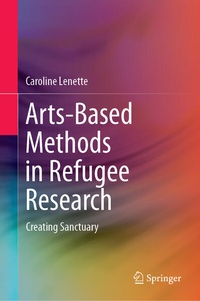
Arts-Based Methods in Refugee Research
Creating Sanctuary
1st Edition
Published on 4. May 2019
XXV, 240 pages
978-981-13-8008-2 (ISBN)
Description

Drawn from a decade of refugee studies, this book offers a wealth of insights on arts-based methodologies. It explores exciting new prospects for participatory and culturally safe research, and will be a reference resource for researchers of all levels and community practitioners.
The book tackles questions of meaningful research practice: How do people with lived experiences of forced migration-Knowledge Holders-lead the way? Can arts-based methods bring about policy and social change? And what of ethical issues?
By reflecting on the strengths and limitations of four research methods (digital storytelling, photography, community music, and participatory video), readers are invited to craft their own approach to arts-based projects.
More details
Series
Language
English
Place of publication
Singapore
Singapore
Publishing group
Springer Singapore
Target group
Professional and scholarly
Product notice
Reflowable
Illustrations
XXV, 240 p. 38 illus., 25 illus. in color.
File size
6,08 MB
ISBN-13
978-981-13-8008-2 (9789811380082)
DOI
10.1007/978-981-13-8008-2
Schweitzer Classification
Other editions
Additional editions
Book
05/2019
Springer
€106.99
Shipment within 15-20 days
Person
Caroline Lenette is Senior Lecturer in the School of Social Sciences, University of New South Wales, Sydney, Australia. She is a member of the UNSW Forced Migration Research Network, an interdisciplinary network of leading researchers in refugee and migration studies. Over the past ten years, Caroline has used arts-based methods in social-justice focused research to collaborate with co-researchers with lived experiences as refugees and asylum seekers, especially women. Together, they explored stories of wellbeing, cultural identity, and settlement through arts-based methodologies. She has published widely on these topics. Caroline's research interests include understanding how creative outcomes can influence decision-makers towards meaningful social change, and the ethical considerations of collaborative, arts-based research and participatory research more broadly.
Content
Part I: Context.- Social Context. Why Arts-based Research?.- Policy Change.- Ethics.- Part II: Methods.- Digital Storytelling.- Photography.- Community Music.- Participatory Video.
