

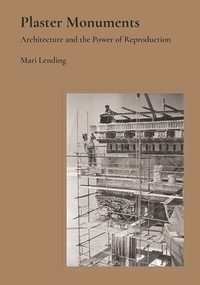
Plaster Monuments
Architecture and the Power of Reproduction
1st Edition
Published on 1. June 2022
304 pages
978-0-691-23962-0 (ISBN)
Description

We are taught to believe in originals. In art and architecture in particular, original objects vouch for authenticity, value, and truth, and require our protection and preservation. The nineteenth century, however, saw this issue differently. In a culture of reproduction, plaster casts of building fragments and architectural features were sold throughout Europe and America and proudly displayed in leading museums. The first comprehensive history of these full-scale replicas, Plaster Monuments examines how they were produced, marketed, sold, and displayed, and how their significance can be understood today.
Plaster Monuments unsettles conventional thinking about copies and originals. As Mari Lending shows, the casts were used to restore wholeness to buildings that in reality lay in ruin, or to isolate specific features of monuments to illustrate what was typical of a particular building, style, or era. Arranged in galleries and published in exhibition catalogues, these often enormous objects were staged to suggest the sweep of history, synthesizing structures from vastly different regions and time periods into coherent narratives. While architectural plaster casts fell out of fashion after World War I, Lending brings the story into the twentieth century, showing how Paul Rudolph incorporated historical casts into the design for the Yale Art and Architecture building, completed in 1963.
Drawing from a broad archive of models, exhibitions, catalogues, and writings from architects, explorers, archaeologists, curators, novelists, and artists, Plaster Monuments tells the fascinating story of a premodernist aesthetic and presents a new way of thinking about history's artifacts.
Plaster Monuments unsettles conventional thinking about copies and originals. As Mari Lending shows, the casts were used to restore wholeness to buildings that in reality lay in ruin, or to isolate specific features of monuments to illustrate what was typical of a particular building, style, or era. Arranged in galleries and published in exhibition catalogues, these often enormous objects were staged to suggest the sweep of history, synthesizing structures from vastly different regions and time periods into coherent narratives. While architectural plaster casts fell out of fashion after World War I, Lending brings the story into the twentieth century, showing how Paul Rudolph incorporated historical casts into the design for the Yale Art and Architecture building, completed in 1963.
Drawing from a broad archive of models, exhibitions, catalogues, and writings from architects, explorers, archaeologists, curators, novelists, and artists, Plaster Monuments tells the fascinating story of a premodernist aesthetic and presents a new way of thinking about history's artifacts.
More details
Other editions
Additional editions
Book
12/2017
Princeton University Press
€61.90
Shipment within 10-20 days
Person
Mari Lending is professor of architectural history and theory at the Oslo School of Architecture and Design. Her books include, with Mari Hvattum, Modelling Time and, with Peter Zumthor, A Feeling for History.
Content
- Cover Page
- Half-title Page
- Title Page
- Dedication Page
- Contents
- Acknowledgments
- Introduction: Monuments in Flux
- Plaster Perfection
- Exhibiting History
- Portable Monuments
- Antiquities as Novelties
- Reassessing a Space in Time
- 1. Travels in the Province of Reproductions
- Architecture Museums
- Rome-London-Paris-New York
- American Perfection
- An Epitome of Monuments in Central Park
- Traveling in the Province of Reproductions
- Temporal Cartographies
- Scaffolded Visibility
- 2. Trocadéro: Proust's Museum
- The Tyranny of the Particular
- Viollet-le-Duc's Museum
- Plaster Kiss
- Traversing Names and Landscapes
- Patina and the Work of Time
- Museophilia
- 3. The Poetics of Plaster
- Monuments in Time
- Monuments in Space and Scale
- Collapsing Taxonomies
- Architectural Promenades
- At Home in History: Traveling Portals
- Preserved in Plaster
- 4. Cablegrams and Monuments
- The Hall of Architecture, Pittsburgh
- A Readymade Monument
- Beaux-Arts Contemporaneity
- Move Every Stone!
- Cast in Situ, Lost at Sea
- Remounting Monuments
- 5. The Yale Battle of the Casts: Albers vs. Rudolph
- The Yale Cast Collection
- Historical or Contemporary
- Beaux-Arts Brutalism
- Cast Concrete and Plaster Casts
- Chance Encounters
- The Man, the Symptom
- Polychronic Wonders
- Fractured Temporalities (Learning from History)
- Coda: Lost Continents, Fluctuating Objects
- Museum Vogues
- The Politics of Reproductions
- When the Cathedrals Were White
- Notes
- Bibliography
- Index
- Illustration Credits
- Copyright Page
