

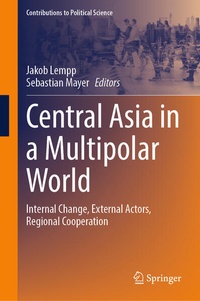
Central Asia in a Multipolar World
Description

This handbook-style edited volume discusses historical, but predominantly current political, economic, and societal trends in Central Asia comprising Kazakhstan, Uzbekistan, Kyrgyzstan, Tajikistan, and Turkmenistan. The five countries exhibit many cultural and historical commonalities and face similar internal and external challenges. Despite different transformation paths and frequent intra-regional tensions, a common regional identity has emerged in the countries since gaining their independence in 1991. Besides covering their political systems, a variety of topics such as human rights, media, terrorism, and civil society are addressed. As well, bilateral relations with seven external actors are examined. Lastly, the authors explore the opportunities and limitations of institutionalized regional cooperation in various fields of action.
More details
Other editions
Additional editions
Persons
Dr. Jakob Lempp is Professor of Political Science with a focus on International Relations at Rhine-Waal University of Applied Sciences in Kleve, Germany. He was a research fellow at Kazakh-German University in Almaty, Kazakhstan and at the OSCE Academy in Bishkek, Kyrgyzstan. He has previously worked at the University of Technology in Dresden and at the Boston Consulting Group in Munich. His research focuses on politics in Central Asia and Europe and on European integration.
Dr. Sebastian Mayer is DAAD Associate Professor of International Relations at the OSCE Academy and Associate Fellow at the American University of Central Asia, Bishkek, Kyrgyzstan. He has held positions at the Free University of Berlin, the Institute for Peace Research and Security Policy in Hamburg, and the University of Bremen. His research focuses on transatlantic, European, and Eurasian security, particularly regional security organizations and security issues in Central Asia.
Content
Chapter 1. Introduction: Central Asia in a Multipolar World (Jakob Lempp).- Chapter 2. Spatial Concepts of Central Asia: A Historical Overview (Stefan B. Kirmse).- Part I. The Political Systems.- Chapter 3. The Political System of Kazakhstan (Sabina Insebayeva).- Chapter 4. The Political System of Uzbekistan (Rustam Burnashev).- Chapter 5. The Political System of Kyrgyzstan (Jakob Lempp).- Chapter 6. The Political System of Tajikistan (Edward Lemon).- Chapter 7. The Political System of Turkmenistan (Sébastien Peyrouse).- Part II. Change, Public Sphere, Conflict.- Chapter 8. Democratization (Shirin Tumenbaeva).- Chapter 9. Human Rights (Anja Mihr).- Chapter 10. Corruption (Marie-Carin von Gumppenberg).- Chapter 11. Media (Othmara Glas).- Chapter 12. Civil Society (Anna-Lena Hönig).- Chapter 13. Violent Conflict (Thorsten Bonacker).- Chapter 14. Terrorism (Almakan Orozobekova).- Chapter 15. Foreign Terrorist Fighters (Elena Zhirukhina).- Part III. External Actors and Bilateral Relations.- Chapter 16. Russia in Central Asia (Zhanibek Arynov).- Chapter 17. China in Central Asia (Luba von Hauff).- Chapter 18. The EU in Central Asia (Jacopo Maria Pepe).- Chapter 19. The US in Central Asia (Alexander Brand).- Chapter 20. India in Central Asia (Bhavna Davé).- Chapter 21. Türkiye in Central Asia (Mustafa Aydın).- Chapter 22. Japan in Central Asia (Assylzat Karabaeva).- Part IV. Regional Cooperation.- Chapter 23. Security Cooperation (Sebastian Mayer).- Chapter 24. Cooperation in Trade (Richard Pomfret).- Chapter 25. Cooperation in Hydrocarbons (Fabio Indeo).- Chapter 26. Cooperation in Renewable Energy (Elena Shadrina).- Chapter 27. Environmental Cooperation (Lutz Mez).- Chapter 28. Educational Cooperation (Jan Niklas Rolf).- Part V. Outlook.- Chapter 29. Prospects and Development Trends in Central Asia.
