

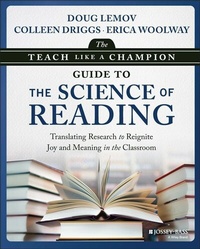
The Teach Like a Champion Guide to the Science of Reading
Description

The most comprehensive and practical guide to understanding and applying the science of reading to improve literacy instruction.
After effectively teaching phonics in the early grades, what does the science of reading tell us should happen in literacy classes? The Teach Like a Champion Guide to the Science of Reading by Doug Lemov, Erica Woolway, and Colleen Driggs, addresses the pressing challenges educators face in effectively incorporating the Science of Reading into their instruction once students already know how to decode. By offering actionable guidance grounded in seven evidence-based principles, this book helps teachers elevate their instructional practices and better prepare students to be lifelong readers and thinkers.
Grounded in proven classroom instruction, the book focuses on techniques that can allow teachers to use the science as effectively and actionably as possible. The Teach Like a Champion Guide to the Science of Reading is enhanced with more than 50 video clips from the classroom and covers ways to practically apply the Science of Reading. The book describes the often overlooked role of fluency in reading comprehension, even into the high school years; the profound importance of managing and socializing attention in an age of technology; the central role of background knowledge in understanding text; and the doubly important role of teaching vocabulary as a form of knowledge. It adds a discussion of how writing can make students better readers and how important it is that reading classes focus on reading actual books-great ones, ideally. And it closes with a discussion of close reading and the challenge of preparing students to rise to the challenge of complex text.
Inside the book:
- An innovative approach to building and reinforcing background knowledge in reading
- Over 50 video demonstrations of effective teaching techniques
- Sample lesson plans and materials for immediate classroom application
The Teach Like a Champion Guide to the Science of Reading is essential for educators, literacy coaches, and administrators who aim to foster rigorous literacy instruction in their classrooms and schools. This guide shows you how to implement techniques that ensure students find joy in reading and become better, wiser, more engaged and more motivated readers, both in their classrooms and in their lives beyond.
More details
Other editions
Additional editions
Persons
Doug Lemov is the author of Teach Like a Champion, now in its third edition, and other influential books about teaching.
Colleen Driggs is the Managing Director of Curriculum and School Support of Teach Like a Champion and former middle school literacy teacher and coach. She is a coauthor of Reading Reconsidered.
Erica Woolway is the President and Chief Academic Officer of Teach Like a Champion. Erica is a former kindergarten teacher and elementary school leader. She is coauthor of Practice Perfect and Reading Reconsidered.
Content
About the Authors ix
Acknowledgments xi
How to Use This Book xiii
Introduction: "The Science of Reading": Shockwaves from a Podcast xvii
1 The Science of Reading in Seven Key Arguments 1
A Broad Base of Research 3
Seven Key Research- Backed Arguments About "Post- Phonics" Reading 4
"The Single Most Important Thing for Teachers to Know" 31
But Will Students Dislike It? 38
Notes 41
2 Attending to Attention 47
The Book Is Dying 49
We Wire How We Fire 55
Intentional Ways of Reading for Attention and Connection 61
High Text, Low Tech 71
Book- Driven Objectives 76
Principles of Reading in Action 79
Chapter Recap 82
Notes 82
3 Fluency and Ways of Reading 87
Orthographic Mapping 92
Balancing Three Ways of Reading 95
Teacher Read Aloud 97
Fase Reading 109
Accountable Independent Reading (AIR) 126
Chapter Recap 134
Notes 135
4 The Hidden Power of Background Knowledge 137
Research on Knowledge 139
We Know Knowledge Matters- Why Don't We Act That Way? 141
Performance on the New York State ELA End- of- Year State Test Grades 3-8 (2022-2023) 149
Embedded Nonfiction 151
Embellishments and Knowledge Feeding 163
Knowledge Organizers 168
Retrieval Practice 172
The Forgetting Curve 175
The Recursiveness of Knowledge: Putting It All Together 179
Chapter Recap 182
Notes 182
5 Vocabulary Reconsidered 185
Explicit Vocabulary Instruction 194
Implicit Vocabulary Instruction 205
The Vocabulary Case for Reading Aloud (and FASE) 210
Lesson Preparation 213
Recursiveness of Vocabulary 217
Chapter Recap 219
Notes 219
6 Using Writing to Develop Readers 221
"Write Down Some Ideas First" 225
Writing for Reading: Principles of Writing to Build Literacy 231
Putting It All Together 271
Chapter Recap 273
Notes 274
7 The Power of the Book 277
Why Have All the Books Gone? 282
Stories are Cognitively Privileged 285
The Medium Is the Message 290
Books Provide Valuable Cultural Capital 291
All Books Are Equal, But Some Books Are More Equal Than Others 294
Getting Them to Read 299
Chapter Recap 302
Notes 304
8 Close Reading 307
Jen Brimming's Close Reading of Lord of the Flies 309
Short Bursts and Opportunities to Encode 319
Selecting Complex Texts for Close Reading 322
Selecting Textual Excerpts 325
The Critical Importance of Establishing Meaning 328
Attentionally Privileged Environments 335
More Examples of Effective Close Reading Questions 338
Knowledge, Disambiguation, and Close Reading 348
Close Reading in the Context of a Lesson 350
Chapter Recap 359
Notes 360
Appendix A: Full Sample Lesson, Seventh Grade 363
Appendix B: Full Sample Lesson, Ninth Grade 375
Appendix C: Decoding Tips 393
Appendix D: Reading Reconsidered Curriculum: The Giver Fluency Practice: Sample Materials 397
Appendix E: Materials for Knowledge Building: Embedded Texts 403
Index 419
Introduction: "The Science of Reading": Shockwaves from a Podcast
In October 2022, education reporter Emily Hanford released a podcast called Sold a Story. Hanford's topic, the flawed science behind the nation's leading primary grade reading programs, might not at first seem the stuff of blockbuster media.
But it spent weeks on Apple's top ten list and became the second most shared podcast in the country in 2023. Time Magazine ranked it as the third best podcast in the United States that same year and by then it had more than five million downloads.
Perhaps more important than the listener statistics and accolades, it became the topic of school board and curriculum committee meetings across the country. States put the topic on the legislative docket. More than fifteen states passed laws in response, some explicitly outlawing unscientific teaching practices in early reading, others requiring districts to choose reading programs supported by science.1
Sold a Story turned out to be the most influential piece of education journalism in years.
One unfortunate reason for the podcast's success was that it was about reading failure, and the failure of a child to learn to read-well, easily, or in some cases at all-is far from a niche issue in American schools. There were tens of thousands of parents listening to the podcast not because the story was a true-crime thriller for PTA types or a cautionary tale about school-gone-wrong. It was the story of their child. They were parents who had lived with the reality that their child couldn't read or wasn't progressing. They had wondered: had they done something wrong? had they read to their children enough? had they failed to spot a learning disability?
The first episode began by introducing one of them: Corinne Adams. During the pandemic, she had sat in on her son Charlie's kindergarten, which was being held via Zoom. Watching over Charlie's shoulder as his teacher tried to get twenty-five kindergarteners to follow along, Corinne quickly recognized that if she helped Charlie manage the mute button and stay focused, she would also be helping his teacher. And so she found herself sitting daily at a window into her child's previously hidden world.
At first what she saw gave her only a vague sense of dissonance. She had expected to see a lot of sounding out of words, but Charlie wasn't taught to do that. He was encouraged to use context, the first letter, or what was shown in the pictures that often accompanied the text to guess at what a word was. Initially, this just seemed like "new math": schools had a way of doing things now that wasn't intuitive to parents who'd grown up in a different era.
She was told she shouldn't encourage Charlie to sound out words deliberately when reading with him at home. She began to notice that he wanted to read aloud only from books she'd already read to him. He especially liked books with predictable patterns ("Good night, room; good night, moon," etc.). But those concerns were balanced by the school's upbeat reassurances: Charlie got good grades and earned notes praising his progress in reading.
"I'd be like, 'Oh, you're doing so great!'" Corinne recalled.
Until she was asked to give Charlie an at-home reading assessment. "I wasn't allowed to read it to him first. And I couldn't help him in any way. I could point to the words for him and that was it. He had to read it," Corinne tells Hanford.
Corinne taped the session, and on the podcast, you can hear the recording of Charlie trying to read the sentence: "This toy moves when you push it."
"You .. It .. You ." he guesses. He has no idea how to start. He guesses at whole words. He doesn't think to go letter-by-letter or sound-by-sound.
He has probably been taught that sounding out is a last resort, but sounding out is all but impossible if you aren't instantly familiar with the great majority of the sounds letters and letter combinations make.
Charlie is lost because he has not been taught how to read correctly.
And there's anxiety and desperation in his voice. He wants to do well and doesn't know how.
Corinne suddenly realizes: Charlie isn't "on his way" or "making progress," he is lost-in danger already of becoming a student for whom school is frustrating and nearly hopeless. Of becoming an adult who can't read a loan application, a contract, a book, or the laws that govern him.
It's every parent's nightmare. Corinne's dreams for him are suddenly weighed down with dread.
And the normalcy of it all is doubly scary. The ship of school goes sailing on, placidly sending home reassuring notes.
Has no one even noticed??
Charlie's school is on the leafy side of the education gap, mind you, with kindness assemblies and SMART Boards in every room. And still there is the disconcerting sense that this is just the way things are. As Hanford notes, 65 percent of students-two-thirds of the nation's fourth graders-were below proficient on the 2019 National Assessment of Educational Progress, even before the disruptions of the pandemic. No wonder no one blinked as a bright and able child became a struggling reader. It's the majority case, you could argue.
Perhaps that's why the podcast was often gut-wrenching for the tens of thousands of teachers who also listened to it. Many had worked for years helping children learn to read, often using the programs described in the podcast-programs that eschewed systematic phonics instruction in favor of the ineffective cueing methods Charlie tried hopelessly to use. They heard how disinterest in and dismissiveness of reading science among the designers of those programs had caused teachers like themselves to give their all and still serve students poorly.
Stunningly, the flawed reading programs Hanford described in the podcast, and which Charlie's school was using, were among the most widely used in the country. Many teachers who used them were unaware of the problems; others had concerns but deferred to the experts. After all, they had been told to use them by their schools or by their professors. Besides, what to do in the face of such misgivings when you are just one teacher is far from clear.
The makers of those faulty early reading programs and their advocates were not just wrong about how to teach reading, though. They were wrong in the face of clear evidence to the contrary. Not even cutting-edge evidence: evidence that had been available for decades; evidence they were aware of. That's the kicker.
At first, their response to indications that they had the science wrong was relatively subtle. As early advocates for cognitive science made the case for the critical importance of phonics-the process of intentionally and sequentially teaching letter-sound correspondences-defenders of the dominant programs, which had been known as whole language for their belief that students could learn to read naturally without breaking words down into sounds, coined the term balanced literacy to describe their programs instead. A rebranding never hurts. After all, the programs did-or could, if a teacher chose-contain some phonics alongside their cueing methods and whole language approach,2 and the new term suggested that they were a compromise, a resolution to the increasingly vociferous arguments about how to teach reading that were sometimes dubbed the "reading wars."
"Balanced literacy was . a way to defuse the controversy and put the criticisms of whole language aside because everyone was just going to use the best of both worlds," University of Wisconsin cognitive psychologist and reading expert Mark Seidenberg said in a 2018 podcast.3 "It didn't solve any of the underlying issues . [because] Teachers already thought they were using the best of both worlds and so they didn't . change anything at all."
Teachers will decide what's best: that was, and is, a critical argument of many approaches to teaching and learning, including balanced literacy. We can resolve this by deploying the wisdom of teachers to determine what works and reconcile the disputes via their learned experience in classrooms.
That's a powerful argument. In fact, teacher autonomy is something we too believe in, deeply. Teachers' capacity to solve problems and adapt ideas in the classroom is one of their most important and under-recognized skills. School doesn't work well without it.
But to be effective in technical and complex fields, autonomy requires decision-makers to have the knowledge required to solve problems effectively.
"Generations of teachers have been trained and remain stubbornly attached to ideas about how to teach reading that are unsupported by research and basic science," the education writer Robert Pondiscio wrote in 2023,4 and this trend is exacerbated by the fact that "education tolerates and even encourages teachers' view of themselves as free agents, who . listen to the latest diktats from the district and then return to their classrooms, close the door, and do what feels right."
If we really want to give teachers the right to decide-and we think we should-we have to empower them by ensuring their access to and...
