

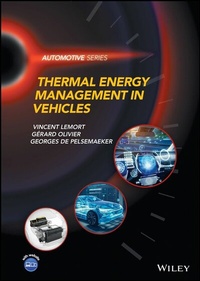
Thermal Energy Management in Vehicles
Description

Comprehensive coverage of thermal energy management systems and components in vehicles
In Thermal Energy Management in Vehicles, a team of distinguished researchers delivers a robust and authoritative account of thermal energy management systems and components in vehicles. Covering three main areas--the thermal management of internal combustion engines, mobile air-conditioning, and thermal management of hybrid electric vehicles and electric vehicles--the book discusses and proposes simulation models for many of the components and systems introduced in the book.
The authors also cover state-of-the-art and emerging technologies, as well as likely future industry trends, and offer an accompanying website with supplementary materials like downloadable models.
Readers will also find:
* Material that bridges the gap between academia and industry
* Proposed simulation models for vehicular components and systems
* Fulsome discussions of industry trends likely to take hold in the near future
* Accompanying online resources, including downloadable simulation models, on a complimentary website
Perfect for researchers, graduate students, and practitioners in automotive engineering, Thermal Energy Management in Vehicles will also benefit anyone seeking a comprehensive treatment of vehicular thermal energy management systems and components.
More details
Other editions
Additional editions
Persons
Vincent Lemort is an Associate Professor at the Thermodynamics Laboratory of the University of Liège. His research interests include the modeling, testing, and optimization of thermal energy systems.
Gérard Olivier worked for many years for Renault Group and filed 70 patents. He was in charge of thermal systems and cabin air quality research activities and served as the expert for innovative solutions for thermal energy management.
Georges de Pelsemaeker is the Program and Research & Development Director of the Valeo Thermal System Business Group. He has over 20 years' experience leading the development of vehicle and engine emission control systems.
Content
CHAPTER 1 FUNDAMENTALS 1
1.1 INTRODUCTION 2
1.2 FUNDAMENTAL DEFINITIONS IN THERMODYNAMICS 2
1.3 FLUIDS 8
1.4 HEAT TRANSFERS 21
1.5 FIRST LAW OF THERMODYNAMICS 28
1.6 SECOND LAW OF THERMODYNAMICS 31
1.7 FLOWS IN HYDRAULIC CIRCUITS 38
1.8 HEAT EXCHANGERS 40
1.9 REFERENCES 48
CHAPTER 2 INTERNAL COMBUSTION ENGINE THERMAL MANAGEMENT 1
2.1 INTRODUCTION 2
2.2 FUNDAMENTALS OF INTERNAL COMBUSTION ENGINES 3
2.3 ENGINE COOLING AND HEATING 24
2.4 OIL COOLING 33
2.5 CHARGE AIR COOLING (CAC) 35
2.6 EXHAUST GAS RECIRCULATION (EGR) COOLING 40
2.7 FRONT-END MODULE 44
2.8 ENGINE WASTE HEAT RECOVERY 50
2.9 REFERENCES 53
CHAPTER 3 CABIN CLIMATE CONTROL 1
3.1 INTRODUCTION 3
3.2 THERMAL CONFORT 3
3.3 CABIN THERMAL LOADS 17
3.4 DISTRIBUTION OF THERMAL ENERGY THROUGH THE CABIN 38
3.5 PRODUCTION OF COOLING POWER 45
3.6 PRODUCTION OF HEATING POWER 75
3.7 LOCAL COOLING AND HEATING SYSTEMS 77
3.8 THERMAL ENERGY STORAGE 79
3.9 REFERENCES 82
CHAPTER 4 THERMAL ENERGY MANAGEMENT IN HYBRID AND ELECTRIC VEHICLES 1
4.1 INTRODUCTION 2
4.2 CLASSIFICATION OF ELECTRIC AND HYBRID ELECTRIC VEHICLES 4
4.3 CABIN THERMAL CONTROL IN HEVs AND EVs 13
4.4 BATTERY THERMAL MANAGEMENT (BTM) 26
4.5 E-MOTOR AND POWER ELECTRONICS COOLING 46
4.6 OVERALL THERMAL ENERGY MANAGEMENT OF ELECTRIFIED VEHICLES 54
4.7 REFERENCES 57
Nomenclature
List of Abbreviations
- AC
- accumulator
- A/C
- air-conditioning
- ACAC
- air-cooled charge air cooler
- BDC
- bottom dead center
- BEV
- battery electric vehicle
- BMEP
- brake mean effective pressure
- BMS
- battery management system
- BPHEX
- Brazed Plate Heat Exchanger
- BTM
- battery thermal management
- BTMS
- battery thermal management system
- BOL
- beginning of life
- CAC
- charge air cooler
- CC
- cooler core
- CFC
- chlorofluorocarbon
- COP
- coefficient of performance
- CP
- compressor
- DN
- direct normal
- DOC
- diesel oxidation catalyst
- DP
- damper
- DPF
- diesel particulate filter
- ECV
- externally controlled valve
- EG
- ethylene glycol
- EGR
- exhaust gas recirculation
- EGRC
- exhaust gas recirculation cooler
- EHRS
- exhaust heat recovery system
- EM
- electric motor
- EOL
- end of life
- EREV
- extended range electric vehicle
- EV
- electric vehicle
- EXV
- electronic expansion valve
- HC
- hydrocarbon
- HEV
- hybrid electric vehicle
- HP
- high pressure
- FC
- fuel cell
- FCEV
- fuel cell electric vehicle
- FMEP
- friction mean effective pressure
- GWP
- global warming potential
- HC
- heater core
- HVAC
- heating, ventilation, and air-conditioning
- HFC
- hydrofluorocarbon
- HFO
- hydrofluoroolefin
- HHV
- high heating value
- ICD
- internal condenser
- ICE
- internal combustion engine
- ICT
- information and communications technology
- ICV
- internally controlled valve
- IEV
- internal evaporator
- IMEP
- indicated mean effective pressure
- IR
- infrared
- LHV
- low heating value
- LP
- low pressure
- LT
- low temperature
- MEP
- mean effective pressure
- NEDC
- new European driving cycle
- NTU
- number of transfer units
- ORC
- organic Rankine cycle
- OCR
- oil circulation ratio
- OCV
- open circuit voltage
- OHEX
- outdoor heat exchanger
- OT
- orifice tube
- PCM
- phase change material
- PE
- power electronics
- PHEV
- plug-in hybrid electric vehicle
- PMV
- predicted mean vote
- PPD
- predicted percent dissatisfied
- PTC
- positive temperature coefficient
- PVB
- polyvinyl butyral
- RC
- Rankine cycle
- RMS
- root mean square
- SCR
- selective catalytic reduction
- SHGC
- solar heat gain coefficient
- SHR
- sensible heat ratio
- SOC
- state of charge
- SOH
- state of health
- TDC
- top dead center
- TIM
- thermal interface material
- TXV
- thermostatic expansion valve
- WCAC
- water-cooled charge air cooler
- WCD
- water-cooled condenser
- WLTP
- worldwide harmonized light vehicles test procedure
- ZEV
- zero emission vehicle
Nomenclature
- a
- specific Gibbs free energy [J kg-1]
- A
- area [m2]
- AU
- conductance [W K-1]
- B
- bore [m]
- c
- specific heat [J kg-1 K-1]
- C
- speed, velocity [m s-1]
- C
- heat capacity [J K-1]
- C
- clearance factor [-]
- C
- concentration [-]
- e
- specific total energy [J kg-1]
- e
- thickness [m]
- e
- amount of excess air [-]
- E
- total energy [J]
- E
- emissive power [W m-2]
- f
- fuel-air ratio [-]
- F
- force [N]
- F
- view factor [-]
- g
- gravitational acceleration [m s-2]
- g
- specific Helmoltz free energy [J kg-1]
- G
- irradiation [W m-2]
- h
- specific enthalpy [J kg-1]
- h
- convective heat transfer coefficient [W m-2K-1]
- H
- enthalpy [J]
- H
- height [m]
- i
- working cycle frequency [-]
- I
- irradiance [W m-2]
- I
- electric current [A]
- k
- spring constant [N m-1]
- k
- thermal conductivity [W m-1K-1]
- L
- length [m]
- m
- mass [kg]
- mass flow rate [kg s-1]
- MM
- molar mass [kg kmol-1]
- n
- number [-]
- N
- rotational speed [Hz]
- P
- pressure [Pa]
- q
- heat flux [W m-2]
- rate of heat transfer [W]
- r
- ratio [-]
- R
- heat transfer resistance [K W-1]
- RH
- relative humidity [-]
- rpm
- rotational speed [rpm]
- T
- temperature [°C or K]
- s
- specific entropy [J kg-1 K-1]
- S
- entropy [J K-1]
- S
- stroke [m]
- t
- time [s]
- T
- torque [N m]
- u
- specific internal energy [J kg-1]
- U
- internal energy [J]
- U
- overall heat transfer coefficient [W m-2 K-1]
- v
- specific volume [m3 kg-1]
- V
- volume [m3]
- volume flow rate [m3 s-1]
- Vol
- volume [m3]
- w
- specific work [J kg-1]
- W
- work [J]
- power [W]
- x
- displacement, distance [m]
- x
- quality [-]
- ...
