

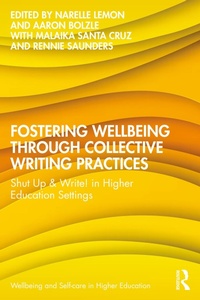
Fostering Wellbeing through Collective Writing Practices
Shut Up & Write! in Higher Education Settings
Published on 18. November 2025
240 pages
978-1-040-64994-7 (ISBN)
Description

This book explores the transformative power of collaborative writing sessions in fostering wellbeing among academics. In this collection, the second of two volumes, the editors bring together diverse voices from around the globe, offering insights into how Shut Up & Write! (SUAW) sessions are revolutionising academic practice and nurturing healthier, more connected scholarly communities.
From remote scholars finding connection to working-class academics addressing unfinished business, this book illuminates the multifaceted benefits of SUAW. It delves into how these sessions build resilience, cultivate passion, boost productivity, and nurture academic identity. The contributors share personal narratives, practical strategies, and critical reflections on how SUAW initiatives are reshaping academic culture.
This is essential reading for academics, doctoral students, and university administrators seeking innovative approaches to enhance wellbeing in higher education. It offers a compelling case for integrating SUAW into academic life, demonstrating its potential to combat isolation, foster supportive networks, and promote a more balanced approach to scholarly work.
From remote scholars finding connection to working-class academics addressing unfinished business, this book illuminates the multifaceted benefits of SUAW. It delves into how these sessions build resilience, cultivate passion, boost productivity, and nurture academic identity. The contributors share personal narratives, practical strategies, and critical reflections on how SUAW initiatives are reshaping academic culture.
This is essential reading for academics, doctoral students, and university administrators seeking innovative approaches to enhance wellbeing in higher education. It offers a compelling case for integrating SUAW into academic life, demonstrating its potential to combat isolation, foster supportive networks, and promote a more balanced approach to scholarly work.
More details
Series
Language
English
Place of publication
London
United Kingdom
Publishing group
Taylor & Francis Ltd
Target group
College/higher education
Professional and scholarly
Illustrations
3 Tables, black and white; 21 Halftones, black and white; 21 Illustrations, black and white
File size
11,97 MB
ISBN-13
978-1-040-64994-7 (9781040649947)
Copyright in bibliographic data and cover images is held by Nielsen Book Services Limited or by the publishers or by their respective licensors: all rights reserved.
Schweitzer Classification
Other editions
Additional editions
Narelle Lemon | Aaron Bolzle | Malaika Santa Cruz
Fostering Wellbeing through Collective Writing Practices
Shut Up & Write! in Higher Education Settings
Book
11/2025
1st Edition
Routledge
€42.90
Shipment within 15-20 days
Narelle Lemon | Aaron Bolzle | Malaika Santa Cruz
Fostering Wellbeing through Collective Writing Practices
Shut Up & Write! in Higher Education Settings
Book
11/2025
1st Edition
Routledge
€201.40
Shipment within 15-20 days
Persons
Narelle Lemon is a Professor and Vice Chancellor Professorial Research Fellow at Edith Cowan University, Australia, where she leads the Wellbeing and Education Research Community, and is an interdisciplinary scholar across arts, education, and positive psychology. She is also Creative Director of Explore & Create Co.
Aaron Bolzle is Co-Founder of Writing Partners and President of its flagship initiative, Shut Up & Write!. He also serves as an Innovation Fellow at the Cambridge University ThinkLab, where he collaborates on community-focused initiatives that support connection and wellbeing. Bolzle's work centers on creating inclusive, thriving global writing communities that foster belonging, resilience, and sustainable practice. Under his leadership, Shut Up & Write! has expanded to hundreds of cities and universities in over 60 countries.
Malaika Santa Cruz served as a key early team member at Shut Up & Write!, growing the community back when Shut Up & Write! was only a few thousand members across eight chapter cities. A decade later, her operational expertise and dedication to fostering meaningful partnerships has been pivotal in maintaining the inclusive culture as Shut Up & Write! has expanded to hundreds of cities and universities worldwide.
Rennie Saunders is the founder and CEO of Shut Up & Write!, a global organisation that hosts free writing events for authors worldwide. What began as a personal quest to find creative community in San Francisco has grown into a movement supporting nearly 100,000 writers across 53 countries. A lifelong science fiction enthusiast who wrote his first story at age 12, Rennie is passionate about providing writers with the resources, community, and accountability they need to succeed.
Aaron Bolzle is Co-Founder of Writing Partners and President of its flagship initiative, Shut Up & Write!. He also serves as an Innovation Fellow at the Cambridge University ThinkLab, where he collaborates on community-focused initiatives that support connection and wellbeing. Bolzle's work centers on creating inclusive, thriving global writing communities that foster belonging, resilience, and sustainable practice. Under his leadership, Shut Up & Write! has expanded to hundreds of cities and universities in over 60 countries.
Malaika Santa Cruz served as a key early team member at Shut Up & Write!, growing the community back when Shut Up & Write! was only a few thousand members across eight chapter cities. A decade later, her operational expertise and dedication to fostering meaningful partnerships has been pivotal in maintaining the inclusive culture as Shut Up & Write! has expanded to hundreds of cities and universities worldwide.
Rennie Saunders is the founder and CEO of Shut Up & Write!, a global organisation that hosts free writing events for authors worldwide. What began as a personal quest to find creative community in San Francisco has grown into a movement supporting nearly 100,000 writers across 53 countries. A lifelong science fiction enthusiast who wrote his first story at age 12, Rennie is passionate about providing writers with the resources, community, and accountability they need to succeed.
Content
Part I: Foundations of Community and Wellbeing 1. Shut Up & Write! A Dialogue on Community, Wellbeing and Purpose Narelle Lemon, Aaron Bolzle, Malaika Santa Cruz 2. From Isolation to Connection: How Online Shut Up & Write Fosters Wellbeing for Remote Scholars Stephanie Milford 3. Moreton Bay Fridays: Creating community in a regional university campus through convivial co-located quiet writing Deanna Grant-Smith, Katie McIntyre, Karen Hands, David Schmitke, Rory Mulcahy, Margarietha de Villiers Scheepers 4. Miriam Reynoldson, Anna Farago Part II: Doctoral and Graduate Student Experiences 5. Everyday Tales of an Online 'Shut Up & Write (SU&W) PhD Research Community'
Margaret Davis, Sandra Croaker, Natalie Lindsay, Bronwyn Charles 6. From procrastination to productivity: developing collegial interconnectedness through belonging, being and becoming Jacqui Peters, Rachel Finneran, Pennie White, Katrina MacDonald 7. And see what comes to you in the silence: Reflecting on the restorative potential of 'Shut Up and Write' Haidee Hicks 8. Beyond the Individual: Reflections on Writing, Identity and Wellbeing in Academia Gillian Kimundi Part III: Creative and Collaborative Approaches 9. Changing the Script: Collective and Creative Possibilities Timothy Clark 10. Shut Up and Write, Connect, and Support: Bridging the gap to support rural postgraduate students Daniel P Wadsworth, David Duncan, Stacey Whitelaw, Kate McCubbery, Rebecca Terlich, Alexandra Potter, Michelle Gossner, Ishwar Koirala, Erin Harcourt, Jolene A Cox, Dylan Poulus 11. The Therapeutic Power of Writing: Exploring the Mental Health Benefits for Writers and Readers Reagan Fleming 12. Academic identity development in the context of online writing groups: Increasing resilience and wellbeing Jason Murphy, Lisa Hodge Part IV: Technology and Innovation 13. Times to Shut Up, Times to Sing Out: How Technology Fosters Productivity and Wellbeing Yvonne Wood, Alison Talmage 14. 'We are all in this together' The role of collaborative writing sessions in developing doctoral candidates' confidence to engage in the academic publication process Lucy Hall, Paula Villegas 15. A Luxurious Commodity: Reflections on 'Shut Up and Write' for part-time, taught, postgraduate students Mark Widdowfield Part V: Maximizing Impact and Effectiveness 16. Shut Up and Write, Not Work: Personal Reflections and Strategies Towards Maximising SUAW Wellbeing Benefits
Stephanie Richey, Caylee Tierney 17. Unlocking writing: Using creative tasks to prepare the ground
Claire Saunders Part VI: Identity, Care, and Resistance 18. Nurturing academic mothers: Reconstructing academic identity during and after career interruptions through a writing community Belinda Paulovich, Emma Fisher, Emma Grace, Abirami Thirumanickam, Julie-Ann Hulin 19. Choosing Affective over Effective Collaboration in Academic Writing: Pathways to Mentorship, Collaborative Wellbeing, and Self-Care through Scholarly Personal Narrative
Syed Ali Nasir Zaidi, Finney Cherian 20. 'Performing' the good neoliberal academic: Using critical autoethnography to interrogate dominant higher education audit cultures Katarina Tuinamuana, Rafaan Daliri-Ngametua, Wade Naylor, Melissa Cain, Luke Rowe, Debra Phillips, Jason Y.L Wong, Helen Sheehan, Marie White, Renee Morrison, Christopher Duncan, Shu Chao 21. Benefits of Shut Up and Write for inclusion Jonathan O'Donnell, Rosemary Chang, Amie O'Shea
Margaret Davis, Sandra Croaker, Natalie Lindsay, Bronwyn Charles 6. From procrastination to productivity: developing collegial interconnectedness through belonging, being and becoming Jacqui Peters, Rachel Finneran, Pennie White, Katrina MacDonald 7. And see what comes to you in the silence: Reflecting on the restorative potential of 'Shut Up and Write' Haidee Hicks 8. Beyond the Individual: Reflections on Writing, Identity and Wellbeing in Academia Gillian Kimundi Part III: Creative and Collaborative Approaches 9. Changing the Script: Collective and Creative Possibilities Timothy Clark 10. Shut Up and Write, Connect, and Support: Bridging the gap to support rural postgraduate students Daniel P Wadsworth, David Duncan, Stacey Whitelaw, Kate McCubbery, Rebecca Terlich, Alexandra Potter, Michelle Gossner, Ishwar Koirala, Erin Harcourt, Jolene A Cox, Dylan Poulus 11. The Therapeutic Power of Writing: Exploring the Mental Health Benefits for Writers and Readers Reagan Fleming 12. Academic identity development in the context of online writing groups: Increasing resilience and wellbeing Jason Murphy, Lisa Hodge Part IV: Technology and Innovation 13. Times to Shut Up, Times to Sing Out: How Technology Fosters Productivity and Wellbeing Yvonne Wood, Alison Talmage 14. 'We are all in this together' The role of collaborative writing sessions in developing doctoral candidates' confidence to engage in the academic publication process Lucy Hall, Paula Villegas 15. A Luxurious Commodity: Reflections on 'Shut Up and Write' for part-time, taught, postgraduate students Mark Widdowfield Part V: Maximizing Impact and Effectiveness 16. Shut Up and Write, Not Work: Personal Reflections and Strategies Towards Maximising SUAW Wellbeing Benefits
Stephanie Richey, Caylee Tierney 17. Unlocking writing: Using creative tasks to prepare the ground
Claire Saunders Part VI: Identity, Care, and Resistance 18. Nurturing academic mothers: Reconstructing academic identity during and after career interruptions through a writing community Belinda Paulovich, Emma Fisher, Emma Grace, Abirami Thirumanickam, Julie-Ann Hulin 19. Choosing Affective over Effective Collaboration in Academic Writing: Pathways to Mentorship, Collaborative Wellbeing, and Self-Care through Scholarly Personal Narrative
Syed Ali Nasir Zaidi, Finney Cherian 20. 'Performing' the good neoliberal academic: Using critical autoethnography to interrogate dominant higher education audit cultures Katarina Tuinamuana, Rafaan Daliri-Ngametua, Wade Naylor, Melissa Cain, Luke Rowe, Debra Phillips, Jason Y.L Wong, Helen Sheehan, Marie White, Renee Morrison, Christopher Duncan, Shu Chao 21. Benefits of Shut Up and Write for inclusion Jonathan O'Donnell, Rosemary Chang, Amie O'Shea
