

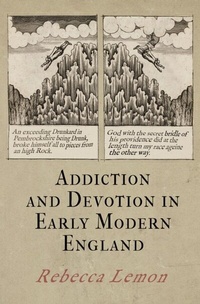
Addiction and Devotion in Early Modern England
1st Edition
Published on 2. February 2018
280 pages
978-0-8122-9481-1 (ISBN)
Description

Rebecca Lemon illuminates a previously-buried conception of addiction, as a form of devotion at once laudable, difficult, and extraordinary, that has been concealed by the persistent modern link of addiction to pathology. Surveying sixteenth-century invocations, she reveals how early moderns might consider themselves addicted to study, friendship, love, or God. However, she also uncovers their understanding of addiction as a form of compulsion that resonates with modern scientific definitions. Specifically, early modern medical tracts, legal rulings, and religious polemic stressed the dangers of addiction to alcohol in terms of disease, compulsion, and enslavement. Yet the relationship between these two understandings of addiction was not simply oppositional, for what unites these discourses is a shared emphasis on addiction as the overthrow of the will.
Etymologically, "addiction" is a verbal contract or a pledge, and even as sixteenth-century audiences actively embraced addiction to God and love, writers warned against commitment to improper forms of addiction, and the term became increasingly associated with disease and tyranny. Examining canonical texts including Doctor Faustus, Twelfth Night, Henry IV, and Othello alongside theological, medical, imaginative, and legal writings, Lemon traces the variety of early modern addictive attachments. Although contemporary notions of addiction seem to bear little resemblance to its initial meanings, Lemon argues that the early modern period's understanding of addiction is relevant to our modern conceptions of, and debates about, the phenomenon.
Etymologically, "addiction" is a verbal contract or a pledge, and even as sixteenth-century audiences actively embraced addiction to God and love, writers warned against commitment to improper forms of addiction, and the term became increasingly associated with disease and tyranny. Examining canonical texts including Doctor Faustus, Twelfth Night, Henry IV, and Othello alongside theological, medical, imaginative, and legal writings, Lemon traces the variety of early modern addictive attachments. Although contemporary notions of addiction seem to bear little resemblance to its initial meanings, Lemon argues that the early modern period's understanding of addiction is relevant to our modern conceptions of, and debates about, the phenomenon.
Reviews / Votes
"Addiction and Devotion performs valuable scholarly work by recovering a lost history of addiction, and illuminating a wide range of cultural attitudes both towards specific addictive practices and towards different forms of addiction as determined by the relationship of the addict to their object." (Renaissance and Reformation) "Addiction and Devotion in Early Modern England simultaneously dismantles the modern, medical definition of addiction as pathology and expertly reconstructs an image of early modern addiction as a confluence between material and immaterial phenomena...[This book] will certainly appeal to scholars of Shakespearean drama looking for nuanced rebuttals of individual sovereignty in canonical plays. More broadly, it will speak to early modernists in search of the period's potential for disrupting and recomposing historical teleologies. In this regard, Lemon's book heartily deserves a glass raised in its honor." (Comitatus) "[Addiction and Devotion in Early Modern England] succeeds in unfolding changing understandings of addiction, drawing attention to its forgotten links to devotion. Lemon amply demonstrates that addiction involved abandonment to something beyond oneself: God; the beloved; a community or cause; a substance... In prompting scholars to pay closer attention to the word's implications, the work performs valuable service. Readers are unlikely to take the term or concept for granted in future." (Parergon) "Rebecca Lemon presents a compelling, richly substantiated treatment of early modern cultures of addiction that offers genuinely new perspectives. Charting the development of the modern sense of addiction while at the same time attending to its early modern senses as something laudable, even heroic, Addiction and Devotion in Early Modern England is an important intervention." (Adam Smyth, University of Oxford)More details
Series
Language
English
Place of publication
Pennsylvania
United States
Target group
Professional and scholarly
Illustrations
4 illus.
File size
12,05 MB
ISBN-13
978-0-8122-9481-1 (9780812294811)
Copyright in bibliographic data and cover images is held by Nielsen Book Services Limited or by the publishers or by their respective licensors: all rights reserved.
Schweitzer Classification
Other editions
Additional editions
Rebecca Lemon
Addiction and Devotion in Early Modern England
Book
02/2024
University of Pennsylvania Press
€28.50
Shipment within 3-4 weeks
Rebecca Lemon
Addiction and Devotion in Early Modern England
Book
03/2018
University of Pennsylvania Press
€65.00
Shipment within 10-20 days
Person
Rebecca Lemon is Associate Professor of English at the University of Southern California and author of Treason by Words: Literature, Law, and Rebellion in Shakespeare's England.
Content
Preface
Introduction. Addiction in (Early) Modernity
Chapter 1. Scholarly Addiction in Doctor Faustus
Chapter 2. Addicted Love in Twelfth Night
Chapter 3. Addicted Fellowship in Henry IV
Chapter 4. Addiction and Possession in Othello
Chapter 5. Addictive Pledging from Shakespeare and Jonson to Cavalier Verse
Epilogue. Why Addiction?
Notes
Works Cited
Index
Acknowledgments
Introduction. Addiction in (Early) Modernity
Chapter 1. Scholarly Addiction in Doctor Faustus
Chapter 2. Addicted Love in Twelfth Night
Chapter 3. Addicted Fellowship in Henry IV
Chapter 4. Addiction and Possession in Othello
Chapter 5. Addictive Pledging from Shakespeare and Jonson to Cavalier Verse
Epilogue. Why Addiction?
Notes
Works Cited
Index
Acknowledgments
