

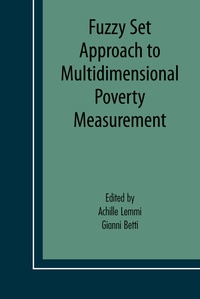
Fuzzy Set Approach to Multidimensional Poverty Measurement
Description

Recent theoretical and empirical studies have concluded that in order to be accurate, poverty and deprivation must be measured within a multidimensional framework that is consistent, efficient, and statistically robust.
The fuzzy sets approach to poverty measurement was developed in the early 1990s and continues to be refined by scholars of economics and sociology who find the traditional "monetary-only" indicators to be inadequate and arbitrary.
This volume brings together advanced thinking on the multidimensional measurement of poverty, including the theoretical background, applications to cross-sections using contemporary European examples, and longitudinal aspects of multidimensional fuzzy poverty analysis that pay particular attention to the transitory, or impermanent, conditions that often occur during transitions to market economies.
This book will be of interest to scholars and researchers and will be a useful text on poverty for advanced students in applied statistics, urban planning, economics, and sociology.
Reviews / Votes
From the reviews:
"The book is a collection written by economists, statisticians, and mathematicians. . The book comprises 13 chapters together with the editorial introduction. . As such, they contain a good deal of interesting empirical information. . The book under review is the kind of book it is and draws on the social science, which it draws on. Of its kind, it is good." (David Byrne, Journal of Regional Science, Vol. 48 (2), 2008)
More details
Other editions
Additional editions
Persons
Achille Lemmi is Professor of Economic Statistics at the University of Siena. His areas of interest and research include personal income distribution models, poverty and living conditions estimation and analysis, and poverty dynamics.
Gianni Betti is Associate Professor of Economic Statistics at the University of Siena. His areas of interest and research include poverty and living conditions analysis, equivalence scales, small area estimation and poverty mapping.
