

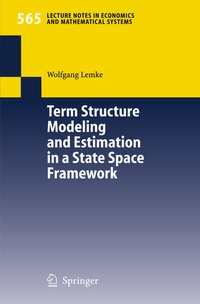
Term Structure Modeling and Estimation in a State Space Framework
1st Edition
Published on 8. December 2005
X, 226 pages
978-3-540-28344-7 (ISBN)
Description

This book has been prepared during my work as a research assistant at the Institute for Statistics and Econometrics of the Economics Department at the University of Bielefeld, Germany. It was accepted as a Ph.D. thesis titled "Term Structure Modeling and Estimation in a State Space Framework" at the Department of Economics of the University of Bielefeld in November 2004. It is a pleasure for me to thank all those people who have been helpful in one way or another during the completion of this work. First of all, I would like to express my gratitude to my advisor Professor Joachim Frohn, not only for his guidance and advice throughout the com pletion of my thesis but also for letting me have four very enjoyable years teaching and researching at the Institute for Statistics and Econometrics. I am also grateful to my second advisor Professor Willi Semmler. The project I worked on in one of his seminars in 1999 can really be seen as a starting point for my research on state space models. I thank Professor Thomas Braun for joining the committee for my oral examination.
Reviews / Votes
From the reviews:
"The author . introduces the AMGM models and gives the exact form for the yields and their moment structures. . the book is well-presented with sufficient references, and can serve as a reference for researchers in macroeconomics and financial mathematics. It can also be studied because it presents an important class of hidden Markov models." (Yanhong Wu, Mathematical Reviews, Issue 2006 h)
More details
Other editions
Additional editions
Book
09/2005
1st Edition
Springer
€106.99
Shipment within 7-9 days
Content
The Term Structure of Interest Rates.- Discrete-Time Models of the Term Structure.- Continuous-Time Models of the Term Structure.- State Space Models.- State Space Models with a Gaussian Mixture.- Simulation Results for the Mixture Model.- Estimation of Term Structure Models in a State Space Framework.- An Empirical Application.- Summary and Outlook.
7 Simulation Results for the Mixture Model (p.101)
After discussing mixture state space models in the previous section, we now present a small simulation study that aims to explore the properties of the AMF(fc) with respect to filtering, prediction and parameter estimation. There are three groups of simulations, where each group is characterized by the distribution of the state innovation. We examine a Gaussian mixture with two components having both mean zero but different variances; a Gaussian mixture with two components having the same variance but different means; and a Student t distribution with three degrees of freedom.
A first objective of the simulations is an assessment of how close the results of the AMF and the Kalman Filter come to those of the exact filter. Since the number of components of the exact filter increases exponentially with time, such comparisons can only be undertaken for small time series. For time series of length T = 10 we explore the discrepancy between the AMF and the Kalman filter on one side and the exact filter on the other side. Such a comparison is carried out with respect to the mean and variance of the filtered and predicted state as well as for the prediction and filtering density at T = 10.
Second, for longer time series of length T = 350 we compare the performance of the AMF and the Kalman filter in filtering and prediction. Of course, for such long time series the exact filter cannot be employed anymore. We also assess how the relative performance of the two algorithms depends on the parameterization of the data generating state space model. For this type of simulation we treat the hyperparameters of the state space models under consideration as known.
Third, again for time series of length T = 350, a subset of the hyperparameters constituting the state space model is treated as unknown. The parameters are estimated using the likelihood methods based on the Kalman filter and the AMF. The distributions of the estimated parameters, obtained from using different algorithms, are compared to each other.
For the group of simulations that uses the Student t distribution, the exact filter algorithm is not known and thus cannot be compared to the AMF and the Kalman filter. However, hyperparameters are estimated even for this case: the state innovation is falsely assumed to be distributed as a normal or a normal mixture and is then estimated using the Kalman filter and the AMF, respectively.
All of the simulations are conducted using GAUSS 3.6. Standard Gaussian pseudo random variables and pseudo random variables from the uniform distribution over [0,1] are generated using GAUSS's rndnO and rnduO function respectively. For generating pseudo random variables from a Student t distribution, the function rstudentO from the DISTRIB library by Rainer Schlittgen and Thomas Noack is used. The appendix shows how random draws from the Gaussian Mixture are generated.
Numerical maximization of the likelihoods is performed using the BFGS algorithm as implemented in GAUSS's MAXLIK Ubrary. The convergence criterion for the gradient is set to 0.5 10 -6. Gradients of the likelihood are computed numerically.
After discussing mixture state space models in the previous section, we now present a small simulation study that aims to explore the properties of the AMF(fc) with respect to filtering, prediction and parameter estimation. There are three groups of simulations, where each group is characterized by the distribution of the state innovation. We examine a Gaussian mixture with two components having both mean zero but different variances; a Gaussian mixture with two components having the same variance but different means; and a Student t distribution with three degrees of freedom.
A first objective of the simulations is an assessment of how close the results of the AMF and the Kalman Filter come to those of the exact filter. Since the number of components of the exact filter increases exponentially with time, such comparisons can only be undertaken for small time series. For time series of length T = 10 we explore the discrepancy between the AMF and the Kalman filter on one side and the exact filter on the other side. Such a comparison is carried out with respect to the mean and variance of the filtered and predicted state as well as for the prediction and filtering density at T = 10.
Second, for longer time series of length T = 350 we compare the performance of the AMF and the Kalman filter in filtering and prediction. Of course, for such long time series the exact filter cannot be employed anymore. We also assess how the relative performance of the two algorithms depends on the parameterization of the data generating state space model. For this type of simulation we treat the hyperparameters of the state space models under consideration as known.
Third, again for time series of length T = 350, a subset of the hyperparameters constituting the state space model is treated as unknown. The parameters are estimated using the likelihood methods based on the Kalman filter and the AMF. The distributions of the estimated parameters, obtained from using different algorithms, are compared to each other.
For the group of simulations that uses the Student t distribution, the exact filter algorithm is not known and thus cannot be compared to the AMF and the Kalman filter. However, hyperparameters are estimated even for this case: the state innovation is falsely assumed to be distributed as a normal or a normal mixture and is then estimated using the Kalman filter and the AMF, respectively.
All of the simulations are conducted using GAUSS 3.6. Standard Gaussian pseudo random variables and pseudo random variables from the uniform distribution over [0,1] are generated using GAUSS's rndnO and rnduO function respectively. For generating pseudo random variables from a Student t distribution, the function rstudentO from the DISTRIB library by Rainer Schlittgen and Thomas Noack is used. The appendix shows how random draws from the Gaussian Mixture are generated.
Numerical maximization of the likelihoods is performed using the BFGS algorithm as implemented in GAUSS's MAXLIK Ubrary. The convergence criterion for the gradient is set to 0.5 10 -6. Gradients of the likelihood are computed numerically.
