

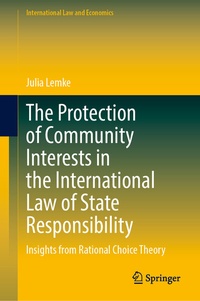
The Protection of Community Interests in the International Law of State Responsibility
Description

This book redefines the traditional understanding of state responsibility. It presents a compelling argument that international law's effectiveness hinges on its ability to protect not only state interests but also those of the global community.
Drawing from principles established in the Articles on the Responsibility of States for Internationally Wrongful Acts (ARSIWA), the book examines how states, conceptualised as rational actors, navigate collective action challenges. Through a law and economics lens, it sheds light on the role of international state responsibility in providing global public goods and safeguarding common pool resources.
This interdisciplinary book offers valuable insights and normative suggestions for enhancing the ARSIWA's efficacy in promoting community interests. It will appeal to scholars and practitioners in public international law, law and economics, and international relations, interested in a better understanding of international law's role in tackling pressing global issues.
More details
Other editions
Additional editions
Person
Julia Lemke is a member of the cabinet of the European Commission Executive Vice-President for a Clean, Just and Competitive Transition, Teresa Ribera. Before this, she was a member of the cabinet of the European Commissioner for Economy, Paolo Gentiloni, and held several senior advisor positions in international and European affairs at the German Federal Ministry of Finance and the French Treasury.
She completed her Doctorate in Law at the University of Hamburg, Germany, and obtained the First and Second State Examination in Law in Berlin, Germany. She also holds law degrees from the University of Paris X, Nanterre, France, and the London School of Economics and Political Science, United Kingdom, and was a visiting researcher at the University of California, Berkeley, USA.
Content
Part I: Introductory Part.- Chapter 1. Introduction: A Rational Choice Analysis of International State Responsibility.- Chapter 2. The Protection of Community Interests in International Law and Economics.- Chapter 3. The Normative Framework: Objectives of State Responsibility in International Law.- Part II: Main Part.- Chapter 4. Conditions for International State Responsibility: A Rational Choice Analysis of Responsibility Standards.- Chapter 5. Exemptions of International State Responsibility: A Rational Choice Analysis of Justifications and Excuses in International Law.- Chapter 6. Consequences of International State Responsibility: A Rational Choice Analysis of Remedies in International Law.- Chapter 7. Implementation of International State Responsibility: A Rational Choice Analysis of Countermeasures in International Law.- Part III: Concluding Part.- Chapter 8. Conclusion.
