

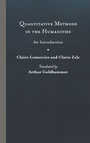
Quantitative Methods in the Humanities
Description
Alles über E-Books | Antworten auf Fragen rund um E-Books, Kopierschutz und Dateiformate finden Sie in unserem Info- & Hilfebereich.
This timely and lucid guide is intended for students and scholars working on all historical periods and topics in the humanities and social sciences--especially for those who do not think of themselves as experts in quantification, "big data," or "digital humanities."
The authors reveal quantification to be a powerful and versatile tool, applicable to a myriad of materials from the past. Their book, accessible to complete beginners, offers detailed advice and practical tips on how to build a dataset from historical sources and how to categorize it according to specific research questions. Drawing on examples from works in social, political, economic, and cultural history, the book guides readers through a wide range of methods, including sampling, cross-tabulations, statistical tests, regression, factor analysis, network analysis, sequence analysis, event history analysis, geographical information systems, text analysis, and visualization. The requirements, advantages, and pitfalls of these techniques are presented in layperson's terms, avoiding mathematical terminology.
Conceived primarily for historians, the book will prove invaluable to other humanists, as well as to social scientists looking for a nontechnical introduction to quantitative methods. Covering the most recent techniques, in addition to others not often enough discussed, the book will also have much to offer to the most seasoned practitioners of quantification.
All prices
More details
Other editions
Additional editions
Persons
Claire Lemercier is Research Professor of History at the Center for the Sociology of Organizations, Paris.
Claire Zalc is Research Professor of History at the Institute for Early Modern and Modern History and at the School of Advanced Studies in the Social Sciences, Paris.
Arthur Goldhammer is an affiliate of the Center for European Studies at Harvard University.
Content
- Intro
- Contents
- Acknowledgments
- Introduction
- One: Quantitative History from Peak to Crisis
- Two: Sources and Samples
- Three: From Source to Data
- Four: From Correlation to Causality?
- Five: Quantification, Networks, and Trajectories
- Six: Visualizing History
- Seven: Counting Words, Exploring Texts
- Conclusion
- Bibliography
- Index

System requirements
File format: ePUB
Copy protection: Adobe-DRM (Digital Rights Management)
System requirements:
- Computer (Windows; MacOS X; Linux): Install the free reader Adobe Digital Editions prior to download (see eBook Help).
- Tablet/smartphone (Android; iOS): Install the free app Adobe Digital Editions or the app PocketBook before downloading (see eBook Help).
- E-reader: Bookeen, Kobo, Pocketbook, Sony, Tolino and many more (not Kindle).
The file format ePub works well for novels and non-fiction books – i.e., „flowing” text without complex layout. On an e-reader or smartphone, line and page breaks automatically adjust to fit the small displays.
This eBook uses Adobe-DRM, a „hard” copy protection. If the necessary requirements are not met, unfortunately you will not be able to open the eBook. You will therefore need to prepare your reading hardware before downloading.
Please note: We strongly recommend that you authorise using your personal Adobe ID after installation of any reading software.
For more information, see our ebook Help page.
File format: PDF
Copy-Protection: Adobe-DRM (Digital Rights Management)
System requirements:
- Computer (Windows; MacOS X; Linux): Install the free reader Adobe Digital Editions prior to download (see eBook Help).
- Tablet/smartphone (Android; iOS): Install the free app Adobe Digital Editions or the app PocketBook before downloading (see eBook Help).
- E-reader: Bookeen, Kobo, Pocketbook, Sony, Tolino and many more (only limited: Kindle).
The file format PDF always displays a book page identically on any hardware. This makes PDF suitable for complex layouts such as those used in textbooks and reference books (images, tables, columns, footnotes). Unfortunately, on the small screens of e-readers or smartphones, PDFs are rather annoying, requiring too much scrolling.
This eBook uses Adobe-DRM, a „hard” copy protection. If the necessary requirements are not met, unfortunately you will not be able to open the eBook. You will therefore need to prepare your reading hardware before downloading.
Please note: We strongly recommend that you authorise using your personal Adobe ID after installation of any reading software.
For more information, see our eBook Help page.
File format: ePUB
Copy protection: without DRM (Digital Rights Management)
System requirements:
- Computer (Windows; MacOS X; Linux): Use a reader that can handle the file format ePUB, such as Adobe Digital Editions or FBReader – both free (see eBook Help).
- Tablet/Smartphone (Android; iOS): Install the free app Adobe Digital Editions or the app PocketBook (see eBook Help).
- E-reader: Bookeen, Kobo, Pocketbook, Sony, Tolino and many more (not Kindle).
The file format ePUB works well for novels and non-fiction books – i.e., 'flowing' text without complex layout. On an e-reader or smartphone, line and page breaks automatically adjust to fit the small displays.
This eBook does not use copy protection or Digital Rights Management
For more information, see our eBook Help page.
