

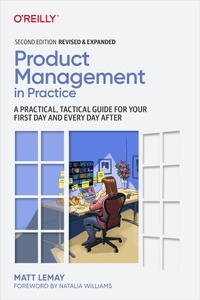
Product Management in Practice
Description

Product management has become a critical function for modern organizations, from small startups to corporate enterprises. And yet, the day-to-day work of product management remains largely misunderstood. In theory, product managers are high-flying visionaries who build products that people love. In practice, they''re hard-working facilitators who bring clarity and focus to their teams.
In this thoroughly revised and expanded edition, Matt LeMay provides real-world guidance for current and aspiring product managers. Updated for the era of remote and hybrid work, this book provides actionable answers to product management''s most persistent and confounding questions, starting with: What exactly am I supposed to do all day?
With this book, you''ll learn:
- What the day-to-day work of product management entails--and how to excel at it
- Why no job title or description will resolve the ambiguity of your role
- How to bridge the false dichotomy between "strategy" and "execution"
- Why the temptation to focus on decks and documentation can be bad for your team (and for you)
- How to prioritize your time and pick your battles
More details
Other editions
Additional editions
Content
- Cover
- Copyright
- Table of Contents
- Foreword
- Author's Foreword to the Second Edition
- Preface
- Why I Wrote This Book: My First Day as a Product Manager
- Who This Book Is For
- How This Book Is Organized
- Stories from Working Product Managers
- "Your Checklist"
- O'Reilly Online Learning
- How to Contact Us
- Acknowledgments
- Chapter 1. The Practice of Product Management
- What Is Product Management?
- What Is Not Product Management?
- What Is the Profile of a Great Product Manager?
- What Is the Profile of a Bad Product Manager?
- No, You Don't Have to Work 60 Hours a Week to Be a Product Manager
- What About Program Managers? Product Owners?
- Summary: Sailing the Seas of Ambiguity
- Your Checklist
- Chapter 2. The CORE Skills of Product Management
- The Hybrid Model: UX/Tech/Business
- The CORE Skills of Product Management: Communication, Organization, Research, and Execution
- Communication
- Organization
- Research
- Execution
- ...But What About Hard Skills?
- Summary: Changing the Conversation About Product Management
- Your Checklist
- Chapter 3. Showing Up Curious
- Taking a Genuine Interest
- Cultivating a Growth Mindset
- The Gift of Being Wrong
- Staying Off the Defensive
- Asking Why Without Asking "Why"
- Spreading Curiosity
- Summary: Curiosity Is Key
- Your Checklist
- Chapter 4. The Art of Egregious Overcommunication
- Asking the Obvious
- Don't Deflect, Be Direct
- Not Everything Is Your Fault, and Outcomes Matter More Than Intentions
- The Two Most Dangerous Words in Product Management: "Looks Fine"
- A Tactical Approach to Move Past "Looks Fine": Disagree and Commit
- Accounting for Different Communication Styles
- Communication Is Your Job-Don't Apologize for Doing Your Job
- Egregious Overcommunication in Practice: Three Common Communication Scenarios for Product Managers
- Scenario One
- Scenario Two
- Scenario Three
- Summary: When in Doubt, Communicate!
- Your Checklist
- Chapter 5. Working with Senior Stakeholders (or, Throwing the Poker Game)
- From "Influence" to Information
- An Answer You Don't Like Is Still an Answer
- "Our Boss Is an Idiot," or, Congratulations-You've Ruined Your Team
- No Alarms and No Surprises
- Staying User Centric in a World of Company Politics
- Senior Stakeholders Are People Too
- Throwing the Poker Game in Practice: Three Common Scenarios for Senior Stakeholder Management
- Scenario One
- Scenario Two
- Scenario Three
- Summary: This Is Part of Your Job, Not an Impediment to Your Job
- Your Checklist
- Chapter 6. Talking to Users (or, "What's a Poker Game?")
- Stakeholders and Users Are Different
- Yes, You Need to Learn How to Talk to Users
- Personae Non Grata
- Product and Research: From Frenemies to BFFs
- Summary: No, Seriously, You Need to Learn How to Talk to Users
- Your Checklist
- Chapter 7. The Worst Thing About "Best Practices"
- Don't Believe the Hype
- Falling in Love with Reality
- Frameworks and Models as Useful Fictions
- You Are Here
- What Are You Solving For?
- "But This Worked at the Last Place!"
- Working with the "Process Averse"
- The Best Thing About Best Practices
- Summary: A Place to Start, Not a Guarantee
- Your Checklist
- Chapter 8. The Wonderful, Horrible Truth About Agile
- Debunking Three Common Myths About Agile
- Turning to the Agile Manifesto
- From Manifesto to Monster
- Rediscovering Alistair Cockburn's "Heart of Agile"
- Agile and the "Proprietization of Common Sense"
- When Doing Agile "Right" Makes Things Worse
- When Doing Agile "Wrong" Makes Things Better
- Seven Conversations About Agile I Never Want to Have Ever Again
- Summary: Ambiguity Lives Here Too
- Your Checklist
- Chapter 9. The Infinite Time Suck of Documentation (and Yes, Roadmaps Are Documentation)
- "The Product Manager Owns the Roadmap!"
- It's Not the Roadmap, It's How You Use the Roadmap
- You Gantt Always Get What You Want
- Your Product Spec Is Not Your Product
- The Best Documentation Is Incomplete
- No First Draft Should Ever Be More Than One Page and One Hour of Effort
- If You've Got It, Template
- A Quick Note on Proprietary Roadmapping and Knowledge Management Tools
- Summary: The Menu Is Not the Meal
- Your Checklist
- Chapter 10. Vision, Mission, Objectives, Strategy, and Other Fancy Words
- The Outcomes and Output Seesaw
- SMART Goals, CLEAR Goals, OKRs, and So On
- Good Strategy Is Inexorably Tied to Execution
- Good Strategy Is Simple and Obvious
- If You're Not Sure, Ask for an Example
- Summary: Keep It Simple, Make It Useful
- Your Checklist
- Chapter 11. "Data, Take the Wheel!"
- The Trouble with the "D" Word
- Start with the Decision, Then Find the Data
- Focusing on Metrics That Matter
- Using Survival Metrics to Set Clear Expectations
- Experimentation and Its Discontents
- From "Accountability" to Action
- Summary: No Shortcuts!
- Your Checklist
- Chapter 12. Prioritization: Where It All Comes Together
- Taking a Bite of the Layer Cake
- Every Decision Is a Trade-Off
- Keeping the Entire Experience in Mind
- From Shiny Objects to Jewels of Understanding
- But This Is an Emergency!
- Prioritization in Practice: Same Options, Different Goals and Strategies
- Summary: Think Big, Start Small
- Your Checklist
- Chapter 13. Try This at Home: The Trials and Tribulations of Remote Work
- Building Trust from Far Away
- Simple Communication Agreements Create Meaningful Trust
- Navigating Synchronous and Asynchronous Communication
- Synchronous Communication for Distributed Teams: Choreographing Time and Space
- Asynchronous Communication for Distributed Teams: Setting Specific Expectations
- Making a "Synchronous Sandwich"
- Creating and Protecting Space for Informal Communication
- Hybrid Moments: Balancing In-Person and Remote Work
- Summary: Strength Training for Your Communication Practice
- Your Checklist
- Chapter 14. A Manager Among Product Managers (The Product Leadership Chapter)
- Climbing the Ladder
- Surprise! Everything You're Doing Is Wrong
- The Standard You Set for Yourself Is the Standard You Set for Your Team
- The Limits of Autonomy
- Clear Goals, Clear Guardrails, Short Feedback Loops
- Externalizing Yourself
- Product Leadership in Practice
- Scenario One
- Scenario Two
- Scenario Three
- Summary: Stepping Into Your Best Self
- Your Checklist
- Chapter 15. In Good Times and Bad
- The Soothing Lull of an Organization on Autopilot
- The Good Times Aren't (Always) the Easy Times
- Carrying the Weight of the World
- Imagine You Work for the Best Company in the World
- Summary: It's Hard Work, but It's Worth It
- Your Checklist
- Whatever It Takes
- Appendix A. A Reading List for Expanding Your Product Management Practice
- Appendix B. Articles, Videos, Newsletters and Blog Posts Cited in This Book
- Index
- About the Author
