

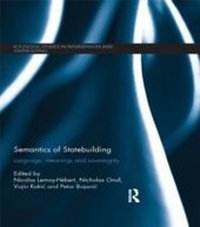
Semantics of Statebuilding
Language, meanings and sovereignty
1st Edition
Published on 4. December 2013
200 pages
978-1-136-65446-6 (ISBN)
Description

This volume examines international statebuilding in terms of language and meanings, rather than focusing narrowly on current policy practices.
After two decades of evolution towards more 'integrated,' 'multi-faceted' or, simply stated, more intrusive statebuilding and peacebuilding operations, a critical literature has slowly emerged on the economic, social and political impacts of these interventions. Scholars have started to analyse the 'unintended consequences' of peacebuilding missions, analysing all aspects of interventions.
Central to the book is the understanding that language is both the most important tool for building anything of social significance, and the primary repository of meanings in any social setting. Hence, this volume exemplifies how the multiple realities of state, state fragility and statebuilding are being conceptualised in mainstream literature, by highlighting the repercussions this conceptualisation has on 'good practices' for statebuilding. Drawing together leading scholars in the field, this project provides a meeting point between constructivism in international relations and the critical perspective on liberal peacebuilding, shedding new light on the commonly accepted meanings and concepts underlying the international (or world) order, as well as the semantics of contemporary statebuilding practices.
This book will be of much interest to students of statebuilding and intervention, war and conflict studies, security studies and international relations.
After two decades of evolution towards more 'integrated,' 'multi-faceted' or, simply stated, more intrusive statebuilding and peacebuilding operations, a critical literature has slowly emerged on the economic, social and political impacts of these interventions. Scholars have started to analyse the 'unintended consequences' of peacebuilding missions, analysing all aspects of interventions.
Central to the book is the understanding that language is both the most important tool for building anything of social significance, and the primary repository of meanings in any social setting. Hence, this volume exemplifies how the multiple realities of state, state fragility and statebuilding are being conceptualised in mainstream literature, by highlighting the repercussions this conceptualisation has on 'good practices' for statebuilding. Drawing together leading scholars in the field, this project provides a meeting point between constructivism in international relations and the critical perspective on liberal peacebuilding, shedding new light on the commonly accepted meanings and concepts underlying the international (or world) order, as well as the semantics of contemporary statebuilding practices.
This book will be of much interest to students of statebuilding and intervention, war and conflict studies, security studies and international relations.
More details
Series
Language
English
Place of publication
London
United Kingdom
Publishing group
Taylor & Francis Ltd
Target group
College/higher education
Professional and scholarly
File size
2,98 MB
ISBN-13
978-1-136-65446-6 (9781136654466)
Copyright in bibliographic data and cover images is held by Nielsen Book Services Limited or by the publishers or by their respective licensors: all rights reserved.
Schweitzer Classification
Other editions
Additional editions
Nicolas Lemay-Hebert | Nicholas Onuf | Vojin Rakic
Semantics of Statebuilding
Language, meanings and sovereignty
Book
01/2016
1st Edition
Routledge
€78.20
Shipment within 10-20 days
Nicolas Lemay-Hebert | Nicholas Onuf | Vojin Rakic
Semantics of Statebuilding
Language, meanings and sovereignty
Book
11/2013
1st Edition
Routledge
€241.50
Shipment within 15-20 days
Persons
Nicolas Lemay-Hebert is a senior lecturer at the University of Birmingham.
Nicholas Onuf is Professor Emeritus of International Relations at Florida International University.
Vojin Rakic is Professor of Political Science at the University of Belgrade.
Petar Bojanic is a researcher at the Institute for Philosophy and Social Theory, Belgrade.
Nicholas Onuf is Professor Emeritus of International Relations at Florida International University.
Vojin Rakic is Professor of Political Science at the University of Belgrade.
Petar Bojanic is a researcher at the Institute for Philosophy and Social Theory, Belgrade.
Content
1. Introduction: Disputing Weberian Semantics, Nicolas Lemay-Hebert, Nicholas Onuf and Vojin Rakic 2. World-Making, State-Building, Nicholas Onuf 3. Politics, Law, and the Sacred: A Conceptual Analysis, Friedrich Kratochwil 4. Kant's Semantics of World (State) Making, Vojin Rakic 5. The semantics of early statebuilding: Why the Eurasian steppe has been overlooked, Iver B. Neumann 6. The Semantics of Statebuilding and Nationbuilding: Looking Beyond Neo-Weberian Approaches, Nicolas Lemay-Hebert 7. Transformative Statebuilding, Occupation, and International Law: Friends or Foes?, Jan Wouters and Kenneth Chan 8. The Semantics of 'Crisis Management': Simulation and EU Statebuilding in the Balkans, David Chandler 9. The Semantics of Contemporary Statebuilding: Kosovo, Timor-Leste, and the 'Empty-Shell' Approach, Nicolas Lemay-Hebert 10. The 'Crisis of Capitalism' and the State - More Powerful, Less Responsible, Invariably Legitimate, Albena Azmanova 11. The Neoliberal Biopolitics of Resilience and the Spectre of the Ecofascist State, Julian Reid
