

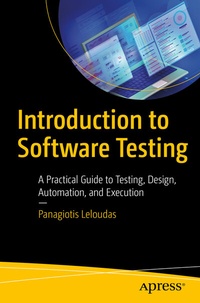
Introduction to Software Testing
Description

Get started and hit the ground running in the world of software testing. This simple and practical guide teaches you the fundamentals of software testing, with no prior experience required.
You will start by learning functional and non-functional software testing. Then you will gain an understanding of the primary responsibilities of a tester in the Software Development Life Cycle and how to plan and execute testing activities. You will also learn how testing applies to an agile environment, what challenges you might face in your day-to-day life as a tester, and how to overcome them. You will learn the most commonly used test design techniques, with ample examples and exercises to practice yourself.
By the end of this book, you will understand the software testing ecosystem, from its types, techniques, and tools, to test planning, execution, and reporting.
What You Will Learn
- Master the fundamentals of Software Testing
- Gain an understanding of different software testing types
- Plan and execute testing activities
- Apply test design techniques to concrete examples
Who This Book Is For
Software testers, developers, project managers, and other stakeholders involved in software testing.More details
Other editions
Additional editions
Person
Panagiotis Leloudas is a software quality assurance engineer with more than ten years of working experience in the industry. He holds several ISTQB certifications and is an expert in testing principles, methodologies, and techniques.
He decided to write a quick guide to software testing because he needed a go-to document to use as a manual for all the decisions he has to make on a day-to-day basis. He tried include everything he would have liked to have known when he started his career.
Content
Chapter 1: Introduction.- Chapter 2: Software Testing Types and Techniques.- Chapter 3: Software Development Life Cycle.- Chapter 4: Test Planning.- Chapter 5: Test Design Techniques.- Chapter 6: Test Execution.- Chapter 7: Test Automation.- Chapter 8: Testing in Agile Environments.- Chapter 9. Challenges and Solutions in Software Testing.- Afterword.
