

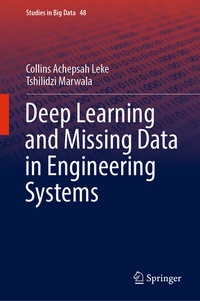
Deep Learning and Missing Data in Engineering Systems
Description

- deep autoencoder neural networks;
- deep denoising autoencoder networks;
- the bat algorithm;
- the cuckoo search algorithm; and
- the firefly algorithm.
The hybrid models proposed are used to estimate the missing data in high-dimensional data settings more accurately. Swarm intelligence algorithms are applied to address critical questions such as model selection and model parameter estimation. The authors address feature extraction for the purpose of reconstructing the input data from reduced dimensions by the use of deep autoencoder neural networks. They illustrate new models diagrammatically, report their findings in tables, so as to put their methods on a sound statistical basis. The methods proposed speed up the process of data estimation while preserving known features of the data matrix.
This book is a valuable source of information for researchers and practitioners in data science. Advanced undergraduate and postgraduate students studying topics in computational intelligence and big data, can also use the book as a reference for identifying and introducing new research thrusts in missing data estimation.
More details
Other editions
Additional editions
Persons
Tshilidzi Marwala is the Vice-Chancellor and Principal of the University of Johannesburg. He was previously the Deputy Vice-Chancellor for Research and Internationalisation as well as Dean of Engineering and the Built Environment at the University of Johannesburg. Prior to that he was the Adhominem Professor of Electrical Engineering as well as the Carl and Emily Fuchs Chair of Systems and Control Engineering at the University of the Witwatersrand. He is a Fellow of The World Academy of Sciences of the Developing World (TWAS) as well as a distinguished member of the ACM. He holds a Bachelor of Science in Mechanical Engineering from Case Western Reserve University, USA, a Master of Engineering from the University of Pretoria, South Africa, and a PhD in Engineering from the University of Cambridge, UK. He was a postdoctoral research associate at the Imperial College of Science, Technology and Medicine, and a visiting fellow at Harvard University and Cambridge University.
Collins Leke holds a PhD and Master's degrees from the University of Johannesburg. He also holds a Bachelor's degree in Computer Science and Applied Mathematics from the University of the Witwatersrand. His research interests include the application of machine learning and computational intelligence to electrical and biomedical engineering, as well as in finance and insurance.
Content
