

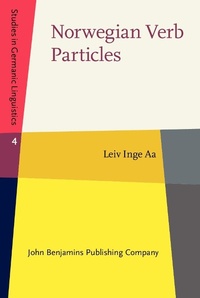
Norwegian Verb Particles
1st Edition
Published on 11. August 2020
194 pages
978-90-272-6083-3 (ISBN)
Description

This book aims to explain the syntax and semantics of Norwegian verb particles. While particles have been claimed to be distributed optionally to the left (as LPrt) or right (as RPrt) of an associated DP in the linguistic literature, the dialectologically oriented literature has shown for a long time that many Norwegian particles are preferred as LPrt (corresponding to English 'throw out the dog'). While spatial particles can appear in both positions, non-spatial particles primarily appear as LPrt. A complex predicate analysis is adopted for non-spatial particles, and a small clause analysis for spatial particles. It is argued that a non-spatial LPrt construction triggers an atelic reading, and the RPrt counterpart identifies a result state.The book combines traditional dialectology with modern linguistic theories and includes much Norwegian data that has not been shed theoretical light on before: simplex and complex spatial and non-spatial constructions, phrasal particles, ground promotion, and unaccusatives. Several earlier theoretical accounts of Norwegian particles are reviewed in a separate chapter.
More details
Other editions
Additional editions
Leiv Inge Aa
Norwegian Verb Particles
Book
08/2020
John Benjamins Publishing Co
€130.73
Shipment within 10-15 days
Content
- Intro
- Norwegian Verb Particles
- Editorial page
- Title page
- Copyright page
- Table of contents
- Acknowledgements
- 1. Introduction
- 1.1 Verb-particle data
- 1.1.1 The alternation problem and a possible solution
- 1.1.2 More Norwegian data to be considered
- 1.1.3 Norwegian in a Scandinavian perspective
- 1.1.4 The Norwegian language situation - and the rendition of Norwegian examples
- 1.2 Basic theoretical assumptions
- 1.2.1 X-bar theory
- 1.2.2 Neo-constructivism
- 1.3 Parameters and syntactic micro-variation
- 1.3.1 (Micro-)Parameters as first-, second-, or third-factor principles?
- 1.3.2 Phrase structural vs. operational variation
- 1.3.3 Dialects as a comparative object of study
- 1.4 Dialectological sources and tools
- 1.4.1 Corpus data
- 1.4.1.1 Speech corpora
- 1.4.1.2 The Nordic Dialect Corpus: Dialects, transcription, and informants
- 1.4.2 'Norsk Ordbok' 'The Norwegian Dictionary'
- 1.4.3 Norwegian dialectological sources
- 1.4.4 Introspective examples
- 1.4.5 Acceptability judgement of the Norwegian particle distribution
- 1.5 The structure of the book
- 2. Norwegian verb-particle data
- 2.1 Simplex constructions
- 2.1.1 Previous accounts
- 2.1.2 The Nordic Dialect Corpus
- 2.1.2.1 Narrowing down to Norwegian
- 2.1.2.2 The specific searches
- 2.1.2.3 Results
- 2.1.3 Fieldwork in Trøndelag (and Nordmøre)
- 2.2 V + LPrt spelled out with word accent
- 2.3 Complex constructions
- 2.3.1 Verb-particles followed by a resultative PP
- 2.3.2 Complex phrasal particles
- 2.4 Ground promotion
- 2.5 Unaccusatives
- 2.6 Conclusion
- 3. The alternation problem and the status of the particle - previous approaches
- 3.1 The alternation problem
- 3.1.1 The Prt-DP base order
- 3.1.1.1 Taraldsen's (1983) approach
- 3.1.1.2 Den Dikken's (1995) approach
- 3.1.2 The DP-Prt order
- 3.1.2.1 Åfarli's (1985) criticism of Taraldsen (1983)
- 3.1.2.2 Svenonius' (1996a) early minimalist version
- 3.1.3 Evaluation and the data problem
- 3.2 The Status of the particle
- 3.2.1 The V-Prt relation in Zeller (2001)
- 3.2.1.1 Structural and morphological adjacency
- 3.2.1.2 The particle as a lexical V-complement
- 3.2.1.3 The non-predicational structure of PPs and VPrt constructions
- 3.2.2 The particle as an identifier of result state in a decomposed VP
- 3.2.2.1 Leftward particle movement to identify result state: Ramchand & Svenonius (2002)
- 3.2.2.2 Case licensing
- 3.2.2.3 Head movement and constraints
- 3.2.2.4 Successful vs. unsuccessful P shift
- 3.2.2.5 Ramchand (2008)
- 3.2.2.6 Conclusion
- 3.3 Conclusion
- 4. The structure of Norwegian verb-particle constructions
- 4.1 The basic assumptions
- 4.1.1 Some basic assumptions from the Larsen (2014) model
- 4.1.2 Particle topicalisation
- 4.1.3 'Rett' 'right' modification
- 4.1.4 V2 and stranded particle
- 4.1.5 Preliminary hypotheses
- 4.2 Simplex constructions
- 4.2.1 Structural semantics, lexical semantics, and world knowledge
- 4.2.2 The structure as the primary carrier of meaning
- 4.2.3 The basic semantics of prepositions and the lexical modification of the structure
- 4.2.4 World knowledge: Possible S-semantic modification of structural semantics
- 4.3 Complex constructions
- 4.3.1 Constructions with a full resultative PP
- 4.3.2 Constructions with complex phrasal particles
- 4.4 Ground promotion
- 4.4.1 Earlier accounts and new data
- 4.4.2 The analysis
- 4.4.3 The case of 'ut' 'out', 'inn' 'in(to)', 'opp' 'up' and 'ned' 'down'
- 4.4.4 Conclusion
- 4.5 Unaccusatives
- 4.5.1 Personal vs. impersonal unaccusatives
- 4.5.2 Meteorological constructions
- 4.6 Conclusion
- 5. Summary and conclusions
- References
- Index
