

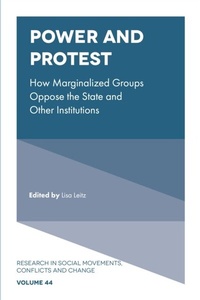
Power and Protest
How Marginalized Groups Oppose the State and Other Institutions
1st Edition
Published on 2. March 2021
224 pages
978-1-83909-834-5 (ISBN)
Description

Power and Protest presents chapters that analyse the dynamics of power in social movements. Examining how marginalized groups use their identities, resources, cultural traditions, violence and non-violence to assert power and exert pressure, this volume shines a light on the interaction of these groups with governments, international organizations, businesses and universities.
Including chapters which draw from multidisciplinary theories and utilise quantitative and qualitative research to examine how power shapes the context and experiences of protest, the authors analyse movements in Asia, South Africa, Arab nations, the United States and Argentina to offer insights into the power utilised by average citizens, and particularly members of marginalized groups. With contributors serving up findings based on uprisings, strikes and activist activity across the globe, the first section provides theoretical insights into the power of protest campaigns against governments or corporations. Moving on to an examination of nongovernmental institutions and cultural traditions, the authors in the second section explore the role of business and education in bringing down illegitimate governments, investigates the clashes of transnational norms, government policy and the heritage industry, and examines student protests against university policies. This volume encourages readers to reconsider their assumptions about which groups can successfully wield power in social movements.
Including chapters which draw from multidisciplinary theories and utilise quantitative and qualitative research to examine how power shapes the context and experiences of protest, the authors analyse movements in Asia, South Africa, Arab nations, the United States and Argentina to offer insights into the power utilised by average citizens, and particularly members of marginalized groups. With contributors serving up findings based on uprisings, strikes and activist activity across the globe, the first section provides theoretical insights into the power of protest campaigns against governments or corporations. Moving on to an examination of nongovernmental institutions and cultural traditions, the authors in the second section explore the role of business and education in bringing down illegitimate governments, investigates the clashes of transnational norms, government policy and the heritage industry, and examines student protests against university policies. This volume encourages readers to reconsider their assumptions about which groups can successfully wield power in social movements.
More details
Series
Language
English
Place of publication
Bingley
United Kingdom
Target group
Professional and scholarly
File size
3,42 MB
ISBN-13
978-1-83909-834-5 (9781839098345)
Copyright in bibliographic data and cover images is held by Nielsen Book Services Limited or by the publishers or by their respective licensors: all rights reserved.
Schweitzer Classification
Other editions
Additional editions
Book
03/2021
Emerald Publishing Limited
€133.30
Shipment within 3-4 weeks
Person
Lisa Leitz is Delp-Wilkinson Professor and Department Chair of Peace Studies at Chapman University, USA. Her book, Fighting for Peace: Veterans and Military Families in the Anti-Iraq War Movement, won the 2015 American Sociological Association's Peace, War and Social Conflict Outstanding Book Award. She serves as the Series Editor of Research in Social Movements, Conflicts and Change.
Content
Introduction; Lisa Leitz and Paige N. Gulley Section I. Theorizing the Power of Protestors
Chapter 1. The Reclamation Master Frame: A Visual Study of the Arab Uprisings; Mounira M. Charrad, Amina Zarrugh and Hyun Jeong Ha
Chapter 2. Understanding Strikes in the 21st Century: Perspectives from the USA; Chris Rhomberg and Steven H. Lopez
Chapter 3. Group Size and the Use of Violence by Resistance Campaigns: A Multi-level Study of Resistance Method; Christopher J. Cyr and Michael Widmeier
Chapter 4. Marginalization and Mobilizing Power in Nonviolent Social Movements; Selina Gallo-Cruz
Section II. Power of Institutions and Tradition
Chapter 5. Illegitimacy, Political Stability, and the Erosion of Alliances: Lessons from the End of Apartheid in South Africa; Eric W. Schoon and Robert J. VandenBerg
Chapter 6: Whaling in Korea: Heritage, Framing and Contention against International Norms; Bradley Tatar
Chapter 7. Mobilizing for Religious Freedom: Educational Opportunity Structures and Outcomes of Conservative Christian Campus Activism; Jonathan S. Coley
Epilogue: Updates to Research in Social Movements, Conflicts and Change
Chapter 1. The Reclamation Master Frame: A Visual Study of the Arab Uprisings; Mounira M. Charrad, Amina Zarrugh and Hyun Jeong Ha
Chapter 2. Understanding Strikes in the 21st Century: Perspectives from the USA; Chris Rhomberg and Steven H. Lopez
Chapter 3. Group Size and the Use of Violence by Resistance Campaigns: A Multi-level Study of Resistance Method; Christopher J. Cyr and Michael Widmeier
Chapter 4. Marginalization and Mobilizing Power in Nonviolent Social Movements; Selina Gallo-Cruz
Section II. Power of Institutions and Tradition
Chapter 5. Illegitimacy, Political Stability, and the Erosion of Alliances: Lessons from the End of Apartheid in South Africa; Eric W. Schoon and Robert J. VandenBerg
Chapter 6: Whaling in Korea: Heritage, Framing and Contention against International Norms; Bradley Tatar
Chapter 7. Mobilizing for Religious Freedom: Educational Opportunity Structures and Outcomes of Conservative Christian Campus Activism; Jonathan S. Coley
Epilogue: Updates to Research in Social Movements, Conflicts and Change
