

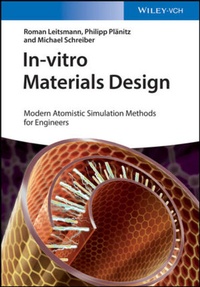
In-vitro Materials Design
Modern Atomistic Simulation Methods for Engineers
1st Edition
Published on 29. April 2015
X, 234 pages
978-3-527-66738-3 (ISBN)
Description

An overview of the latest computational materials science methods on an atomic scale.
The authors present the physical and mathematical background in sufficient detail for this highly current and important topic, but without unnecessary complications. They focus on approaches with industrial relevance, covering real-life applications taken from concrete projects that range from tribology modeling to performance optimization of integrated circuits.
Following an introduction to the fundamentals, the book describes the most relevant approaches, covering such classical simulation methods as simple and reactive force field methods, as well as highly accurate quantum-mechanical methods ranging from density-functional theory to Hartree-Fock and beyond. A review of the increasingly important multiscale approaches rounds off this section. The last section demonstrates and illustrates the capabilities of the methods previously described using recent real-life examples of industrial applications. As a result, readers gain a heightened user awareness, since the authors clearly state the conditions of applicability for the respective modeling methods so as to avoid fatal mistakes.
The authors present the physical and mathematical background in sufficient detail for this highly current and important topic, but without unnecessary complications. They focus on approaches with industrial relevance, covering real-life applications taken from concrete projects that range from tribology modeling to performance optimization of integrated circuits.
Following an introduction to the fundamentals, the book describes the most relevant approaches, covering such classical simulation methods as simple and reactive force field methods, as well as highly accurate quantum-mechanical methods ranging from density-functional theory to Hartree-Fock and beyond. A review of the increasingly important multiscale approaches rounds off this section. The last section demonstrates and illustrates the capabilities of the methods previously described using recent real-life examples of industrial applications. As a result, readers gain a heightened user awareness, since the authors clearly state the conditions of applicability for the respective modeling methods so as to avoid fatal mistakes.
More details
Other editions
Additional editions
Roman Leitsmann | Philipp Plänitz | Michael Schreiber
In-vitro Materials Design
Modern Atomistic Simulation Methods for Engineers
Book
07/2015
Wiley-VCH
€72.90
Article exhausted; check different version
Persons
Roman Leitsmann is project leader at GWT-TUD, a leading company for knowledge and technology transfer, in Chemnitz, Germany. After having obtained his PhD in physics from the University of Jena, he changed to GWT-TUD where he is responsible for several research and development projects with industrial partners. In 2011 he received the Nanoscience Award commissioned by the Working Group of the Centers of Competence of Nanotechnology in Germany.
Philipp Plänitz is CEO of AQcomputare, a company focusing on the calculation of materials properties with ab-initio methods as a service for industrial companies. He received the Diploma and PhD degrees in physics from the Chemnitz University of Technology in 2004 and 2009, respectively. In 2009 he founded AQcomputare, a GWT-TUD spin-off company. His research interests include industrial applications of atomic scale methods for calculating a wide range of material properties.
Michael Schreiber is Full Professor of Physics at Chemnitz University of Technology since 1993. After his PhD in physics, obtained from the Technical University of Dortmund, he moved to Tokyo University for two years. He obtained his first professorship in theoretical chemistry from the University of Mainz in 1990 and was Dean of the Faculty of Science from 1998 to 2001. Michael Schreiber has authored or co-authored more than 330 refereed scientific publications, edited 15 books and contributed to more than 100 books and proceedings.
Philipp Plänitz is CEO of AQcomputare, a company focusing on the calculation of materials properties with ab-initio methods as a service for industrial companies. He received the Diploma and PhD degrees in physics from the Chemnitz University of Technology in 2004 and 2009, respectively. In 2009 he founded AQcomputare, a GWT-TUD spin-off company. His research interests include industrial applications of atomic scale methods for calculating a wide range of material properties.
Michael Schreiber is Full Professor of Physics at Chemnitz University of Technology since 1993. After his PhD in physics, obtained from the Technical University of Dortmund, he moved to Tokyo University for two years. He obtained his first professorship in theoretical chemistry from the University of Mainz in 1990 and was Dean of the Faculty of Science from 1998 to 2001. Michael Schreiber has authored or co-authored more than 330 refereed scientific publications, edited 15 books and contributed to more than 100 books and proceedings.
Content
I. BASIC PHYSICAL AND MATHEMATICAL CONCEPTS
Newtonian Mechanics and Molecular Dynamics
Operators and Fourier Transformations
Bravais Lattice and k-Space
Introduction to Quantum Mechanical Concepts
II. COMPUTATIONAL METHODS
Classical Simulation Methods:
Simple Force Field Methods
Reactive Force Field Methods
Quantum Mechanical Simulation Methods:
Hartree-Fock (HF) Method
Density Functional Theory (DFT)
Concepts beyond HF and DFT
Multiscale Approaches
III. INDUSTRIAL APPLICATIONS
Tribological Properties
Intercalation of Ions in Electrode Materials
Nano-Structured Materials
Chemical Reactions in Porous Materials
Leakage Current in Integrated Circuits
Newtonian Mechanics and Molecular Dynamics
Operators and Fourier Transformations
Bravais Lattice and k-Space
Introduction to Quantum Mechanical Concepts
II. COMPUTATIONAL METHODS
Classical Simulation Methods:
Simple Force Field Methods
Reactive Force Field Methods
Quantum Mechanical Simulation Methods:
Hartree-Fock (HF) Method
Density Functional Theory (DFT)
Concepts beyond HF and DFT
Multiscale Approaches
III. INDUSTRIAL APPLICATIONS
Tribological Properties
Intercalation of Ions in Electrode Materials
Nano-Structured Materials
Chemical Reactions in Porous Materials
Leakage Current in Integrated Circuits
