

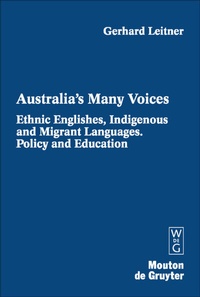
Ethnic Englishes, Indigenous and Migrant Languages
Description

Australia is host to many languages - English, indigenous, migrant, and contact. Its multilingualism, the sociopolitical changes that have been impacting upon them, and its wide-ranging language policy efforts are well-known. What has been missing so far is a comprehensive, integrative study of the entire 'habitat' of languages - the contacts and interactions that have been taking place from the beginning of colonization to the present day with their linguistic outcomes.
This book and its companion, Australia's Many Voices. Australian English - The National Language, develop and apply such an approach. The present book deals with non-mainstream varieties of English, indigenous, migrant, and contact languages. Based on census and other data to 2003, it addresses themes such as language demographics, language shift, and socio-psychological factors that bear upon it. Language change is discussed from the angle of the uprooting of indigenous languages from their original context, of transplantation, and of contact with English. Pidgins and creoles are located inside the Pacific context of the nineteenth century.
This study provides an analysis of language and language-education policies to 2003 and connects this theme with the role of Australian English, the national language. It suggests that Australia's habitat is reaching a new stage of plurilingual tolerance.
The book is of interest for specialists from a wide range of language and policy disciplines. Its discursive, non-technical style makes it accessible to non-specialists with no background in linguistics.
Reviews / Votes
"The breadth of information Leitner brings together in this series makes it a perfect ready-reference and springboard for casual enthusiast and scholars of Australian languagues alike."Louisa Willoughby in: Linguist List 16.955 "One can only commend the book's underlying aim, to provide a unified description of Australian English, within a contemporary linguistic paradigm. It brings light sources that will be of interest to future researchers and provides a map of that very large geographical and sociolinguistic landscape."Pam Peters in: Journal of English Linguistics 6/2005 "Leitner is not the first to conceive the idea of relating language developments with the socio-political history of the continent, but he has done it more extensively than earlier writers like Jupp, Ozolins, Clyne and Mitchell. And he is the first to explore the possibility of treating all the major questions within a single overarching concept. And that makes history!"Arthur Delbridge in Zeitschrift für Australienstudien, 19, 2005 "These volumes really are now the standard reference work on the Australian language habitat, past and present; every library should have copies."Scott F. Kiesling in: World EnglishesMore details
Other editions
Additional editions
Person
Content
- Intro
- Acknowledgements
- List of Illustrations
- Notational Conventions
- Introduction
- Chapter 1 Australia's non-English language habitats
- Chapter 2 Language habitats of Indigenous Australians
- 2.1 The traditional language habitat
- 2.2 The typology and structure of indigenous languages
- 2.3 The social history of contact
- 2.4 Linguistic responses to contact
- 2.5 The modern language habitat
- Chapter 3 Languages of Australians of non-Anglophone background
- 3.1 The social history of migrant language diversity
- 3.2 Linguistic responses to contact
- 3.3 The migrant language repertoire
- Chapter 4 Language politics and education
- 4.1 The path to a national language policy
- 4.2 Acquisition and communication planning
- 4.3 Success or failure of Australia's language policies?
- Chapter 5 Transforming Australia's languages habitat
- References
- Name Index
- Subject Index
