

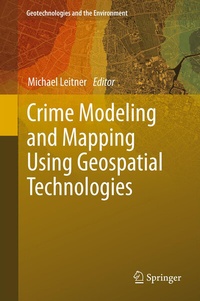
Crime Modeling and Mapping Using Geospatial Technologies
1st Edition
Published on 19. January 2013
XIII, 446 pages
978-94-007-4997-9 (ISBN)
Description

Recent years in North America have seen a rapid development in the area of crime analysis and mapping using Geographic Information Systems (GIS) technology.
In 1996, the US National Institute of Justice (NIJ) established the crime mapping research center (CMRC), to promote research, evaluation, development, and dissemination of GIS technology. The long-term goal is to develop a fully functional Crime Analysis System (CAS) with standardized data collection and reporting mechanisms, tools for spatial and temporal analysis, visualization of data and much more. Among the drawbacks of current crime analysis systems is their lack of tools for spatial analysis.
For this reason, spatial analysts should research which current analysis techniques (or variations of such techniques) that have been already successfully applied to other areas (e.g., epidemiology, location-allocation analysis, etc.) can also be employed to the spatial analysis of crime data. This book presents a few of those cases.
In 1996, the US National Institute of Justice (NIJ) established the crime mapping research center (CMRC), to promote research, evaluation, development, and dissemination of GIS technology. The long-term goal is to develop a fully functional Crime Analysis System (CAS) with standardized data collection and reporting mechanisms, tools for spatial and temporal analysis, visualization of data and much more. Among the drawbacks of current crime analysis systems is their lack of tools for spatial analysis.
For this reason, spatial analysts should research which current analysis techniques (or variations of such techniques) that have been already successfully applied to other areas (e.g., epidemiology, location-allocation analysis, etc.) can also be employed to the spatial analysis of crime data. This book presents a few of those cases.
More details
Series
Language
English
Place of publication
Dordrecht
Netherlands
Publishing group
Springer Netherland
Target group
Professional and scholarly
Product notice
Reflowable
Illustrations
XIII, 446 p.
File size
13,02 MB
ISBN-13
978-94-007-4997-9 (9789400749979)
DOI
10.1007/978-94-007-4997-9
Schweitzer Classification
Other editions
Additional editions
Michael Leitner
Crime Modeling and Mapping Using Geospatial Technologies
Book
06/2015
Springer
€160.49
Shipment within 15-20 days
Michael Leitner
Crime Modeling and Mapping Using Geospatial Technologies
Book
01/2013
1st Edition
Springer
€160.49
Shipment within 15-20 days
Person
Michael Leitner is a Professor at the Department of Geography and Anthropology at the Louisiana State University in Baton Rouge (USA).
At LSU, he is teaching courses in (advanced) computer cartography, GIS, methods of spatial analysis, aerial photo interpretation, and how GPS collected data can be used for the analysis, modeling, and visualization in a GIS environment.
His current research interests include automated map generalization, the visualization of data quality and its effect on spatial decision support, the utilization of GPS for computer mapping, GIS, and spatial analysis, and the development of new techniques (for example, spatial association) for the spatial analysis of crime data. His research has been published in refereed journals and proceedings and has been presented at (inter)national conferences.
He also works for the Center of Geoinformatics at the University of Salzburg, Austria.
At LSU, he is teaching courses in (advanced) computer cartography, GIS, methods of spatial analysis, aerial photo interpretation, and how GPS collected data can be used for the analysis, modeling, and visualization in a GIS environment.
His current research interests include automated map generalization, the visualization of data quality and its effect on spatial decision support, the utilization of GPS for computer mapping, GIS, and spatial analysis, and the development of new techniques (for example, spatial association) for the spatial analysis of crime data. His research has been published in refereed journals and proceedings and has been presented at (inter)national conferences.
He also works for the Center of Geoinformatics at the University of Salzburg, Austria.
Content
From the Contents: Spatial Heterogeneity in Crime Analysis.- When Does a Drug Market Become a Drug Market? Finding the Boundaries of Illicit Event Concentrations.- Convicted Sex Offender Residential Movements.- Street-Level Spatiotemporal Crime Analysis: Examples from Bronx County, NY (2006-2010).- Exploring Spatial Patterns of Crime Using Non-Hierarchical Cluster Analysis.- Reconstitution of the Journeys to Crime and Location of their Origin in the Context of a Crime Series. A Raster Solution for a Real Case Study.- Journey-to-Crime by Gender and Age Group in Manchester, England.- Crime Scene Locations in Criminal Homicides: A Spatial Crime Analysis in a GIS Environment.
